Tag: Israel

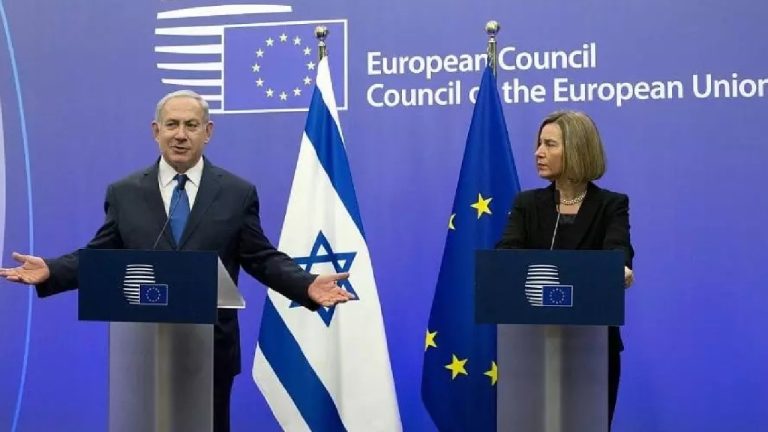
Benjamin Netanyahu and Federica Mogherini standing behind blue podiums with the European Council logo during a press conference, with Israeli and EU flags in the middle.

Evolving Diplomatic Dynamics: European-Israeli Relations Under Pressure

Rising tensions over Gaza and West Bank settlements have forced a reassessment of the EU-Israel Association Agreement. While Spain, Ireland, and Norway’s recognition of Palestine marks a diplomatic rift, the EU remains Israel’s largest trading partner. Future cooperation faces a deadlock between legal obligations to the ICJ and internal opposition from pro-Israel members like Germany and Hungary.

Read More »
A portrait of Ze'ev Jabotinsky in a hat and glasses, superimposed over a faded background of historical Middle Eastern figures and conflict scenes.

Revisionist Zionism’s Iron Wall Doctrine: Ideological Foundations of Netanyahu’s Strategy

Vladimir Jabotinsky’s “Iron Wall” essay remains the cornerstone of Revisionist Zionism, arguing that regional peace can only be achieved through an unbreachable military presence. From its early ideological ties with nationalist movements to Benjamin Netanyahu’s current hardline policies, this doctrine prioritizes military dominance and settlement expansion over negotiated compromise, framing the Israel-Arab conflict as a perpetual struggle for security and sovereignty.

Read More »
Three people, including two children, painting the "Free Syria" flag on a large white wall.

Syria’s Transitional Government: International Recognition Amid Domestic Fragility

Ahmed al-Sharaa’s administration in Syria marked its first anniversary by achieving diplomatic milestones and facing internal strife post-Bashar al-Assad’s fall. Key successes include gaining Western backing, with the U.S. and U.K. removing Sharaa from terrorist lists, and normalizing relations through significant meetings, notably with President Trump. These diplomatic efforts led to sanctions relief under the Caesar Act and Syria’s return to SWIFT, fostering prospects for economic recovery amid challenges in asserting control over the diverse sectarian landscape.

Read More »
Aerial view of a completely devastated urban area with destroyed buildings and rubble-filled streets.

Gaza “Ceasefire” Enables Continued Israeli Genocide Through Territorial Annexation

Israel’s October 10 ceasefire is viewed as a tactical adjustment rather than a move toward peace, as it continues systematic genocide through starvation, land seizure, and violence under the guise of humanitarian efforts. Since the ceasefire began, at least 401 Palestinians have been killed, including 67 children, revealing the deceptive narrative of peace as Israel strengthens its permanent occupation of 58% of Gaza.

Read More »
Protesters holding a large banner that reads "NO STAGE FOR GENOCIDE" with Palestinian flags in a crowded city square.

Eurovision’s Israeli Participation Exposes Western Double Standards on Genocide

Five countries—Iceland, Ireland, Netherlands, Slovenia, and Spain—are boycotting Eurovision 2026 in protest of Israel’s participation, following UN reports of genocide in Gaza. This marks the largest withdrawal from the event since 1970, although 35 countries are still confirmed to participate, highlighting inconsistencies in Europe’s cultural sanctions against nations involved in mass atrocities.

Read More »
A line of Israeli Merkava tanks and a supply truck moving along a paved road next to a barbed-wire border fence

Israeli Military Expansion in Syria Risks Strategic Overextension Despite Initial Advantages

Twelve months after Bashar al-Assad’s fall, Israeli forces have carried out over 600 military operations in Syria, averaging nearly two daily. This extensive campaign, alongside the occupation of territories beyond the 1974 disengagement lines, illustrates a classic pattern of overreach, where tactical dominance leads to strategic vulnerability due to commitments across multiple fronts without clear objectives.

Read More »