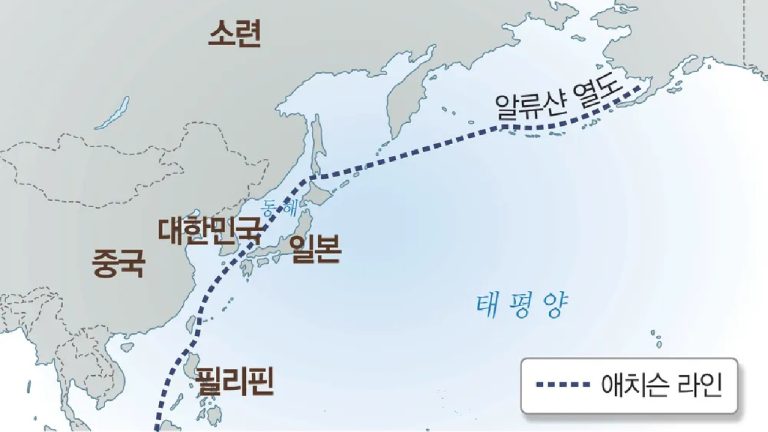
The release of the 2025 National Security Strategy (NSS) by the Trump administration has sent shockwaves through the Indo-Pacific, signaling a fundamental restructuring of U.S. defense commitments. While the document is framed as a “realist” recalibration, analysts in Tokyo and Seoul see it as a strategic retreat.1 By reviving the logic of the Nixon Doctrine and drawing a new defensive perimeter along the First Island Chain, Washington appears to be effectively ceding the Asian mainland to Chinese hegemony, prioritizing economic nationalism over alliance solidarity.
Resurrecting the Ghost of 1950
The most alarming feature of the new NSS is its implicit re-drawing of the U.S. defense perimeter.2 The strategy’s focus on the “First Island Chain”—a maritime boundary stretching from Japan to the Philippines—echoes the infamous 1950 speech by Secretary of State Dean Acheson, which excluded South Korea from the U.S. defensive umbrella.3 Historians often cite that exclusion as the green light for the North Korean invasion that triggered the Korean War.
In 2025, this omission is no less consequential. By prioritizing maritime defense while remaining silent on the Korean Peninsula and North Korea’s nuclear arsenal, the administration suggests a de facto withdrawal from mainland Asia. This aligns with the “Trump Corollary” to the Monroe Doctrine outlined in the NSS, which elevates the Western Hemisphere to the top priority while delegating Asian security to regional partners.4 For Seoul, the message is clear: burden-sharing is no longer a request, but a precondition for survival.
The Commercialization of National Security
Unlike previous strategies that framed competition with China as an ideological struggle between democracy and authoritarianism, the 2025 NSS views Beijing primarily as an economic rival to be managed, not a military threat to be contained.5 The document calls for a “rebalancing” of trade relations rather than strategic decoupling, prioritizing “reciprocity and fairness” over human rights or territorial integrity.
This transactional approach was vividly illustrated by President Trump’s recent decision to authorize the export of advanced Nvidia H200 chips to China. Despite warnings from security hawks that these chips could enhance the People’s Liberation Army’s capabilities, the administration prioritized the 25% tariff revenue and market access for U.S. firms.6 This move, described by critics as selling out national security for profit, reinforces fears in Tokyo that Washington views its Asian alliances as leverage for better trade deals with Beijing.
Abandoning Values for ‘Sovereignty’
The ideological pivot of the NSS is stark. Drafted under the guidance of State Department Policy Planning Chief Michael Anton—a figure known for his “Flight 93 Election” essay and critiques of liberal internationalism—the document rejects “values-based interventionism.” Instead, it embraces a vision of international relations where “sovereignty” trumps democracy, and “strongman” leadership is respected as a legitimate governance model.7
This shift has left U.S. allies in a precarious position. When Japanese Prime Minister Sanae Takaichi recently warned that a Chinese invasion of Taiwan would constitute an existential crisis for Japan, the Trump administration reportedly pressured her to de-escalate rather than offering support. This refusal to back a key ally in the face of Chinese “Three Warfares” tactics signals the end of the U.S. as a reliable guarantor of the liberal order in Asia.
The Burden of Self-Help
The practical consequence of this “National Retreat Strategy” is the rapid militarization of Asian states. Confronted with a U.S. ally that demands payments for protection while simultaneously cutting deals with their primary adversary, nations like Japan and South Korea are being forced to adopt independent defense postures. The NSS explicitly calls for allies to assume “primary responsibility” for their regions, a euphemism for the withdrawal of the American security blanket.
This dynamic risks triggering a nuclear arms race in Northeast Asia. If Seoul and Tokyo can no longer rely on the U.S. nuclear umbrella, the domestic pressure to develop indigenous deterrents will become irresistible. By treating alliances as transactional service contracts, the Trump administration is dismantling the non-proliferation architecture that has kept the region stable for decades.
Conclusion
The 2025 National Security Strategy is not a blueprint for victory, but a manifesto of resignation. By retreating to the First Island Chain and prioritizing commercial interests over strategic alliances, the United States is voluntarily ceding its role as a Pacific power. For Asia, the era of American leadership is over; the era of self-help, armed neutrality, and accommodation with China has begun.
Original analysis inspired by Daniel Sneider from Asia Times. Additional research and verification conducted through multiple sources.