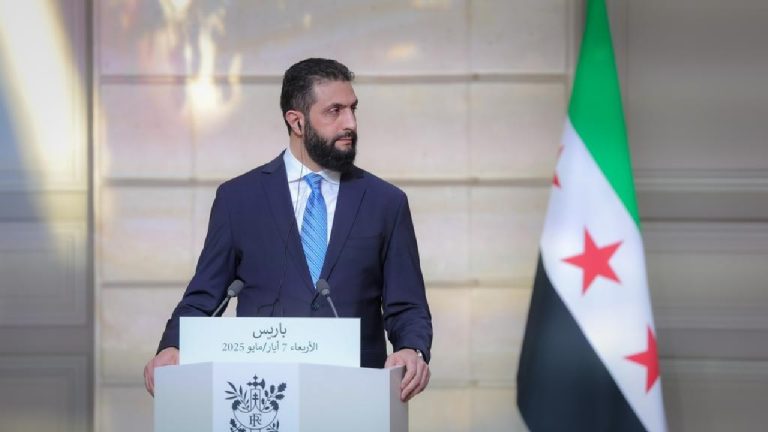
One year after the Assad regime’s collapse, Syria’s transitional government under President Ahmed al-Sharaa faces the monumental challenge of rebuilding state institutions while managing deep sectarian divisions, economic crisis, and complex regional dynamics. The anniversary of this political transition reveals both notable diplomatic achievements and persistent domestic fragility that will shape Syria’s trajectory for years to come.
Leadership Transformation and Governance Structures
Ahmed al-Sharaa, formerly known as Abu Mohammad al-Joulani during his leadership of Jabhat al-Nusra, represents one of the Middle East’s most striking political transformations. His evolution from jihadi commander to internationally recognized statesman reflects both personal calculation and organizational adaptation. Since 2017, his organization Hayat Tahrir al-Sham underwent gradual deradicalization in Idlib, prioritizing governance capacity over ideological purity to maintain territorial control.
The transitional government has implemented systematic stabilization measures including technocratic cabinet formation, temporary constitutional declaration, and national reconciliation dialogue. October elections for the People’s Council allocated 210 parliamentary seats through indirect voting via provincial electoral colleges, with one-third reserved for presidential appointment. General elections are scheduled for 2028-2029, premised on the need for extended stabilization before conducting direct democratic processes.
However, Syria’s political trajectory suggests centralized rather than pluralistic governance. Rapid political procedures lack genuine inclusivity, particularly regarding minority representation in leadership selection and government composition. The “National Reconciliation Committee” and parliamentary elections have drawn criticism for opacity and insufficient representation of non-Sunni communities.
Military Integration and Security Architecture
The “new Syrian army” functions more as confederation of semi-institutionalized militias than unified national force. While most rebel factions have been incorporated under Defense Ministry umbrella, each maintains independent command structures without systematic officer rotation or shared organizational identity. This arrangement prevents inter-factional conflict but preserves autonomous operational capacity during political crises.
Exclusion of former Syrian army officers—predominantly Alawites—from new security structures creates potential for insurgent formations. Ethnic minorities including Kurds, Druze, and Alawites view the Sunni-dominated regime with suspicion, particularly following violent sectarian clashes. Kurdish integration proves especially problematic given Syrian Democratic Forces’ autonomous governance structures in northeastern territories.
Military capabilities rely primarily on light infantry following Israeli strikes that destroyed heavy weapons and air assets. Turkey provides significant weapons supply, training, and salary funding, creating dependence that Damascus seeks to balance through diversified partnerships. The army operates without meaningful civilian oversight, with HTS personnel dominating key positions.
Territorial Control and Governance Fragmentation
The transitional government directly controls approximately 50-60% of Syrian territory, primarily the Damascus-Homs-Hama-Aleppo corridor and major urban centers where state institutions function relatively effectively. In peripheral regions—eastern desert, northeast, and southern areas—local militias, tribal structures, Kurdish forces, Turkish proxies, and Druze communities maintain predominant authority.
This fragmentation enables persistent security threats. ISIS operates through terrorist cells and guerrilla tactics concentrated in Syrian desert regions around Raqqa and Deir ez-Zor, recently expanding operations to Damascus and Idlib. While not controlling territory, ISIS exploits ungoverned spaces and weak law enforcement to maintain disruptive capacity. Recent data indicates rising ISIS activity in government-controlled Hama, Homs, Aleppo, and Idlib, though levels remain below historical peaks.
Iran and Hezbollah, despite substantial losses in 2025 confrontations with Israel, continue seeking influence through minority community support, smuggling route maintenance, and information campaigns portraying the regime as Western tool. Research indicates Assad-aligned figures transfer funds through Lebanon and UAE to finance Alawite coastal militias aimed at destabilizing the government.
Sectarian Tensions and Minority Security
Violent clashes along the Alawite coastal region resulting in over 1,000 civilian deaths, followed by attacks on Druze communities in Suwayda, exposed Syria’s sectarian volatility. These incidents raise critical questions about whether violence reflects deliberate regime policy or represents uncontrolled militia actions amid fragmented security authority.
The July Suwayda events marked a low point in Druze-government relations, triggering siege conditions and humanitarian crisis while deepening divisions within Druze leadership. Sheikh Hikmat al-Hijri’s calls for Druze autonomy under Israeli protection illustrate the gap between Damascus’s centralization ambitions and minority communities’ pursuit of external security guarantees.
Similar patterns characterize Kurdish relations with Damascus. Despite March understandings between Syrian Democratic Forces leadership and the government regarding military integration and administrative authority transfer, tensions persist and periodically escalate into violence. Kurds seek preserved autonomous institutions and protected minority rights, while the regime pursues centralized security and administrative control.
Violence against minorities has eroded trust in the regime’s capacity to ensure universal security. Individual Sunni extremists driven by vengeance and “Sunni supremacy” perceptions have mobilized across Syria to participate in confrontations with Alawites and Druze, suggesting grassroots rather than top-down extremism.
Economic Reconstruction and Investment Challenges
American support translated into full Caesar Act sanctions repeal, enabling cautious economic recovery trajectory. UN Security Council discussions address asset freeze modifications and arms restriction adjustments. Global companies, banks, and digital payment platforms gradually return to Syrian markets, while Qatar and Turkey assist energy infrastructure rehabilitation and diversification.
However, economic recovery remains dependent on external capital, fuel imports, and essential inputs while agricultural sectors suffer severe drought damage. Damascus faces rising pressure for wage increases, refugee repatriation, and subsidy reductions without triggering inflation. Investment mapping reveals $25 billion in declared memoranda of understanding, but significant portions involve opaque companies lacking demonstrated financial capacity or professional expertise.
Infrastructure projects awarded to inexperienced entities without open tenders or meaningful due diligence continue “crony economy” patterns despite reform rhetoric. The critical question extends beyond sanctions relief to whether Damascus can establish transparency standards, oversight mechanisms, and binding investment criteria providing stable growth foundations.
Diplomatic Renaissance and Regional Relations
Al-Sharaa’s transformation from jihadi leader to legitimate White House partner represents dramatic diplomatic shift. The Trump-al-Sharaa Riyadh meeting in May, UN General Assembly speech, and November Washington visit symbolized Syria’s return to international community with full American backing. More than 80 diplomatic delegations have visited Syria since the regime change.
Turkey has become key player shaping Syrian affairs, broadening influence through military, economic, and logistical support. Damascus seeks balancing Turkish dependence in force-building, equipment supply, and reconstruction with diversified partnerships. Gulf states—Saudi Arabia, Qatar, UAE—deepen engagement through economic support, infrastructure investments, and public sector assistance including salary funding and electricity expansion.
Al-Sharaa’s pragmatism extends to Russia, Assad’s former ally. Moscow seeks preserving investments and maintaining limited presence at Khmeimim and Tartus bases while retaining energy and diplomatic leverage. Possibilities include deploying Russian policing forces in southern Syria to enforce order and reduce Israel-Syria friction.
Israeli-Syrian Security Dynamics
Following intensive Israeli military operations including buffer zone seizure, Mount Hermon occupation, and strike campaigns, direct talks began in April regarding potential security arrangements. Proposed elements include Israeli withdrawal to 1974 disengagement lines and southern Syria demilitarization, exchanged for Syrian commitments to border quiet, counter Iranian axis re-establishment attempts, and ensure Druze security.
Negotiations reportedly reached impasse over IDF withdrawal scope and demilitarized zone establishment. Following al-Sharaa’s Washington visit, Israeli concerns grew regarding potential American pressure for concessions. Israeli security officials emphasize Mount Hermon’s strategic importance for early warning and preventing Hezbollah weapons smuggling.
For Damascus, agreement would consolidate sovereignty and legitimacy by ending Israeli military activity. Al-Sharaa stressed full normalization remains premature: “Syria’s situation differs from Abraham Accords countries because it shares borders with Israel, which occupies Syrian Golan.”
A November 28 Israeli raid in Beit Jinn targeting militants planning attacks complicated relations when gunfire exchange resulted in Syrian casualties and six IDF injuries. The operation—occurring on Assad fall anniversary during mass demonstrations—shifted public attention toward anti-Israeli sentiment, with Syrians perceiving continued “aggression policy” aimed at border expansion and regime destabilization.
Strategic Pathways and Policy Implications
The first anniversary reveals Syria poised between fragile stabilization and potential fragmentation. Al-Sharaa achieved diplomatic recognition and initiated governance structures, yet faces persistent sectarian tensions, incomplete territorial control, economic dependence, and complex regional dynamics.
Several scenarios appear possible: continued gradual centralization with Turkey and Gulf backing; fragmentation into autonomous regions controlled by ethnic and sectarian communities; renewed conflict driven by extremist rejectionists or external interventions; or negotiated settlement including international guarantees and balanced regional partnerships.
For neighboring states and international actors, Syria presents both opportunity and risk. Stabilization could enable refugee return, counter extremism, and establish predictable governance. Failure could produce renewed civil war, humanitarian catastrophe, and regional instability affecting Lebanon, Jordan, Iraq, and Turkey.
The transitional government’s trajectory depends substantially on whether al-Sharaa can balance centralization imperatives with minority security concerns, manage external dependencies while maintaining sovereignty, deliver economic improvements despite structural constraints, and navigate regional pressures from competing powers.
For Israel specifically, choices include maintaining military presence and freedom of action versus negotiated arrangements with American guarantees. Security agreements could ensure stable borders, facilitate Iranian axis containment through Damascus cooperation, protect Druze communities, and enhance regional standing. However, Syrian instability and regime fragility require contingency planning for agreement collapse scenarios.
The coming year will prove critical in determining whether Syria’s transitional government consolidates authority and moves toward stability, or whether centrifugal forces fragment the country into competing spheres controlled by ethnic communities, external powers, and jihadi remnants. International engagement—particularly American policy—will substantially influence these outcomes.
Original analysis inspired by Carmit Valensi and Amal Hayek from Institute for National Security Studies. Additional research and verification conducted through multiple sources.