The year 2025 will mark a watershed moment in international relations. While the contours of the emerging global system remain uncertain, the nations best equipped to navigate this transition have revealed themselves through their responses to accelerating geopolitical fragmentation.
America’s Transformation from Guarantor to Disruptor
Donald Trump’s recognition by major publications as among 2025’s most influential figures is notable not for traditional leadership achievements—crisis resolution or institutional strengthening—but for demolishing established norms, disrupting longstanding alliances, accelerating economic fragmentation, and institutionalizing transactional international relations.
For decades, Washington could pursue hardline policies while maintaining its fundamental role as guarantor of the post-World War II architecture. That era has concluded. Trump has not only cemented America’s retreat from global leadership but operationalized it. As he attempts to extract immediate returns from decades of accumulated influence—frequently benefiting himself and his inner circle—he actively undermines international cooperation and the rule of law.
American trade policy has transformed from an instrument for maximizing mutual benefits of economic openness into a tool of economic and geopolitical coercion. Alliances are now evaluated not through intangible factors like shared values and strategic interests, but according to immediate financial returns. Cooperative frameworks aimed at long-term stability and prosperity are being displaced by bilateral arrangements reflecting narrow reciprocity conceptions. Strategic engagement combining hard and soft power has yielded to shortsighted coercion.
Global Responses: From Endurance to Exploitation
This transformation has not occurred in isolation. While reactions to Trump’s foreign policy varied, most nations chose adaptation over confrontation. Some actors absorbed their punishment, hoping Trump would cease targeting those who avoided challenging him. Others balanced acceptance—even appeasement—with quiet resilience-building efforts. Countries including Brazil and India neither capitulated to nor directly challenged Trump, instead seeking to preserve autonomy and identify opportunities within this emerging post-postwar arrangement.
China advanced further. Having long pursued Western decentering in international politics, Chinese leaders recognized Trump-induced disruption as an opportunity: a world unsettled by American withdrawal from global leadership would welcome a new stability and continuity champion. By positioning itself accordingly, China has emerged as the principal beneficiary of this turbulence.
China’s Alternative Vision: The Global Governance Initiative
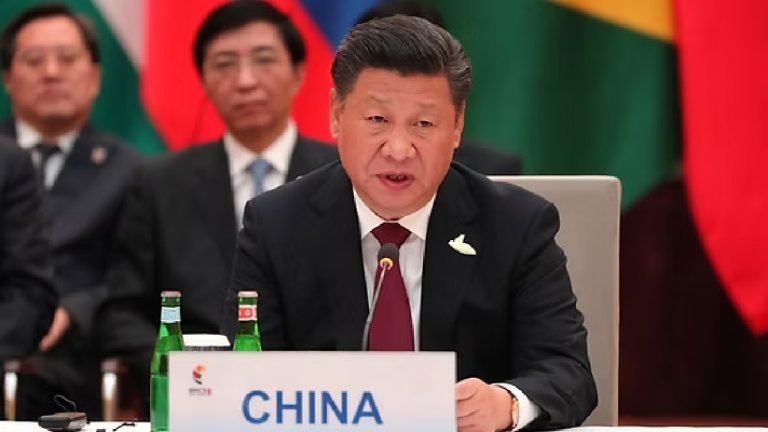
In September, Chinese President Xi Jinping unveiled the Global Governance Initiative, premised on ensuring “all countries, regardless of size, strength, and wealth” serve as “equal participants, decision-makers, and beneficiaries in global governance.” The GGI, combined with the Global Development Initiative (2021), Global Security Initiative (2022), and Global Civilization Initiative (2023), transmits an unmistakable message: China seeks leadership in creating a more stable, pluralistic global order capable of facilitating shared progress.
This is not a liberal project, nor has China positioned it as such. Instead, it emphasizes supporting international cooperation in critical domains—including advancing the United Nations 2030 Agenda for Sustainable Development and peacefully resolving interstate differences—while respecting national sovereignty and rejecting civilizational superiority narratives.
Critically, China packages this vision not as an entirely new order emerging from postwar system rubble—which would imply a chaos period few desire—but as organic evolution of existing structures. China wants recognition as a reliable continuity, prosperity, and respectful coexistence force, not a revolutionary power.
The Busan Contrast: Strategic Confidence versus Transactional Desperation
When contrasted with Trump’s capricious, self-serving, and coercive behavior, this prospect proves highly appealing, particularly across the Global South. This contrast was vividly displayed at the October meeting between Trump and Xi at South Korea’s Busan airport: while Trump appeared eager to close a deal, even if it meant shifting goalposts, Xi offered selective concessions while displaying confidence to walk away from unfavorable offers.
Europe’s Dilemma: Between American Abandonment and Chinese Pragmatism
Unlike China, which discovered ways to benefit from Trump’s 2025 presidency, Europe found itself increasingly vulnerable. It can no longer count on American fulfillment of NATO commitments or European security backstopping. By openly favoring Russia in Ukraine war negotiations, Trump has contributed to a more dangerous European security environment. Reports even suggest the Trump administration hopes to convince certain countries to exit the European Union.
Yet Europe cannot simply embrace the Chinese-led world order Xi promotes. While Europe does not share America’s China animosity, it cannot ignore the country’s role in sustaining Russia’s Ukraine war technologically, economically, and diplomatically. The coming year will test the EU’s capacity to transcend its dependency legacy and act cohesively and decisively.
2025: Year of Reckoning
The year 2025 appears destined for remembrance as one of reckoning. The global order’s future remains undetermined, but we now know which countries are best prepared to adapt to what preceded. What follows this disruption will be determined not by whoever commands maximum attention, but by those demonstrating strategic vision and performing the difficult work of establishing new engagement rules.
Original analysis by Ana Palacio from Project Syndicate. Republished with additional research and verification by ThinkTanksMonitor.