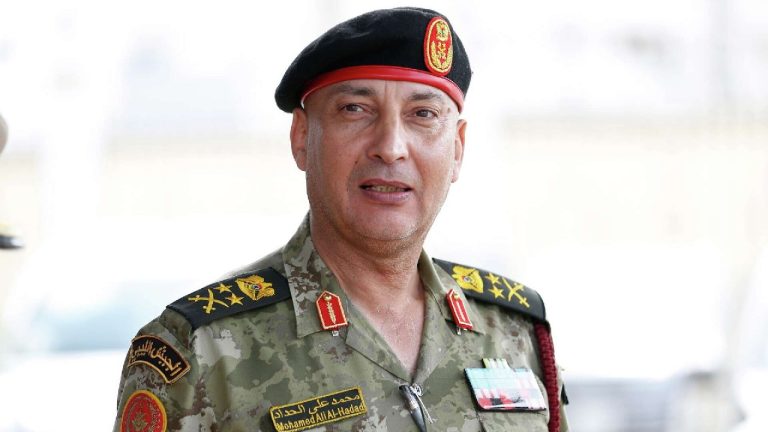
The December 24, 2025 crash of Dassault Falcon 50 business jet near Ankara killing Lieutenant General Mohammed Al-Haddad, Chief of Staff of Libya’s western forces, along with seven others including four senior military officials, has violently decapitated military leadership of Government of National Unity in Tripoli. Turkish Transport Minister Abdulkadir Uraloğlu’s announcement that black boxes would not be analyzed in Turkey but instead shipped to “neutral third country” represents stunning admission of sovereignty abdication by NATO member state, broadcasting message of paralyzing weakness as Ankara appears terrified of what those boxes might reveal.
The crash occurred approximately 45 miles south of Ankara near village of Kesikkavak in Haymana district after jet requested emergency landing due to electrical failure minutes after 8:30 PM takeoff from Esenboga Airport en route to Tripoli. All eight people aboard died, including Gen. Al-Fitouri Ghraibil (head of Libya’s ground forces), Brig. Gen. Mahmoud Al-Qatawi (military manufacturing authority director), Mohammed Al-Asawi Diab (adviser to chief of staff), Mohammed Omar Ahmed Mahjoub (military photographer), and three unidentified crew members. Libyan government declared three-day national mourning with flags flown half-staff at all state institutions.
Turkey-Libya Alliance Fragility Exposed
For years, Erdogan regime has marketed itself to West and Arab world as neo-Ottoman hegemon, rising power capable of projecting force and protecting clients across Mediterranean. Government in Tripoli, dominated by Muslim Brotherhood affiliates and Islamist militias, staked survival on this Turkish security umbrella. General Al-Haddad was architect of this dependency, professionalizing Islamist-leaning militias into coherent force under Turkish tutelage.
His death in heart of Turkey exposes fraudulent nature of this protection. If Erdogan cannot guarantee safety of his most important viceroy mere minutes after he departs meeting with Turkish Defense Ministry, entire premise of Turkish-Libyan alliance collapses. Neo-Ottoman “protector” has been revealed as paper tiger, unable to secure even its own airspace against hostile actors.
Visit by Libyan delegation came day after Turkey’s parliament approved two-year extension of mandate allowing Turkish troops to remain in Libya, underscoring strategic importance of relationship between two countries. During Ankara visit, Al-Haddad held talks with Turkish Defense Minister Yasar Guler and his military counterpart Gen. Selcuk Bayraktaroglu on high-level defense cooperation aimed at boosting military ties.
Russian Federation Sabotage Speculation
Specter haunting investigation is Russian Federation. Parallels to assassination of Yevgeny Prigozhin, whose jet fell from sky near Moscow under similarly suspicious circumstances August 23, 2023 exactly two months after his Wagner Group rebellion, are glaring. Intelligence circles are already treating “technical failure” narrative with derision, pointing instead to high probability of electronic warfare jamming or sabotage.
Russia, which backs rival eastern Libyan forces of Khalifa Haftar through Africa Corps deployment (estimated 2,000-2,500 personnel by August 2024), has clear motive to decapitate western command. Russian Deputy Defense Minister Yunus-Bek Yevkurov visited Haftar in Benghazi at least five times since August 2023, with latest visit June 2024, pledging to enhance Libyan National Army military capabilities. In May 2025, Haftar visited Moscow meeting Russian President Vladimir Putin, Defense Minister Andrei Belousov, and Security Council Secretary Sergey Shoigu.
If Russian intelligence assets were indeed responsible for downing jet inside capital of NATO member, it constitutes act of war. This explains Ankara’s desperate haste to hand evidence to third party. If Turkish technicians opened black box and found proof of Russian sabotage, Erdogan would face impossible binary: invoke NATO Article 5 and risk direct conflict with Putin, or suppress truth and stand revealed as vassal. By shipping evidence abroad, Turkey is buying time and diffusing responsibility—cowardly maneuver exposing hollow core of Turkey-Russia relationship. Ankara is not partner to Moscow; it is hostage.
Libya Political Vacuum and Succession Crisis
Removal of Al-Haddad leaves dangerous vacuum in western Libya. He was only figure capable of bridging divide between disparate militia cartels of Misrata and Tripoli. Without him, and with confidence in Turkish security shattered, region is primed for violent succession crisis that will undoubtedly be exploited by Russia’s Africa Corps and eastern forces.
Libya’s Presidential Council appointed General Salah Eddine al-Namrush as acting chief of staff for Libyan army until Al-Haddad’s replacement is announced. However, Al Jazeera correspondent Malik Traina described Al-Haddad’s death as “huge loss” stating “It’s extremely big shoes to fill. It is really going be very difficult for authorities to find somebody as charismatic and strong who can unify country like Mohammed al-Haddad.”
Al-Haddad was career soldier who supported rebels during 2011 uprising against Gaddafi and was highly regarded for his refusal to align with powerful militias that have fragmented country’s security landscape since civil war. He was appointed Chief of General Staff in August 2020 by then-Prime Minister Fayez al-Sarraj and played crucial role in ongoing UN-brokered efforts to unify Libya’s military.
Turkish Investigation Protocols
Turkey assigned four prosecutors to lead investigation, with Turkish Interior Minister Ali Yerlikaya stating 408 personnel were deployed for search and recovery effort. Wreckage was scattered across area covering three square kilometers, complicating recovery efforts. Turkish disaster management agency AFAD set up mobile coordination center with specialized vehicles including tracked ambulances deployed because of muddy terrain after night of heavy rain and fog.
Twenty-two-person delegation including five family members arrived from Libya early December 25 to assist in investigation. Walid Ellafi, GNU’s state minister of political affairs and communication, told broadcaster Libya Alahrar it was not clear when crash report would be ready, stating jet was leased Maltese aircraft (tail number 9H-DFJ) and that officials did not have “sufficient information regarding its ownership or technical history.”
Turkish officials initially told Al Jazeera that initial investigations ruled out sabotage and pointed to technical failure as cause. However, decision to analyze black boxes in neutral country rather than using Turkey’s advanced aviation forensics capabilities represents unprecedented departure from standard aviation accident investigation protocols.
Geopolitical Implications for Mediterranean
“Neutral third country” that receives those black boxes will hold future of North African stability in its hands. But verdict on Turkish power is already in. Pretense of Turkey as independent regional power has been exposed as fraud. State that is too afraid to investigate death of its own allies on its own territory is no power at all. It is compromised entity, managing its own decline while its Islamist proxies in Libya are left to face wolves alone.
Libya plunged into chaos after country’s 2011 NATO-backed uprising toppled and killed longtime dictator Moammar Gadhafi. Country split with rival administrations in east and west, backed by array of rogue militias and foreign governments. Turkey has been main backer of Libya’s government in west, but has recently taken steps to improve ties with eastern-based government as well.
Original analysis by Amine Ayoub from Ynet News. Republished with additional research and verification by ThinkTanksMonitor.