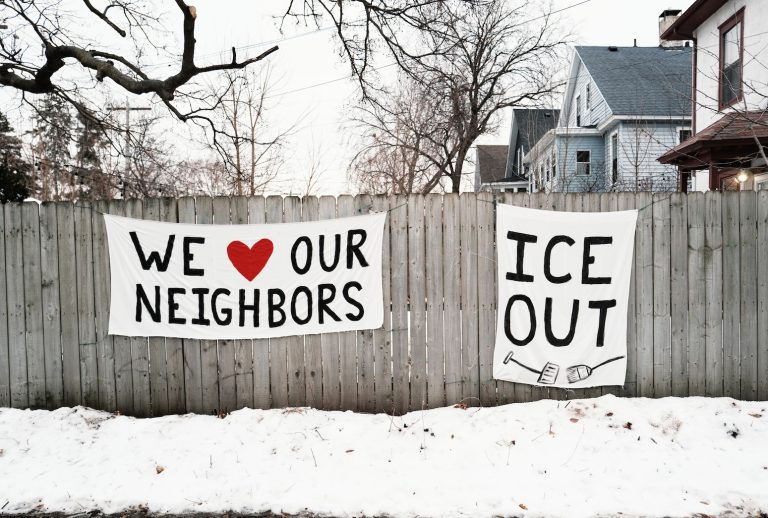
Two months of federal immigration enforcement turned Minneapolis into a proving ground. On December 4, 2025, the Department of Homeland Security announced Operation Metro Surge, and on January 6, 2026, expanded it into what officials called the largest immigration enforcement operation ever carried out, sending 2,000 agents to the Minneapolis–Saint Paul metropolitan area. ICE and border patrol agents soon outnumbered local police nearly three to one, according to Senator Amy Klobuchar. What met them was not silence but an organized, layered civilian response — one that other American cities are now racing to replicate.
The Twin Cities chapter of Indivisible recently hosted a constitutional observer training that drew more than 200 attendees, part of a wave of sessions that have reached some 23,000 Minnesotans. The Immigrant Defense Network, a state-based organization that helps prepare training materials, is taking its curriculum on tour to 30 Midwest cities. What’s happening in Minnesota is a model of what other states could experience as the administration expands enforcement — and the growing public resistance is also a model of how people can unite and fight back.
Anatomy of a Resistance Network
The organizing in Minneapolis operates on multiple levels, none of which rely on a single tactic. At the base sit neighborhood-level group chats on Signal, the encrypted messaging app, where residents track ICE vehicle movements in real time, coordinate court accompaniment, organize food drives for families afraid to leave home, and arrange protection for religious services.
One layer up are the “commuters” — locals who have organized to resist Operation Metro Surge by monitoring federal operations in the Twin Cities. They tail ICE vehicles throughout the day, maintaining a running picture of where agents are active. Their work feeds into rapid-response networks run by groups like the IDN, which alert trained constitutional observers based on their proximity to a developing situation. Observers document everything: officer uniforms, badge numbers, equipment, location, time of day, and whether agents present judicial or administrative warrants — a critical legal distinction, since an administrative warrant issued by an immigration officer does not authorize entry into a home without consent.
The trainings stress precise language. Observers are coached to tell bystanders “you have the right to remain silent” or “you have the right to refuse entry” rather than more direct phrases like “don’t open your door,” which ICE officers have reportedly treated as obstruction and used to justify arrests. Trainees receive reference booklets and a set of emergency numbers: an ACLU hotline for reporting agent misconduct tied to an existing lawsuit, a National Lawyers’ Guild line for observers who are arrested, and a legal aid hotline for anyone detained in an immigration case.
Parallel to the observer network, other groups provide nonviolent civil disobedience training — protesters who blow whistles, chant, and make noise to alert neighborhoods and draw public attention to ongoing operations. Residents use whistles, horns, chants, and even song to create a wall of noise, working in coordinated fashion with some spotting agents and alerting others while a growing crowd gathers to block the agents’ path.
The Human Cost That Changed Everything
The organizing didn’t emerge from nowhere. Minneapolis carries a deep history of neighborhood-level activism, much of it forged after the killing of George Floyd in 2020. Networks of citizens formed after Floyd’s death continued into 2026. But the current intensity was catalyzed by violence from federal agents themselves.
Federal agents killed two civilian protesters during the operation: Renée Good and Alex Pretti, both U.S. citizens. Good, a 37-year-old mother of three, was shot and killed by an ICE agent on January 7 during a raid. On January 24, Alex Pretti, a 37-year-old ICU nurse participating in a demonstration, was fatally shot ten times by ICE agents — with video footage and eyewitness accounts appearing to contradict official claims of self-defense. Even as federal officials praised agents and claimed the operation was making the city safer, two of three homicides in Minneapolis in 2026 had been committed by ICE agents.
The killings gutted the administration’s political position. An open letter posted to the Minnesota Chamber of Commerce website was signed by over 60 CEOs of Minnesota-based companies calling for “immediate de-escalation of tensions.” Signers included the heads of 3M, Cargill, Mayo Clinic, Target, Best Buy, UnitedHealth Group, and General Mills. In one month alone, with up to 3,000 federal agents operating in neighborhoods, the city experienced at least $203.1 million in economic impact.
Governor Tim Walz framed the withdrawal bluntly. “It became very clear to the administration, especially after the murders of Renee and Alex and the horrific actions of these agents on the ground, that an issue the president saw himself as being strong on, certainly politically, has eroded into an albatross around their neck.”
A Template, Not a Victory
City leaders are hopeful following Border Czar Tom Homan’s announcement that Operation Metro Surge will soon end. The City of Minneapolis did not make any deals or concessions with the federal government or ICE to end the operation — a point officials have emphasized publicly. But the drawdown doesn’t mean the threat has passed, for Minneapolis or anywhere else.
State and local officials in California, Illinois, Oregon, and Minnesota have sued the federal government, looking to halt National Guard troops and limit surges in federal enforcement. California and Illinois enacted laws prohibiting federal officers from conducting civil immigration enforcement in certain locations such as courts, schools, and health care facilities. Illinois created an Accountability Commission to investigate civil rights abuses, while California’s Attorney General launched an online portal for the public to submit reports of potentially unlawful actions by federal agents.
Minneapolis showed that a combination of legal knowledge, digital coordination, mass visibility, and sheer persistence can raise the cost of enforcement operations to the point where they become politically untenable. The city didn’t defeat ICE in any permanent sense — agents will be redeployed elsewhere, and the administration’s appetite for enforcement shows no sign of fading. What Minneapolis built is a template: proof that organized communities, armed with encrypted group chats, legal training, and enough whistles to fill a winter night, can make an occupation unsustainable.
Original analysis inspired by Russell Payne from Salon. Additional research and verification conducted through multiple sources.