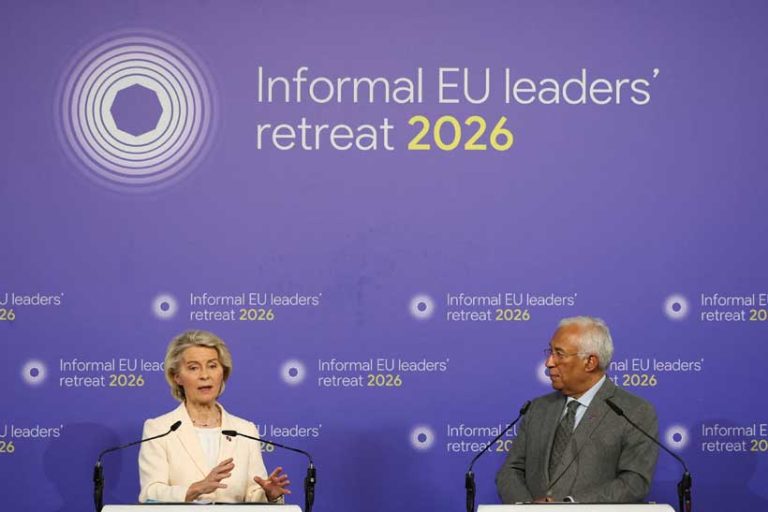
Europe faces a fundamental contradiction: accelerating economic integration requires political decisions that member states remain unwilling to make. Recent high-level summits reveal not breakthrough progress but deepening institutional strain as leaders demand faster action while rejecting the fiscal and political transformations necessary to achieve it.
The Acceleration Imperative: Competing with State-Backed Champions
European competitiveness has deteriorated noticeably against both the United States and China. Both rivals deploy substantial state resources toward industrial development, technology advancement, and supply chain control. The US provides subsidies, favorable tax treatment, and strategic procurement to domestic producers. China coordinates state capacity across financial institutions, industrial planning agencies, and export support mechanisms. Europe, by contrast, fragments decision-making across twenty-seven separate governments with conflicting interests and regulatory philosophies.
This structural disadvantage manifests in concrete economic metrics. Investment gaps continue widening as capital flows toward jurisdictions offering clearer industrial strategies and consolidated policy frameworks. Technology firms cite regulatory uncertainty and fragmented markets as deterrents to substantial European investment. Manufacturing capacity gravitates toward regions with explicit industrial policy support and simplified permitting procedures.
The response from European leadership emphasizes urgency. France’s approach centers on mobilizing European fiscal capacity to fund technology development, infrastructure investment, and industrial consolidation. France argues that strategic autonomy requires fiscal capacity—meaning joint borrowing and coordinated investment at continental scale. Germany counters that permanent fiscal mechanisms pose constitutional and political risks while creating moral hazard that weakens fiscal discipline across member states.
The Two-Speed Dilemma: Acceleration Through Fragmentation
Faced with persistent disagreement on fundamental questions, EU leadership has begun embracing enhanced cooperation mechanisms that permit willing states to advance without unanimous agreement. This represents significant institutional departure—previously, enhanced cooperation remained rare and controversial. Now it becomes normalized policy approach, enabling groups of member states to pursue joint action in defined policy areas.
The mechanism offers apparent solution: if all twenty-seven cannot agree on competitiveness reforms, perhaps nine or more can advance without waiting for consensus. The Savings and Investment Union framework and proposed “28th regime” for company registration exemplify this approach. These initiatives permit regulatory streamlining and capital mobilization among participating states while others maintain existing frameworks.
However, normalized enhanced cooperation carries profound risks. The EU’s fundamental design assumes that critical integration occurs through inclusive processes permitting all member states participation. Shifting toward variable-geometry frameworks threatens this assumption, creating conditions where wealthy, large states advance integration while smaller, less developed economies fall behind. The prospect becomes not a unified European market but a fragmented institutional landscape where integration depth correlates with economic size and development level.
Smaller member states express anxiety about becoming peripheral participants in decision-making. Southern European governments worry that acceleration benefiting larger, wealthier states will exacerbate existing development gaps. Some states value procedural inclusion even when disagreeing with outcomes—losing voice in integration processes feels more threatening than losing integration pace.
The Fiscal Question: Power Without Treasury
The core disagreement separating major EU states concerns fiscal capacity. France views joint debt issuance as essential infrastructure for strategic autonomy. Permanent eurobonds would enable the EU to mobilize capital at competitive rates, directly funding technology development, infrastructure investment, and industrial consolidation. From Paris’s perspective, this constitutes leverage—not redistribution but pooled capacity enabling collective action impossible through national mechanisms.
Germany approaches fiscal integration from opposite direction. Berlin argues that permanent joint borrowing creates moral hazard, weakening incentives for fiscal discipline among member states. German constitutional law restricts automatic participation in open-ended fiscal commitments. More fundamentally, German leadership sees fiscal union as proceeding from political integration—mutual trust and harmonized governance should precede shared fiscal mechanisms, not follow them.
This disagreement proves resistant to compromise because the positions reflect fundamentally different conceptions of European integration. France prioritizes rapid capacity development for geopolitical competition. Germany prioritizes institutional deepening and political trust. Neither side can accommodate the other without abandoning core strategic logic.
Industrial Policy as Geopolitical Tool
European industrial policy increasingly reflects geopolitical rather than purely market logic. The Industrial Accelerator Act proposes preferential treatment for European producers in strategic sectors, screening mechanisms for foreign investment in sensitive industries, and procurement standards favoring “Made in EU” production. These measures represent explicit departure from market-based competition toward state capacity mobilization.
The shift generates predictable resistance from trading partners and multinational corporations. Technology firms warn that restricting global innovation access risks weakening rather than strengthening European competitive position. International business groups characterize European industrial tools as political signaling divorced from market rationality. Some argue that protective measures will trigger retaliation, reducing investment confidence and ultimately constraining rather than expanding European capacity.
However, US and Chinese industrial policies have normalized state-backed market intervention. European reluctance to deploy equivalent tools appears strategically naïve in this context. The tension between liberal trade theory and geopolitical necessity will intensify as competition over critical technologies and supply chains escalates.
Energy Policy as Constraint on Ambition
Energy costs represent major competitive disadvantage for European industry. The US enjoys substantially cheaper energy through domestic fossil fuel production and access. Europe depends on imported energy while pursuing carbon transition that increases short-term costs. Some member states propose adjusting carbon markets or separating electricity and gas pricing to relieve industrial cost pressures.
Energy policy exposes another layer of European fragmentation. Member states with different energy resources, geographic positions, and climate commitments pursue conflicting strategies. States dependent on renewables oppose carbon market adjustments that might undermine transition incentives. States with stranded fossil fuel infrastructure resist acceleration toward full decarbonization. Energy transition that benefits some constituencies disadvantages others, making consensus difficult.
Conclusion: Institutional Limits to Strategic Ambition
Europe’s institutional design reflects assumptions about consensus-building and inclusive decision-making that prove increasingly incompatible with geopolitical competition demanding rapid, coordinated action. The EU can either reform governance to permit faster decision-making—accepting fragmentation and variable participation—or maintain institutional unity while accepting slower adaptation to changing strategic environment.
The current approach attempts both simultaneously: normalizing enhanced cooperation while maintaining rhetoric about European unity. This permits continued movement without fundamental institutional reform. It also prevents resolution of underlying tensions between member states pursuing contradictory strategic visions.
Whether Europe can develop fiscal capacity, industrial policy, and institutional coordination adequate to strategic competition without either complete fragmentation or political integration remains the central question. Current trajectory suggests movement toward enhanced cooperation and variable-geometry integration, creating a differentiated Europe where capacity advances among willing states while others maintain existing frameworks.
Original analysis inspired by Modern Diplomacy. Additional research and verification conducted through multiple sources.