For billions of people across developing economies, electricity access is not an environmental issue—it is the foundation of economic opportunity. The clean-energy transition, therefore, should be understood not primarily as climate policy, but as a development imperative. Yet success depends less on deploying renewable capacity than on modernizing the institutional, regulatory, and digital infrastructure that manages electricity distribution. Nations that recognize this distinction will leapfrog to energy abundance; those that remain fixated on solar deployment alone will replicate the inefficiencies of legacy systems.
Traditional electricity systems operated on a simple linear model: centralized generation plants produced power, transmission networks delivered it to passive consumers, and utilities maintained unidirectional control. This architecture functioned adequately for decades because generation capacity was concentrated and demand patterns were predictable.
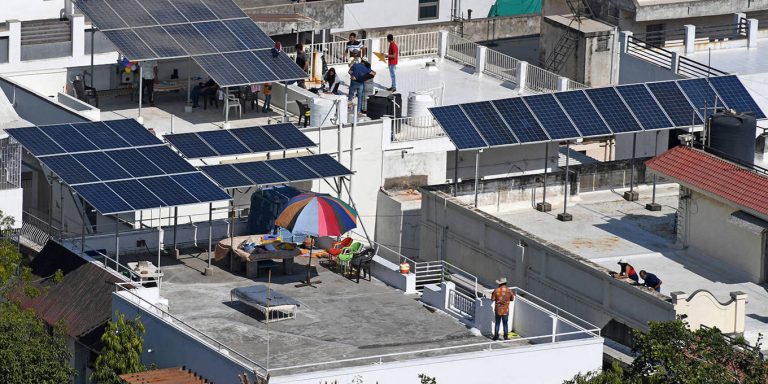
Renewable energy systems fundamentally alter this dynamic. When homes install rooftop solar panels, farms deploy wind turbines, and private enterprises battery-storage systems, electricity generation becomes decentralized. Citizens transform from passive consumers into “prosumers”—simultaneously generating and consuming power. This transition introduces unprecedented complexity: while consumer expectations for reliable, consistent service remain unchanged, renewable energy sources (solar and wind) are inherently variable and unpredictable.
Distributing generation assets across millions of locations while maintaining grid stability and service quality demands technological solutions unavailable in legacy systems. AI-ready grids built on interoperable digital infrastructure become not optional enhancements, but foundational necessities. Without real-time coordination across distributed assets, decentralized systems collapse into instability.
The Operational Inefficiency Tax on Developing Economies
Developing economies suffer systematic losses throughout their electricity value chains. Distribution losses—electricity lost to theft, illegal tapping, technical degradation, and metering inaccuracy—exceed fifteen percent in many nations, compared to five percent in developed systems. Billing collection rates average seventy percent, meaning utilities operate with chronic revenue shortfalls. Maintenance is reactive rather than predictive, leading to cascading outages that undermine consumer confidence and stall economic growth.
These inefficiencies function as an implicit tax on development. Higher operational costs translate directly into elevated electricity prices, reducing affordability for poor and middle-income households and raising production costs for manufacturers competing globally. The losses also drain utility finances, preventing investments in network expansion or quality improvement.
AI-integrated grid systems address these inefficiencies through multiple mechanisms: predictive demand forecasting optimizes purchasing and reduces over-procurement; real-time asset monitoring enables preventive maintenance rather than reactive repair; digital billing systems improve collection rates; and loss-reduction technologies recover revenue lost to theft and technical degradation. Applied systematically, AI-enabled grids can reduce operational costs by ten to twenty percent—an enormous improvement in economies where energy expenses represent a significant share of household budgets.
The Interoperability Imperative and Vendor Lock-In Risk
Currently, energy-sector digitalization is fragmented and siloed. One city pilots a new billing dashboard; another utility deploys a predictive maintenance model; a third implements smart meters. These projects rarely integrate because they depend on proprietary systems designed for isolation. The result is duplication, redundancy, and escalating costs as utilities replicate solutions rather than scaling shared platforms.
The Global South has encountered this problem before during the buildout of basic digital infrastructure. Nations that failed to establish interoperable standards became locked into expensive, difficult-to-upgrade, audit-vulnerable systems designed by external vendors. Breaking free required costly migration and renegotiation, consuming resources that could have been invested in expansion or service improvement.
This historical lesson demonstrates why energy-sector interoperability is strategically critical. Systems designed on open, standardized, interoperable principles allow utilities and entrepreneurs to combine solutions modularly, avoid vendor lock-in, and scale rapidly. Proprietary systems, conversely, force continued dependence on original vendors regardless of cost or performance.
India’s Energy Stack Model and Leapfrogging to Platform-Era Grids
India has launched an ambitious strategic initiative—the India Energy Stack (IES)—designed as a digital public infrastructure backbone for the entire energy sector. Rather than mandating a single technology or system, the IES establishes open standards and interoperable frameworks that allow utilities, startups, and service providers to build complementary solutions.
The IES initiative encompasses multiple coordinated components: installation of 200 million smart meters enabling real-time consumption monitoring; standardized digital identities for distributed energy assets (rooftop solar, batteries, electric vehicles); and open APIs enabling peer-to-peer energy trading. By creating a shared digital foundation, the IES enables entrepreneurs—installers, aggregators, battery owners, energy service agents—to develop new income streams and business models without building infrastructure from scratch.
Equally important, interoperable platforms allow utilities to optimize millions of distributed resources in real-time, improving grid stability and enabling higher renewable penetration. The system strengthens grids not through centralized control, but through distributed coordination enabled by shared digital standards.
The IES also embodies India’s broader approach to digital public infrastructure: rather than mandating a single technology or vendor, publicly-funded platforms establish foundations upon which competitive private ecosystems can flourish. This model contrasts sharply with traditional approaches wherein utilities procure proprietary systems and remain dependent on vendor support indefinitely.
Scaling Beyond National Boundaries: The International Solar Alliance
The benefits of interoperable energy platforms extend beyond individual nations. The International Solar Alliance, comprising 125 member countries committed to solar deployment cooperation, could catalyze a global mission on AI-driven grid transformation. Smaller economies and least-developed nations, constrained by limited budgets and fragmented markets, require collective coordination and blended financing to overcome barriers that prevent independent infrastructure development.
A coordinated global approach would involve shared standards for smart metering, digital asset registries, and energy trading platforms. This would enable technology transfer, reduce per-unit costs through procurement economies of scale, and allow smaller nations to benefit from larger nations’ institutional learning. The alternative—allowing each nation to develop proprietary systems independently—perpetuates inefficiency and vendor dependence.
Conclusion: The Platform Era of Energy Systems
The next phase of the clean-energy transition will not be led by nations that build the most solar panels, but by those that modernize their grids, markets, and institutions to support decentralized, variable renewable sources. The defining distinction between success and failure is whether energy modernization occurs through fragmented, proprietary, vendor-locked systems or through interoperable digital public infrastructure.
Developing economies have a unique opportunity: they can avoid replicating the expensive, complex legacy systems that wealthy nations are now attempting to modernize at enormous cost. Instead, they can leapfrog directly to platform-era grids that combine renewable energy, AI optimization, and open-source digital standards. India’s Energy Stack demonstrates this pathway. Whether the Global South collectively embraces this model—or fragments into isolated, expensive, vendor-dependent systems—will determine whether energy modernization accelerates development or perpetuates inefficiency and dependence.
Original analysis by Nandan Nilekani and Ashish Khanna, Project Syndicate (February 2026). Restructured and expanded by ThinkTanksMonitor.