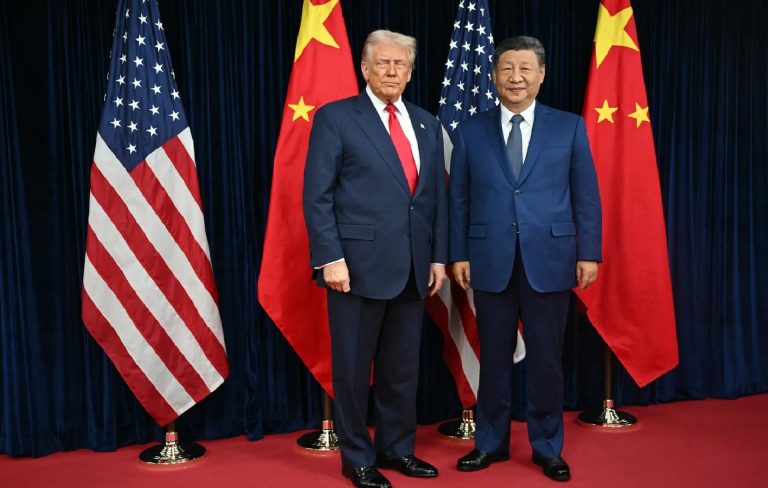
The recent Trump-Xi summit at the Asia-Pacific Economic Cooperation gathering in Busan has catalyzed fundamental questions about regional security architecture. When Washington announces plans for a “G2” framework with Beijing, the implications extend far beyond bilateral trade negotiations, potentially reshaping the entire Indo-Pacific strategic landscape that has defined 21st-century geopolitics.
Geopolitical Realignment and Strategic Recalibration
The contemporary international system is experiencing profound transformation driven by two simultaneous forces: American strategic retrenchment from multiple global commitments and China’s systematic expansion into new spheres of influence. While economic competition has dominated headlines, the security ramifications of this realignment will prove far more consequential for regional stability and international norms.
Despite ongoing contests for influence across various theaters, direct military confrontation between Washington and Beijing has been avoided. Instead, competition has manifested through proxy influence operations, economic coercion, and institutional competition. The Indo-Pacific region has emerged as the primary arena for this rivalry, where competing visions of regional order—rules-based openness versus sphere-of-influence hierarchies—collide most directly.
The Illusion of Bipolarity in a Multipolar Theater
Conventional analysis has long portrayed the Indo-Pacific as a bipolar competition between American alliance networks and Chinese revisionism. This framing, while superficially accurate, obscures the region’s actual complexity. The Indo-Pacific hosts diverse middle powers with distinct strategic interests, sophisticated diplomatic capabilities, and legitimate security concerns that transcend the Washington-Beijing dyad.
Washington’s approach has emphasized freedom of navigation operations, alliance reinforcement, and multilateral security frameworks designed to preserve international law and open maritime commons. Conversely, Beijing’s regional strategy employs territorial expansion through artificial island construction, naval deployments, and gray-zone coercion against neighboring states, particularly targeting the Philippines and Vietnam in disputed waters.
Chinese officials have consistently characterized American regional engagement as containment strategy designed to suppress China’s legitimate rise. This narrative frames Beijing’s assertiveness as defensive necessity rather than offensive expansion, complicating regional diplomatic dynamics and creating space for Chinese influence operations.
The G2 Concept and Regional Implications
The proposition of enhanced US-China cooperation, formalized through a G2 construct, has generated understandable skepticism among strategic analysts. However, dismissing this possibility as unrealistic may prove shortsighted. Even preliminary steps toward US-China accommodation carry profound implications for allies and partners who have structured their security policies around assumptions of sustained American commitment to regional order.
Trump administration foreign policy has consistently emphasized reducing American military expenditures and strategic overextension. The Indo-Pacific has not been exempt from this scrutiny. The AUKUS trilateral security partnership faced review early in Trump’s term, requiring explicit reassurances from the White House to maintain alliance confidence. Similarly, the Squad mechanism linking Australia, Japan, the Philippines, and the United States has demonstrated minimal momentum under current American leadership.
The Quad partnership—comprising the United States, India, Japan, and Australia—faces analogous uncertainties. Perhaps most critically, American commitment to Taiwan’s security remains ambiguous, generating anxiety across the region about Washington’s reliability during potential crisis scenarios.
Strategic Diversification as Regional Imperative
The emerging uncertainty surrounding American engagement creates both challenges and opportunities for Indo-Pacific stakeholders. Regional actors must recognize that over-dependence on American security guarantees represents strategic vulnerability, particularly when Washington’s commitment fluctuates with electoral cycles and domestic political pressures.
However, diversification faces significant obstacles. American economic and military capabilities remain unmatched within the region. US defense spending exceeds $800 billion annually, dwarfing all regional competitors. The Seventh Fleet maintains approximately 70-80 ships and submarines, providing maritime security infrastructure that no alternative coalition can currently replicate.
Nevertheless, Chinese military modernization and assertiveness continue driving regional security concerns. Beijing’s expanding naval capabilities, island militarization in disputed waters, and willingness to employ coast guard vessels for territorial coercion demonstrate that Chinese threats will persist regardless of Washington’s posture.
Building Alternative Security Architectures
The current moment demands creative diplomatic engineering. Regional middle powers must strengthen bilateral and multilateral partnerships that do not rely exclusively on American participation. ASEAN centrality in regional architecture provides one framework, though the organization’s consensus requirements and varying member state orientations toward China limit its security functionality.
Japan-Australia security cooperation has deepened significantly, creating an alternative axis for maritime security coordination. India’s Act East policy and expanding defense partnerships across Southeast Asia and the Pacific offer another pillar for multipolar security frameworks. South Korea’s increased engagement with ASEAN nations and participation in regional security dialogues creates additional connectivity.
These partnerships must extend beyond symbolic declarations to substantive capability development: joint maritime patrols, intelligence sharing mechanisms, coordinated responses to gray-zone coercion, and genuine interoperability among regional maritime forces. Economic integration through mechanisms like the Comprehensive and Progressive Agreement for Trans-Pacific Partnership can complement security cooperation, creating resilience against economic coercion.
Redefining Regional Multipolarity
The potential emergence of a G2 framework, rather than representing catastrophe, offers clarifying moment for Indo-Pacific strategy. It forces acknowledgment of what has always been true but often overlooked: the region’s security cannot be reduced to great power competition between Washington and Beijing.
The Indo-Pacific contains multiple powerful actors with legitimate interests and increasing capabilities: India’s rising economic and military power, Japan’s sophisticated defense establishment, Australia’s strategic position and resources, South Korea’s technological prowess, Indonesia’s demographic weight and geographic centrality, and Vietnam’s proven resistance to great power domination.
Effective regional architecture must harness this diversity rather than forcing alignment behind either Beijing or Washington. This requires moving beyond binary Cold War thinking toward sophisticated multilateral frameworks that allow states to cooperate on specific issues without demanding comprehensive alignment.
The Path Forward: Resilience Through Multipolarity
American and Chinese influence will undoubtedly continue shaping regional dynamics. However, the degree of that influence and its specific manifestations remain contested terrain where regional actors retain agency. The G2 concept, whether it materializes substantively or remains largely rhetorical, serves as crucial reminder that external guarantees are inherently unreliable.
Regional stakeholders must therefore invest in indigenous capabilities, diversified partnerships, and institutional frameworks that function regardless of Washington’s engagement level or Beijing’s pressure tactics. This approach does not require anti-American or anti-Chinese positioning. Instead, it demands strategic autonomy: the capability to defend vital interests through multiple pathways rather than exclusive dependence on any single partner.
The rules-based international order in the Indo-Pacific depends ultimately not on American enforcement alone but on collective commitment by states benefiting from open maritime commons, peaceful dispute resolution, and respect for sovereignty. Building resilient institutions and capabilities to uphold these principles represents the most effective response to both American unreliability and Chinese assertiveness.
The Indo-Pacific’s future will be shaped by how regional actors respond to current uncertainties. Those who diversify partnerships, build indigenous capabilities, and create flexible coalitions will navigate the emerging order most effectively. Those who remain passive, waiting for either Washington or Beijing to determine their security environment, will find themselves increasingly vulnerable to external manipulation.
The G2 framework, real or imagined, clarifies a fundamental reality: in a genuinely multipolar Indo-Pacific, security depends not on choosing the right great power patron but on building the collective capacity to shape regional order according to shared principles and interests.
Original analysis inspired by Raisina Debates from Observer Research Foundation. Additional research and verification conducted through multiple sources.