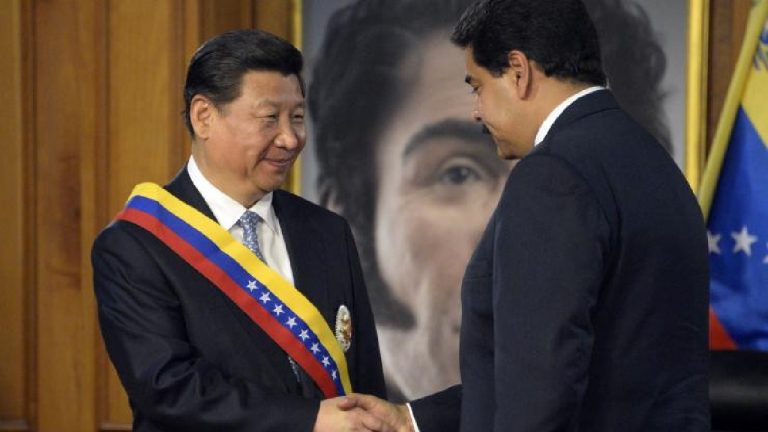
Chinese Foreign Minister Wang Yi’s December 17 call with Venezuelan counterpart condemned US “unilateral bullying” and expressed support for Venezuela’s right to “defend its sovereignty and national dignity,” yet Beijing has failed offering Caracas anything beyond rhetoric. China’s inaction demonstrates influence limits in Latin America as US escalation—including seizing Venezuelan oil tankers, striking alleged drug-smuggling boats, and imposing coastal blockade—threatens regime change that would hurt Chinese interests as biggest customer of Venezuelan crude oil.
Despite over two decades of economic relations expansion making China South America’s top trading partner and Mexico’s second-largest trading partner, Beijing remains wary of falling into geopolitical trap. Venezuela’s limited economic value to China and geopolitical distance mean Chinese government would not commit resources to defending the Latin American country in event of US invasion, though such scenario would expose Chinese power limits in region.
Economic Complementarity and Trade Relationships
Chinese engagement with Latin American countries is fueled by high degree of economic complementarity. Agricultural goods—notably soya beans from Brazil, Argentina, and Uruguay—have improved China’s food security, especially during US trade war. Meanwhile, minerals such as lithium carbonate from Chile, Argentina and Bolivia have become indispensable to China’s rapidly growing electric vehicle industry.
Chinese EV exports to Latin America surged 55% in 2023 alone. The region has not only alleviated China’s overcapacity problem but also offered Chinese telecommunication technology like Huawei’s 5G—spurned by Western countries—a market. Currently, Huawei’s 5G equipment is present in most Latin American countries.
While China is not dependent on Venezuelan oil—Venezuela not ranking among its top 10 crude suppliers—US interception of Venezuelan oil tankers nonetheless undermines China’s energy strategy aiming to avoid over-reliance on any single energy supplier.
US Counteroffensive and Regional Pressure
US Secretary of State Marco Rubio—outspoken China hawk who previously labeled Communist Party of China an “evil, genocidal regime”—embarked on February diplomatic blitz across region declaring mission to “counter the [CPC’s] influence in the Western Hemisphere,” seeking to persuade several Latin American countries to scale back China ties.
Despite being unable to offer compelling alternative economic cooperation model and opting for extortion tactics through tariffs, Washington nonetheless holds upper hand in this influence battle. Although most regional countries have been economically enticed to adhere to one China policy recognizing Taiwan as inalienable part of China, the region continues being last bastion of diplomatic support for Taiwan, with seven Latin American and Caribbean countries maintaining formal diplomatic relations with Taiwan over China.
Trump administration achieved resounding victory when Trump-backed conservative Nasry Asfura won presidential elections in Honduras this week; during his campaign, he pledged to sever diplomatic ties with China and re-establish formal relations with Taiwan.
Strategic Retreats Under US Pressure
Over past year under Trump administration, several Latin American countries yielded to US pressure limiting economic ties with China. In February, Panama formally withdrew from China’s Belt and Road Initiative. Then in March, Panama Canal’s Hong Kong-based operator announced selling most of its stake to consortium of American companies—move following Trump’s allegation that vital waterway was controlled by China. In December, Mexico announced it would slap tariffs up to 50% on Chinese goods starting January 1.
In Venezuela, US pressure is not related to its close China ties, having more to do with US domestic politics: Rubio is seeking to fulfill long-held political agenda to please opposition-minded Venezuelan and Cuban American constituencies. Nevertheless, any regime change in Caracas would certainly hurt Chinese interests.
Monroe Doctrine Revival and Geopolitical Signals
China views Venezuela escalation not only through economic lens but also geopolitically. Recently released National Security Strategy declared days of US acting as world’s policeman are over, advocating instead for return to Monroe Doctrine principles—19th-century foreign policy strategy seeking to block any outside interference in Americas that could infringe on US interests.
Although NSS notably does not designate China as greatest threat to US, it nonetheless states US government will maintain military capable of deterring Chinese ambitions on Taiwan by military means. This document, along with escalating US-Venezuela tensions, has sent mixed signals to China.
On one hand, US appears to deprioritize competition with China and instead focus on reasserting hegemony over Western Hemisphere. On other hand, it has not made any significant steps indicating Asia disengagement; for example, military bases in South Korea and Japan remain fully operational. Beijing fears Washington might be trying to lure it into false sense of security with rhetoric and ostensible geopolitical shift; thus, it remains cautious.
Chinese Policy Response Limitations
Following NSS release, China put out policy paper on Latin America and Caribbean. Likely response to recent events, the paper reflects Beijing’s attempt to bring fight to US doorstep. However, policies and strategies laid out in document share same shortcomings Chinese foreign policy has always had: they offer support more symbolic than substantive.
China’s attempt to rally Global South under banner of opposing US hegemony and foster grievance-based unity seriously falls short when confronted with American military might. In this context and given Venezuela’s limited economic value to China and geopolitical distance, Chinese government would not commit resources defending the Latin American country.
In event of US invasion, China would likely leverage it to promote its vision of multipolar world and position itself as champion of international law and UN Charter. While it would consider US being bogged down in protracted war a positive development, China would almost certainly not come to Venezuela’s aid.
However, US toppling of Venezuelan government would expose limits of Chinese power in region. Such scenario would undoubtedly prompt many Latin American countries to reconsider whether aligning themselves with China is good idea when aggressive US is so close by.
Original analysis by Yang Xiaotong from Al Jazeera. Republished with additional research and verification by ThinkTanksMonitor.