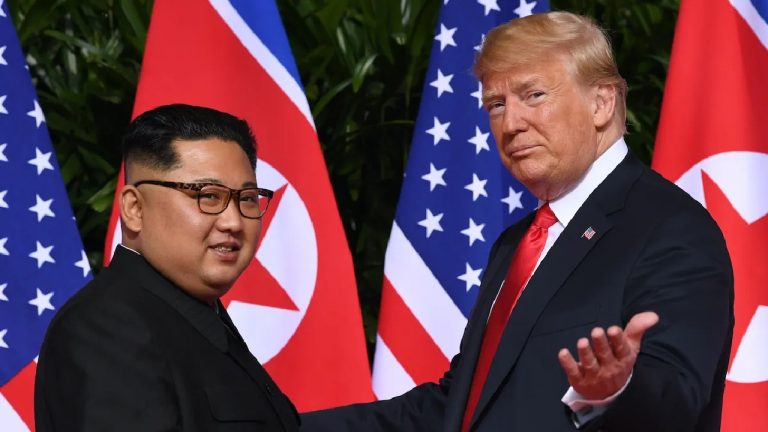
North Korean dictator Kim Jong Un’s dramatic reversal from pariah status to sought-after diplomatic partner represents geopolitical shift with profound implications for nonproliferation regime. Russian President Vladimir Putin comes to Kim with hat in hand needing ammunition and cannon-fodder troops for Ukraine war, Chinese President Xi Jinping gave Kim place of honor at September 3, 2025 military parade commemorating 80th anniversary of World War II end, and US President Donald Trump is heard literally begging Kim to meet during Trump’s late October Seoul visit. Suddenly, Kim Jong Un is everybody’s favorite prom date.
Most unsettling has been President Trump’s overeagerness to resume his bromance with Kim, even as Kim has thus far spurned advances, warning United States must first get over “delusional obsession with denuclearization” before he is willing to sit down, as equal, with world’s most powerful leader. Why President Trump is so eager to meet again with Kim, given fruitlessness of previous encounters, remains unclear. Some speculate this is part of his very transparent drive to obtain Nobel Peace Prize. Others fear it is first step toward terminating or at least seriously downgrading long-standing US-ROK alliance, which has kept peace on Peninsula for over 70 years.
Trump October Asia Visit and Kim Meeting Requests
Trump administration officials privately discussed setting up meeting between President Trump and Kim Jong Un when Trump visited Asia for November APEC summit in Gyeongju, South Korea, though many were skeptical it would ultimately happen. Trump told reporters before departing for Asia late October: “He knows I’m going there,” referring to Kim, adding “Someday, I’ll see him. I look forward to seeing him. He was very good with me.”
Senior US official speaking on condition of anonymity told reporters October 25 that while president expressed willingness to meet Kim in future, “it is not on schedule for this trip.” South Korean Unification Minister Chung Dong-young stated he believed there was “considerable” chance Trump would meet Kim while in South Korea, noting North Korea appears “to be paying attention to United States” with “various signs suggest considerable possibility of meeting.”
South Korea’s National Intelligence Service assessed November 4 that Kim “has intent to pursue dialogue with United States and will seek contact if conditions become favorable,” according to Lee Seong-kweun, opposition lawmaker and secretary for national assembly’s intelligence committee. NIS reported “various signs have been confirmed through multiple channels indicating North Korea was preparing behind scenes for dialogue with United States” and “subtle changes” in rhetoric since Kim’s September address to Supreme People’s Assembly.
Xi Jinping September 2025 Military Parade
Chinese President Xi Jinping presided over 70-minute September 3, 2025 parade marking 80 years since World War II end from atop Gate of Heavenly Peace in Beijing, flanked by Putin waging Europe’s bloodiest conflict since 1945 and Kim funneling him troops and weapons. More than 12,000 People’s Liberation Army troops participated in parade attended by 26 world leaders including Putin and Kim, representing first time North Korean leader attended Chinese military parade in 66 years.
Last North Korean leader to attend military parade in China was Kim’s late grandfather Kim Il Sung in 1959. Event marked China’s largest ever military parade, with 50,000 observers watching display of hypersonic missiles, ballistic missiles, underwater drones, fighter jets, aircraft jamming systems and long-range intercontinental missiles capable of delivering nuclear warheads. Trump accused Xi, Putin and Kim of conspiring against United States, posting on Truth Social: “Please give my warmest regards to Vladimir Putin, and Kim Jong Un, as you conspire against United States of America.”
Denuclearization Policy Abandonment Dangers
Trump administration needs to make crystal clear that its long-term goal remains Korean Peninsula denuclearization. To abandon this goal is to accept North Korea as de facto nuclear weapons state, which would undermine international nonproliferation regime. It would also most likely open nuclear door for South Korea, perhaps Japan, and most likely for Taiwan as well. This would reverse decades of US policy and strategic thinking.
Should administration decide that nuclear proliferation among its allies is in America’s best interest, this policy reversal should come about due to serious deliberation. It should not happen as side effect of some visit. Once nuclear genie is deliberately let out of bottle in Northeast Asia, we should expect to see its emergence elsewhere around globe as well.
From 1991 until 2018, North Korea had periodically endorsed broader framing of “denuclearization of Korean Peninsula,” language that appears in text of Singapore joint statement. Distinction between “Korean Peninsula” and “denuclearization of DPRK” has drawn ire from North Korea repeatedly in past. At no point in its history has North Korea endorsed any documents or agreements seeking “denuclearization of DPRK.”
Trilateral Summit and DMZ Meeting Concerns
Should President Trump, under any conditions (hopefully including CVID: complete, verifiable, irreversible denuclearization), agree to meet with Kim in Korea, he should insist that it be trilateral meeting including South Korean President Lee Jae Myung (who is otherwise very supportive of Kim-Trump Summit). When Trump last met with Kim Jong Un in Korean DMZ June 30, 2019, then-South Korean President Moon Jae-in was allowed to appear for brief photo op and then waited in car while Trump conducted 53-minute private session with Kim.
This was not only truly insulting to Moon and people of South Korea but also fed into Pyongyang’s long-standing narrative that South Korea was mere vassal of United States and not sovereign entity in own right. It’s hard to imagine Kim agreeing to come to South Korea—and Trump traveling to North, after having previously stepped into North Korea during DMZ visit, would further Pyongyang’s narrative that Kim Jong-Un is highly important, powerful world leader and that Washington is at his beck and call.
If Trump insists on another private bilateral meeting, then it should not happen on Korean Peninsula. Guam represents ideal meeting place, where Kim could witness firsthand extent of US air power and air defenses readily available to US should North Korean ruler ever contemplate attack on US ally (Korea or Japan) or US territory.
Abraham Accords Success and Appeasement Risks
Trump’s efforts to bring peace to Middle East, first through Abraham Accords and now through his UNSC-endorsed 20-point ceasefire peace plan for Gaza, deserve recognition. If Gaza ceasefire holds and hope remains for eventual Palestinian state, that alone should more than justify his being awarded Nobel Peace Prize.
Best way to ensure such prize will never be awarded, however, would be to take steps that would ultimately legitimize North Korea as nuclear weapons state, while letting additional nuclear dominos fall. Instead of being demonstration of “peace through strength,” such move would qualify Trump to become new international poster child for appeasement as 21st century version of Neville Chamberlain. When it comes to North Korea, US/South Korea are in driver’s seat; they, and not Pyongyang, should be driving agenda.
Original analysis by Ralph Cossa from Asia Times / Pacific Forum. Republished with additional research and verification by ThinkTanksMonitor.