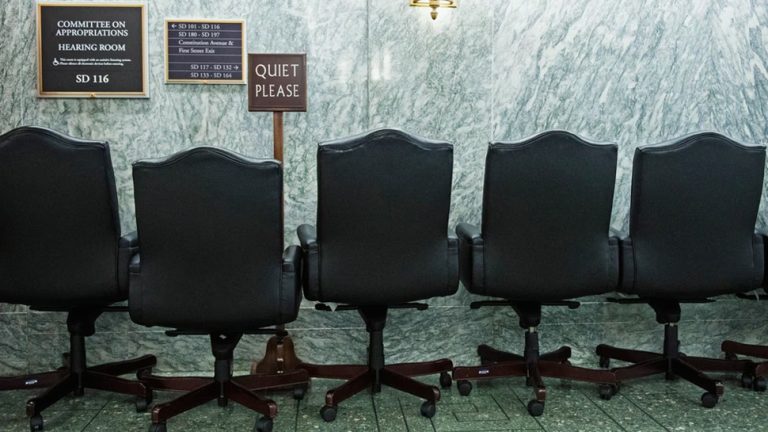
A severe personnel shortage across critical government agencies continues to cripple the operational capacity of the current administration. While President Trump frequently attacks the career civil service—often dubbing them the “deep state”—his administration has simultaneously failed to staff the “shallow state” of politically appointed leadership roles. According to tracking data from the Partnership for Public Service, hundreds of top appointed positions lack even a nominee, leaving major departments struggling to execute the president’s ambitious policy agenda.
Nowhere is this leadership vacuum more apparent than within immigration enforcement. The recent, unexplained withdrawal of Lance Schroyer as the nominee to direct Immigration and Customs Enforcement (ICE) extends a years-long vacancy at the top of the agency. While Schroyer was a close confidant of Homeland Security Secretary Markwayne Mullin, his withdrawal leaves ICE rudderless during a period when the administration relies heavily on the agency for its mass deportation initiatives. Without a Senate-confirmed director, authority has fractured among acting officials and senior advisors, leading to volatile tactics, recruitment struggles, and severe disciplinary scandals involving field agents.
The national security apparatus faces an equally alarming personnel crisis. As the United States wades deeper into a conflict with Iran, the Defense Department lacks crucial leadership. The Army operates without a confirmed secretary or a permanent chief of staff following ideological clashes with Secretary of Defense Pete Hegseth, who has aggressively purged upper-echelon military leaders. Furthermore, the administration’s broader diplomatic and security infrastructure is hollowed out. The National Counterterrorism Center remains without a director following the protest resignation of Joe Kent, and the State Department lacks ambassadors in vital Middle Eastern nations, including Iraq, the United Arab Emirates, and Qatar.
Even domestic departments directly tied to the president’s top priorities suffer from this chronic understaffing. The Justice Department, which has been aggressively reshaped under Attorney General Todd Blanche, currently lacks a nominated deputy attorney general. Similar leadership voids plague the Census Bureau, the National Park Service, and the Bureau of Reclamation, severely stalling major structural reorganizations and critical infrastructure management.
Ultimately, this unprecedented level of vacancies creates a paradoxical dynamic. The administration seeks to wield state power more aggressively than any modern Republican presidency, yet its failure to appoint qualified officials to execute these plans ensures widespread operational dysfunction.
Original analysis inspired by David A. Graham from The Atlantic. Additional research and verification conducted through multiple sources.