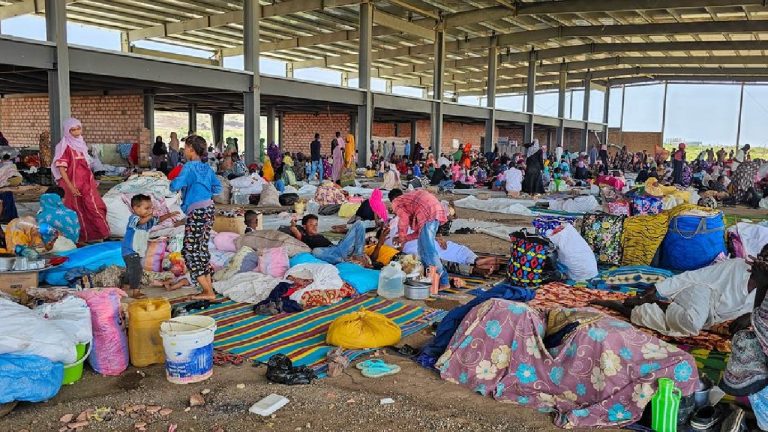
Sudan confronts what United Nations officials characterize as the twenty-first century’s gravest humanitarian emergency, with approximately 25 million people experiencing extreme hunger and over 14 million displaced from civil conflict that erupted in April 2023. The scale dwarfs concurrent crises receiving substantially greater international attention—Sudan’s starving population exceeds Gaza’s total population tenfold, while displacement surpasses Gaza’s figures sixfold. Yet media coverage and diplomatic engagement remain disproportionately minimal, reflecting patterns where African suffering generates less Western concern than Middle Eastern conflicts.
The US State Department determined in January 2025 that the Rapid Support Forces and allied militias committed genocide, while the International Criminal Court reported to the UN Security Council in July that war crimes and crimes against humanity continue systematically in Darfur. Despite these findings and UK Baroness Chapman’s November assessment that Sudan represents “the largest humanitarian crisis of the 21st century,” international response remains inadequate both in funding and diplomatic pressure.
Origins and Trajectory of Current Conflict
Sudan’s contemporary crisis emerged from a 2019 popular uprising that successfully dislodged longtime autocrat Omar al-Bashir following massive nonviolent demonstrations. The Sudanese Professionals Association and civil society coalition Forces of Freedom and Change initially partnered with military officers forming a Transitional Military Council to establish civilian governance. However, the Sudanese Armed Forces (SAF) led by General Abdel Fattah al-Burhan soon overthrew nascent democratic institutions, establishing military rule that recalled patterns from Egypt’s 2013 coup and Algeria’s 2019 transition failures.
Tensions between al-Burhan’s SAF and Muhammad Hamdan Dagalo’s Rapid Support Forces—two erstwhile allies in al-Bashir’s government—erupted into open warfare in April 2023 over disputes regarding RSF integration into regular military structures. Fighting initially concentrated in Khartoum before spreading to Darfur, where the RSF maintains deep roots through its origins in the Janjaweed militia responsible for 2003-2005 genocidal campaigns against Black African farming communities.
The RSF captured el-Fasher in October 2025 following an 18-month siege, securing control over most of western Sudan. The city’s fall after prolonged starvation tactics exemplifies both sides’ systematic disregard for civilian protection. International Crisis Group documented that el-Fasher residents faced mass killings including 500 patients and companions massacred at Saudi Maternity Hospital, widespread sexual violence, and extortion at RSF checkpoints where fighters confiscated possessions while forcing families to call relatives for money transfers before permitting passage.
Humanitarian Emergency and Famine Conditions
The conflict has generated catastrophic humanitarian consequences. World Food Programme estimates indicate 24.6 million people—approximately half Sudan’s population—suffer acute food shortages, with 637,000 facing devastating hunger levels. Famine has been confirmed in el-Fasher and Kadugli, with 20 additional areas at imminent risk. Nearly four million children experience acute malnutrition, including over 770,000 at imminent death risk.
UN officials cite multiple factors impeding humanitarian response: funding gaps, access restrictions by both parties, attacks on aid workers, and bureaucratic obstacles. The 2025 appeal remains only 27% funded, with minimal US contributions following Trump aid cuts.
Both sides weaponize humanitarian access. The SAF restricts access to RSF territories while its Humanitarian Aid Commission creates bureaucratic hindrances. Brookings notes SAF-linked cells have menaced and killed activists in Emergency Relief Rooms providing essential services. The RSF employs direct brutality through siege tactics, with BBC reporting less than half of el-Fasher’s 260,000 pre-fall residents accounted for.
External Actors and Arms Supplies
Foreign involvement sustains the conflict. Secretary of State Marco Rubio acknowledged weapons acquired abroad represent critical factors enabling warfare. The UAE appears as the RSF’s primary arms supplier according to Amnesty International, though officials deny this. Weapons originate from China, Turkey, Russia, and Serbia violating international Arms Trade Treaty obligations.
The SAF receives support from Egypt, Qatar, Turkey, Saudi Arabia, and Iran. Russia’s Wagner Group supplied RSF missiles in 2023, while Moscow subsequently offered SAF support potentially enabling Russian naval outpost construction. Saudi Arabia shifted toward SAF support by February 2025, while the crown prince’s White House visit prompted Trump engagement.
US Policy Impact and Humanitarian Aid Cuts
Trump administration policies have directly exacerbated Sudan’s humanitarian emergency despite rhetorical concerns about the crisis. When Elon Musk spent February 2025 “feeding USAID into the wood chipper” through dramatic aid cuts, the Washington Post reported the impact in Sudan proved “especially deadly,” with WHO estimating 5 million Sudanese losing access to lifesaving health services as result of US cuts.
The cuts forced US-supported soup kitchens to close, causing babies to starve while older siblings died begging for food. Critical medical supply deliveries were halted, and lack of disease response teams has complicated containing cholera outbreaks claiming lives of hunger-weakened populations. The United States provided over $1 billion in FY2024 humanitarian aid for Sudan—nearly half of all humanitarian assistance to the country—yet no new pledges have been announced in 2025.
Sudan features among 19 countries for which Trump halted immigration applications, meaning refugees fleeing starvation and genocide receive no welcome. US Citizenship and Immigration Services announced plans for “comprehensive review” of nationals and naturalized citizens who received immigration benefits under Biden, including several thousand Sudanese immigrants and refugees. Sudanese immigrants retain Temporary Protected Status until October 2026 expiration, prohibiting deportation to Sudan, though Trump revoked TPS for separate nation South Sudan.
Violence Escalation and Failed Peace Efforts
December 2025 witnessed conflict escalation in Kordofan as fighting shifted from Darfur, with RSF capturing strategic locations including Heglig oil fields. UN officials warned these developments reflect expanding regional dimensions that could draw Sudan’s neighbors into wider war. Violence has killed at least 100 civilians since early December, including six Bangladeshi peacekeepers killed in drone strikes.
Multiple diplomatic initiatives have failed to halt fighting. The US-Saudi Jeddah talks collapsed in late 2023, while Biden’s Special Envoy Tom Perriello launched the ALPS Group without breakthroughs. The RSF announced a humanitarian truce in November 2025 yet resumed drone strikes shortly afterward, while SAF rejected the truce citing crimes against civilians.
Implications for Democratic Movements and Military Power
Sudan’s trajectory from successful popular uprising dislodging dictatorship to military rule and civil war catastrophe offers sobering lessons for democratic movements globally. The 2019 nonviolent revolution initially succeeded in removing al-Bashir, generating optimism about civilian governance prospects. However, military forces’ unwillingness to cede political control—patterns repeated in Egypt 2013 and Algeria 2019—demonstrates that toppling dictators proves insufficient without ensuring military subordination to civilian authority.
The failure to establish mechanisms preventing military takeover during transitional periods has generated catastrophic humanitarian consequences in Sudan while returning Egypt and Algeria to authoritarian governance under military control. These precedents suggest that extra-electoral strategies opposing authoritarianism require not only targets for removal but comprehensive planning for maintaining civilian rule during power vacuums created by successful mobilization.
Original analysis by Rebecca Gordon from Foreign Policy in Focus. Republished with additional research and verification by ThinkTanksMonitor.