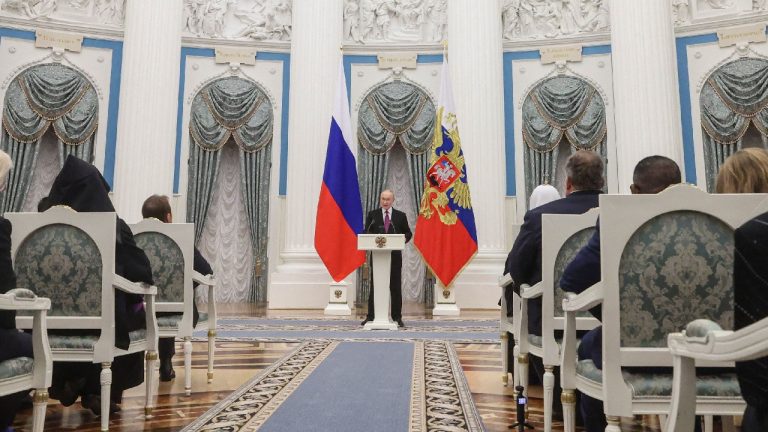
Vladimir Putin’s December 17, 2025 address to Russian Defense Ministry board emphasized NATO threats to Russian security and Moscow’s nuclear arsenal expansion efforts, stating “Our nuclear forces are 92 percent modernized” and declaring “Improving our strategic nuclear forces remains a priority.” Russia remains biggest nuclear power globally with approximately 4,309 nuclear warheads stockpile, of which 1,718 are deployed. With Moscow lowering nuclear use thresholds late 2024 and New START treaty expiring in less than two months, Putin’s focus on newest weapons systems signals coercive deterrence strategy.
Putin detailed catastrophic capabilities of Oreshnik and Burevestnik missiles, plus Poseidon unmanned submersible, adding Oreshnik would enter “combat duty” before year’s end. Belarusian President Lukashenko confirmed today that Oreshnik has been deployed in Belarus. Taking place during critical Ukraine peace negotiations, the deployment signals Moscow’s commitment and willingness to deter Western interference in what Russia regards as its sphere of influence.
Oreshnik Intermediate Range Ballistic Missile
First deployed November 2024 when it struck Ukrainian city of Dnipro, Oreshnik is intermediate range ballistic missile based on modified intercontinental ballistic missile Rubezh. It was developed after 2019 Intermediate-Range Nuclear Forces Treaty collapse, which had banned ground-launched ballistic missiles with 500-5,500 kilometer range.
Oreshnik carries six warheads in multiple independent re-entry vehicle configuration, allowing independent targeting of each warhead and making defense against missile very difficult. Although warheads that struck Dnipro were conventional and carried no explosive material, the dual-use missile is also capable of carrying nuclear payloads. Intermediate range missiles can threaten European countries as well as NATO assets throughout Europe, which is why Russia notified United States 30 minutes before launch.
Burevestnik Nuclear-Powered Cruise Missile
In October 2025, Russia announced successful test-flight of Burevestnik, nuclear-powered and nuclear-capable cruise missile. During presidential briefing, General Valerii Gerasimov stated missile traveled during testing approximately 15 hours and 14,000 kilometers, adding neither figure is “the limit.” If it becomes operational, Burevestnik’s nuclear propulsion system can, at least in theory, allow missile to reach United States while maneuvering to avoid detection and interception by missile defense systems.
Poseidon Unmanned Underwater Torpedo
Just over week after Burevestnik test, Putin announced Russia had successfully tested nuclear-powered, nuclear-armed, unmanned underwater torpedo Poseidon. Experts believe Poseidon can travel at astonishing 185 kilometers per hour at depth up to 1,000 kilometers while evading acoustic tracking devices. In doomsday scenario, monstrous torpedo-drone could unleash massive tsunami, leveling coastal cities and destroying ports while causing radioactive contamination rendering entire regions uninhabitable.
Coercive Deterrence Effectiveness and Western Response
Despite these chilling developments, there is nothing these world-destroying weapons can do that Russia’s nuclear arsenal cannot already accomplish multiple times over, which is only likely as second-strike scenario. Moscow’s coercive nuclear threats are working exactly as intended since they have so far succeeded in deterring United States from entering war in Ukraine or supporting Kyiv more decisively.
Concerns about escalation risks with Russia not only stalled shipments of key military aid to Kyiv but also contributed to Biden team’s unwillingness to let Ukraine strike Russia with ATACMS missiles until after 2024 election. As Biden’s national security advisor Jake Sullivan stated earlier this year, administration’s decision-making was constrained by “possibility of Russian nuclear use.”
Feeding fear of that possibility in adversaries’ minds is one way Russia protects itself while sowing uncertainty in Western countries. Although nuclear risk ought to be taken seriously, Putin’s constant reminders of his country’s new capabilities suggest he has more conventional ambitions in mind, like territorial gain in Ukraine.
Russia’s nuclear modernization effort has been underway for decades, representing long-term strategic investment rather than sudden capability development. The emphasis on these systems during current Ukraine peace negotiations indicates their role as diplomatic leverage tools rather than weapons Moscow intends to deploy. New systems like Oreshnik, Burevestnik, and Poseidon serve primarily to reinforce psychological deterrence effects on Western decision-makers.
Strategic Context and Political Messaging
Putin’s December 17 address also emphasized what he considers NATO threat to Russian security, described European leaders as “piglets” or “swine,” and vowed to “liberate” Russia’s “historical lands” in Donbas region. The 15-minute address emphasized technological gains Russian military and overall defense sector have made throughout course of Ukraine war.
Taking place during critical Ukraine peace negotiations, weapons system announcements and Belarus deployment serve multiple purposes: signaling resolve to domestic audiences, demonstrating military capability to Western adversaries, and establishing negotiating position strength. Moscow’s willingness to lower nuclear use thresholds late 2024 combined with New START treaty expiration in less than two months creates strategic uncertainty environment favoring Russian leverage in ongoing diplomatic processes.
Original analysis by Sveta Yefimenko from Foreign Policy in Focus. Republished with additional research and verification by ThinkTanksMonitor.