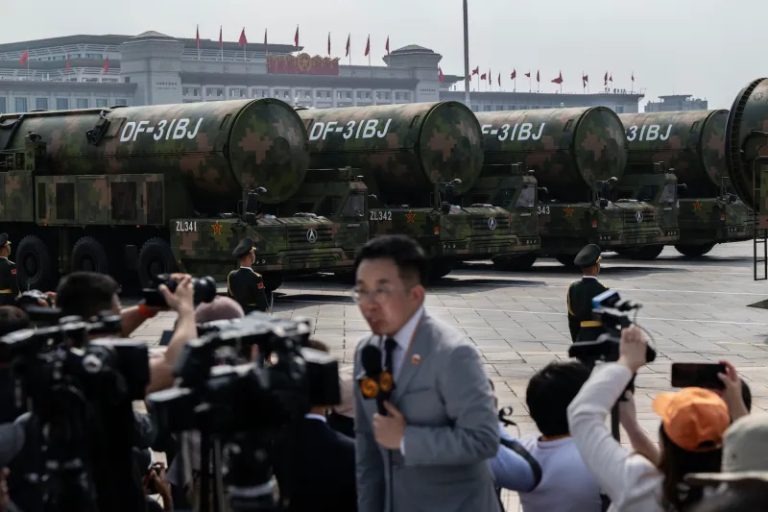
The expiration of New START, Beijing’s rapid arsenal expansion, and the emergence of a three-way nuclear rivalry are dismantling the frameworks that prevented catastrophe for over half a century, pushing the world toward an era of unconstrained strategic competition.
For more than fifty years, a web of treaties, doctrines, and diplomatic norms kept the world’s most destructive weapons within a predictable framework. That framework has now effectively ceased to exist. The February 5 expiration of New START—the final legally binding agreement limiting American and Russian strategic nuclear arsenals—did not occur in isolation. It represents the culmination of a decade-long erosion that has left the international community without any of the guardrails that once defined the nuclear order, at precisely the moment when the competitive dynamics governing these weapons have grown dramatically more complex and dangerous.
From Bilateral Restraint to Tripolar Competition
The Cold War nuclear standoff, for all its terrifying potential, operated within relatively legible parameters. Two superpowers held overwhelmingly dominant arsenals, and a succession of agreements—from the 1972 Anti-Ballistic Missile Treaty through the original START and ultimately New START in 2010—established ceilings, verification mechanisms, and communication channels that imposed a measure of order on the competition. The world was not safe, but it was structurally stable: each side understood the other’s capabilities, and both recognized that unrestricted accumulation would only multiply the risk of annihilation without delivering meaningful advantage.
That bipolar architecture has given way to something fundamentally different. Beijing’s nuclear expansion has been staggering in both pace and ambition. When Xi Jinping assumed power in 2012, China maintained roughly 240 warheads oriented toward a posture of minimum deterrence. Pentagon assessments now place that figure above 600, with projections exceeding 1,000 operational warheads by 2030. China is simultaneously fielding a complete nuclear triad—intercontinental ballistic missiles, submarine-launched weapons, and air-delivered capabilities—and moving toward launch-on-warning postures that dramatically compress decision-making timelines during a crisis.
Moscow, meanwhile, has not merely maintained its arsenal but transformed it. President Putin has claimed that 95 percent of Russia’s strategic nuclear forces have been modernized, and Russia’s regional nuclear capabilities—estimated at approximately 1,500 tactical warheads deployable across land, air, and maritime platforms—were never subject to New START constraints in the first place. The war in Ukraine has introduced a particularly alarming dimension: Moscow has repeatedly weaponized nuclear threats as a tool of political coercion, lowering the rhetorical threshold in ways that erode the taboo against nuclear signaling during conventional conflicts.
The Collapse of the Treaty Architecture
The disappearance of New START must be understood not as a single event but as the final chapter of a systemic unraveling. The United States withdrew from the ABM Treaty in 2002 and the Intermediate-Range Nuclear Forces Treaty in 2019. Russia suspended its participation in New START in 2023. The Federation of American Scientists has documented that for the first time since 1972, no legally binding instrument constrains the strategic arsenals of the world’s two largest nuclear powers—a condition unprecedented in the modern nuclear age.
The UN Secretary-General described the expiration as a “grave moment” for international peace and security, and that assessment is difficult to dispute. The treaty’s value extended well beyond numerical caps. Its verification regime—including on-site inspections, data exchanges, and notification requirements—provided both Washington and Moscow with transparency into the other’s strategic posture. That transparency reduced the risk that either side would misinterpret modernization efforts or deployment shifts as preparations for a first strike. Without it, the space for miscalculation widens considerably.
Efforts to construct a successor framework face formidable obstacles. Washington has insisted that any future agreement must include China—a position Beijing flatly rejects, arguing it will consider arms control discussions only when its arsenal approaches parity with American and Russian stockpiles. Beijing treats transparency and verification not as confidence-building instruments but as strategic vulnerabilities that would expose the contours of a deterrent force still under construction. This impasse means the three-way competition will likely proceed without any institutional mechanism to manage it for years, if not decades.
The Deterrence Paradox in a Multipolar Nuclear World
A bipartisan Congressional Strategic Posture Commission warned in 2023 that the United States would soon face two nuclear peer adversaries simultaneously—a circumstance for which American force structure, doctrine, and deterrence strategy were never designed. The commission highlighted the risk of “opportunistic aggression,” in which one nuclear-armed rival exploits a crisis involving the other to press its own advantage, and the possibility of coordinated pressure across multiple theaters that would strain Washington’s capacity to respond credibly.
This tripolar dynamic introduces instability that goes beyond simple arithmetic. Deterrence in a bilateral framework depended on each side’s confidence that the other would not strike first because retaliation was assured. Adding a third major nuclear power with independent strategic calculations, opaque decision-making processes, and its own regional flashpoints—Taiwan, the South China Sea, the Korean Peninsula—creates a system in which the interactions between any two actors can unpredictably affect the third. The deepening Sino-Russian strategic partnership, which now includes joint military exercises involving nuclear-capable platforms, further complicates Western attempts to treat Moscow and Beijing as separate deterrence problems.
Modern nuclear systems compound these risks through their integration with cyber networks, space-based early-warning sensors, and artificial intelligence-assisted command architectures. Decision timelines have compressed from the thirty minutes that Cold War planners assumed for an ICBM flight to potentially seconds for hypersonic weapons. A false alarm, a cyber intrusion misinterpreted as a prelude to attack, or a miscalibrated response to ambiguous satellite data could trigger escalation cascades that move faster than human judgment can control.
The Fraying Nonproliferation Bargain
The consequences of great-power nuclear dysfunction extend well beyond the triangle of Washington, Moscow, and Beijing. The Nuclear Non-Proliferation Treaty rested on an implicit exchange: non-nuclear states agreed to forgo these weapons in return for security assurances and a commitment by nuclear powers to manage their arsenals responsibly and pursue disarmament. Both halves of that bargain are now visibly deteriorating.
Growing uncertainty about America’s willingness to extend reliable security guarantees to allies has triggered increasingly mainstream debates about independent nuclear capabilities in countries that were once firmly anchored in the nonproliferation regime. In South Korea, public polling has consistently shown majority support for an indigenous deterrent, and political figures across the spectrum have openly engaged with the question. In Japan, strategic conversations that would have been unthinkable a decade ago are now occurring among senior defense officials. The Hudson Institute’s analysis of Asian nuclear dynamics warned that if proliferation pressures materialize in Northeast Asia, the cascading effects would be global, potentially prompting reassessments in the Middle East and beyond.
Navigating an Uncharted Nuclear Landscape
The international community now confronts a nuclear environment without historical precedent: three major powers expanding or modernizing arsenals without any binding constraints, an eroding nonproliferation regime, compressed decision timelines enabled by new technologies, and weakened diplomatic channels for managing crises. The SIPRI assessment following New START’s expiration called on European states to assume greater responsibility for sustaining arms control dialogue, recognizing that neither Washington nor Moscow currently demonstrates the political will to rebuild bilateral frameworks.
The architecture of nuclear restraint that emerged from the Cold War was never elegant or complete, but it worked well enough to prevent the unthinkable for over fifty years. What replaces it—if anything does—will determine whether the coming decades are characterized by managed competition or a spiraling accumulation of risk that makes catastrophic miscalculation not a question of if, but when.
Original analysis inspired by Fareed Zakaria from Foreign Policy. Additional research and verification conducted through multiple sources.