Category: Persian Gulf Countries

The national flags of the United States of America and the United Arab Emirates flying side-by-side against a blue sky with soft clouds.

Technology Partnerships and Diplomatic Intermediaries: A Framework for Peace Implementation

This analysis examines how the U.S.-UAE strategic partnership leverages a $1.4 trillion investment framework to replace traditional military dominance with AI-backed “Data-Driven Diplomacy.” By combining Microsoft’s $15.2 billion AI commitment with the UAE’s unique credibility in Moscow and Washington, this model offers a pragmatic, verifiable architecture for resolving complex global conflicts.

Read More »
Two men in formal attire standing in a modern hall, looking at a large architectural model of a city.

The Changing Dynamics of Middle Eastern Alliances: A Battle Between Abrahamic and Islamic Coalitions

In early 2026, the Middle East has moved beyond the simple “Sunni vs. Shia” binary. Instead, the region is now fractured into two competing ideological and strategic blocs: the Abrahamic Coalition—focused on secular-leaning economic integration and high-tech defense—and the Islamic Coalition, which prioritizes sovereign statehood, Islamic solidarity, and a more cautious distance from Israel.

Read More »
A collection of various Iranian newspapers spread out on a wooden table, featuring headlines in Persian and a prominent photograph of Donald Trump on one of the front pages.

Iran’s Battle for Survival is the Arab World’s Fight Too

In early 2026, the Middle East has entered what analysts describe as a state of “Exhausted Realignment.” Following the kinetic “12-Day War” between Israel and Iran in June 2025 and the fall of the Assad regime in Syria in December 2024, the region is now caught between a “Maximum Pressure 2.0” campaign from Washington and a desperate diplomatic “hedging” strategy by the Gulf states.

Read More »
A crowded outdoor walkway lined with tall green "COP28 UAE" banners, with palm trees and a large domed architectural structure in the background.

Middle Eastern Energy Politics: Transition as Power Redistribution Rather Than Technical Evolution

Middle Eastern energy transition is not a mere technical shift but a fundamental geopolitical power redistribution. While regional players like Saudi Arabia and Qatar invest in renewables, they simultaneously leverage hydrocarbons to assert autonomous diplomacy, navigating a multipolar world where energy remains a primary instrument of strategic influence and state survival.

Read More »
Mohammed bin Salman in traditional Saudi attire shaking hands with Xi Jinping in a black suit, standing in front of a row of international flags.

Expanding Orbital Influence: China’s Strategic Space Partnerships in the Middle East and North Africa

China has transitioned from a traditional infrastructure builder to a primary provider of high-tech space solutions for the Middle East and North Africa (MENA). By offering launch services, satellite manufacturing, and the BeiDou navigation system, Beijing is establishing a “Space Silk Road” that challenges Western technological dominance while enabling regional powers to achieve “strategic autonomy.”

Read More »
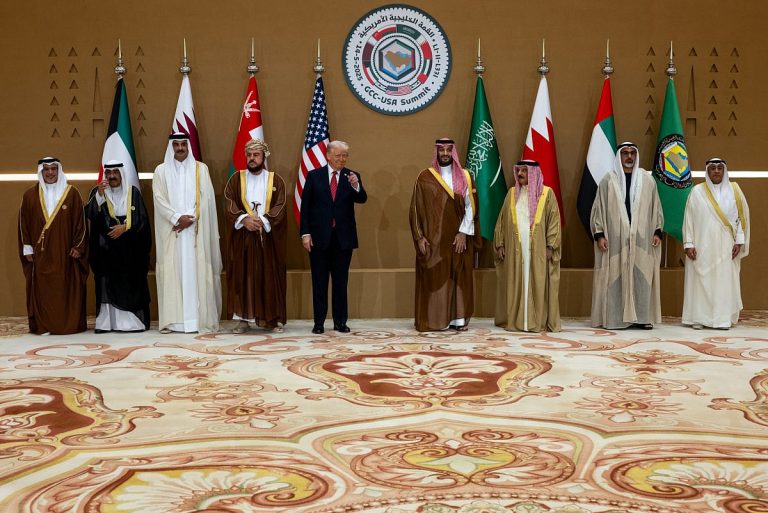
Leaders of the Gulf Cooperation Council (GCC) at a summit, symbolizing the growing economic and political competition between Saudi Arabia and the UAE.

Saudi-UAE Regional Competition: Economic Hub Rivalry and Political Divergence Risk Gulf Stability

The competition between Riyadh and Abu Dhabi has shifted from healthy rivalry to a high-stakes struggle for regional gravity. As Saudi Arabia lures 675 global headquarters with tax incentives, it directly challenges the UAE’s hub model. This economic friction, mirrored in political clashes over Sudan and Yemen, threatens to destabilize Gulf integration and overall regional security.

Read More »
A line of Israeli Merkava tanks and a supply truck moving along a paved road next to a barbed-wire border fence

Israeli Military Expansion in Syria Risks Strategic Overextension Despite Initial Advantages

Twelve months after Bashar al-Assad’s fall, Israeli forces have carried out over 600 military operations in Syria, averaging nearly two daily. This extensive campaign, alongside the occupation of territories beyond the 1974 disengagement lines, illustrates a classic pattern of overreach, where tactical dominance leads to strategic vulnerability due to commitments across multiple fronts without clear objectives.

Read More »
A jigsaw puzzle where the pieces show the American flag, with a missing piece being replaced by a dark piece featuring a map of the Middle East

Business Entanglements Shape American Foreign Policy Execution

The intersection of commercial interests and diplomatic decision-making is a defining feature of current American foreign policy, as evidenced by dropped prosecutions, controversial pardons, and Gulf investments. These cases highlight the influence of personal business relationships on international relations, raising questions about conflict of interest, transparency, and strategic coherence.

Read More »