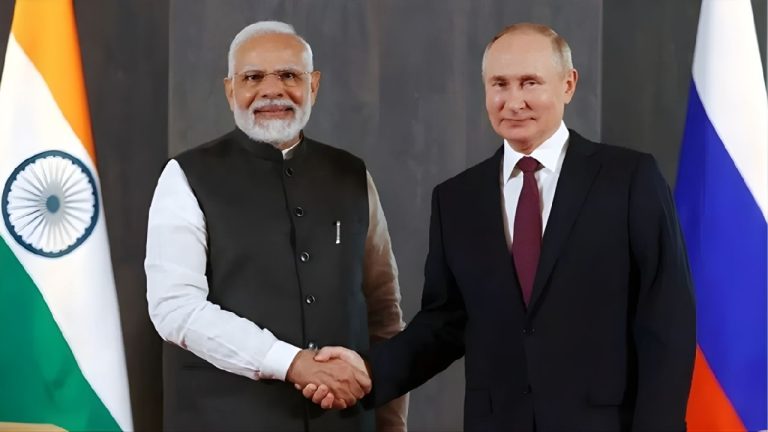
American foreign policy toward New Delhi exemplifies how punitive approaches toward crucial partners generate precisely the outcomes they aim to prevent. As Putin received ceremonial welcome at Rashtrapati Bhavan with full honors during his December 2025 visit—his first to India since Ukraine’s invasion—Washington confronted uncomfortable reality: economic coercion strengthens the very relationships American strategy seeks to undermine.
Tariff Warfare Undermines Indo-Pacific Strategic Architecture
Trump administration imposed 50% total tariffs on Indian goods through stacked levies—initial 25% plus additional 25% penalty specifically targeting Russian oil purchases. This executive order cited “national emergency” stemming from Russia’s Ukraine actions as justification for targeting India’s energy security decisions.
The economic impact proves substantial. Indian government estimates place affected exports at $48.2 billion, representing significant portion of bilateral trade that totaled $87 billion in US imports from India in 2024. American tariffs on Indian goods now exceed those applied to Chinese exports—extraordinary reversal given Washington’s stated priority of Chinese containment requiring robust Indian partnership.
This approach contradicts foundational strategic logic. India-Russia bilateral trade expanded from $10 billion pre-pandemic to nearly $69 billion in fiscal 2025, primarily through discounted Russian crude enabling India to maintain energy security amid global price volatility. Both countries target $100 billion trade by 2030, with Putin promising “uninterrupted shipments of fuel for the fast growing Indian economy.”
Washington’s calculation appears straightforward: pressure India to sacrifice economic interests for distant conflict alignment. Yet this ignores asymmetric dependencies. US goods trade deficit with India nearly doubled since Trump’s first term as both countries roughly doubled imported goods volumes—integration that tariffs now jeopardize through self-inflicted damage to American commercial interests.
Strategic Partnership Rhetoric Contradicts Policy Implementation
American officials consistently characterize India as indispensable Indo-Pacific partner. India conducts more military exercises with the US than any other country, while Washington emerged as India’s largest trading partner. This operational integration developed through successive administrations recognizing India’s unique capacity—population size, geographical positioning, military capabilities including nuclear deterrence—necessary for balancing Chinese regional ambitions.
Yet policy implementation undermines stated priorities. Biden administration helped Pakistan secure IMF bailout in 2022, then approved $450 million to modernize Pakistan’s F-16 fleet—reviving bitter Indian memories of American arms flowing to adversaries during Cold War confrontations. Trump intensified Pakistani embrace through lucrative cryptocurrency agreements, signals reinforcing perceptions of American unreliability.
The chaotic Afghanistan withdrawal crystallized concerns about American judgment and commitment. Washington effectively handed Afghanistan to Taliban terrorists through Biden’s execution of Trump’s negotiated deal, abandoning regional partners while creating sanctuary for extremist groups threatening Indian security. This pattern—treating Indian interests as peripheral while expecting unconditional loyalty on distant conflicts—generates precisely the hedging behavior American strategy seeks to prevent.
Putin’s ceremonial reception featured Modi personally greeting him at the airport with hugs and limousine selfies, symbolizing relationship depth transcending temporary Western pressure. Streets lined with Russian and Indian flags, towering billboards welcoming Putin, and Putin’s flight becoming most-tracked on FlightRadar during arrival demonstrated public support for defiant positioning against American economic warfare.
Selective Sanctions Enforcement Exposes Contradictory Standards
Washington’s punitive approach toward India appears particularly arbitrary when examining broader enforcement patterns. Trump granted sanctions exemptions to Hungary despite Prime Minister Viktor Orbán’s close alignment with Moscow, while sparing other major Russian energy importers from similar penalties. US allies including Israel and Turkey similarly refused sanctions compliance without facing equivalent economic warfare.
Putin questioned this selective application directly, noting that “the United States itself still buys nuclear fuel from us for its own nuclear power plants. If the US has the right to buy our fuel, why shouldn’t India have the same privilege?” This observation highlights fundamental inconsistency: Washington continues purchasing Russian uranium for American nuclear reactors while punishing India for pursuing similar energy security imperatives.
Indian Ministry of External Affairs characterized American actions as targeting India “for importing oil from Russia after the commencement of the Ukraine conflict” while noting “the very nations criticizing India are themselves indulging in trade with Russia.” Ministry statements emphasized that “unlike our case, such trade is not even a vital national compulsion” for Western nations—contrasting European economic choices with Indian requirements for supplying 1.4 billion citizens’ energy needs.
This double standard undermines American credibility while strengthening Indian resolve. India’s statement condemned tariffs as “unfair, unjustified and unreasonable” while warning “India will take all actions necessary to protect its national interests.” Such language signals not compliance but determination to resist what New Delhi perceives as illegitimate economic coercion.
Unintended Consequences: Strengthening Sino-Russian Coordination
American sanctions strategy produces outcomes opposite stated objectives. When Trump reimposed harsh Iran sanctions in 2019, India lost cheap reliable energy sources while China seized opportunities for discounted Iranian crude and expanded security presence. Similar dynamics followed Russia’s Ukraine invasion: Western sanctions effectively turned China into Russia’s economic lifeline, enabling Beijing to strengthen overland energy routes ensuring continued access even during potential Taiwan contingencies.
China now knows that even military moves against Taiwan won’t cost Russian energy access—directly undermining American deterrence objectives in East Asia. This pattern demonstrates how isolating Russia from Western markets consolidates Sino-Russian strategic coordination rather than weakening Moscow’s international position.
India adapted by also purchasing discounted Russian oil, partially offsetting strategic disadvantages created by deepened Sino-Russian ties. Yet American tariff warfare now constrains even this hedging strategy. Indian companies cut Russian oil purchases to lowest levels in three years following October 2025 American sanctions on major Russian producers—demonstrating Washington’s capacity to inflict economic pain while failing to generate strategic compliance.
Russia-China-India trilateral dynamics remain complex, with New Delhi increasingly concerned about Russian dependence on Chinese components for military systems India traditionally purchased from Moscow. Over 50% of India’s in-service military platforms remain Russian-origin, though Russian arms imports dropped from 72% of India’s total in 2010-14 to 36% by 2020-24 as New Delhi diversified suppliers and expanded domestic production.
Defense Cooperation Faces American Pressure Despite Strategic Logic
The 23rd India-Russia annual summit focused heavily on defense deals New Delhi considers vital following May 2025’s brief but intense conflict with Pakistan. India has not placed major defense orders from Russia since Ukraine war began, partly due to Moscow prioritizing own military needs causing delivery delays for systems like S-400 air defense platforms.
Yet Indian analysts emphasized that “New Delhi is wary of upsetting Washington regarding its defence deals with Moscow, but that’s not going to deter it from making important deals”. This hedging reflects calculated risk assessment: American reliability questions persist despite operational military cooperation expansion.
Modi and Putin signed agreements covering jobs mobility, healthcare, shipping and chemicals alongside defense discussions. Business leaders from multiple sectors attended ceremonies though major commercial deals remained unsigned—suggesting Delhi’s caution about provoking further American economic warfare.
The strategic calculation becomes transparent: India hopes to “blunt US criticism by making similar deals” with Washington, including increased American LNG purchases and energy diversification. India recently agreed to purchase 2.2 million metric tons of liquified petroleum gas from US sources, attempting accommodation without sacrificing core Russian partnerships.
Diplomatic Messaging Transcends Bilateral Economic Cooperation
Harsh Pant from Observer Research Foundation characterized the summit’s primary significance as political messaging: “The biggest takeaway from the summit is the signalling that neither side has any intention to dilute this relationship, and is ready to withstand any external pressure.”
Modi praised bilateral relations as “steadfast like a pole star” while Putin expressed appreciation for India “resisting external pressure” and investing in shared partnership. Kanti Bajpai from Ashoka University noted that rolling out red carpets for Putin signals to both West and China that India “has options”—diplomatic hedging providing “a bit more bargaining room” with Washington and Beijing.
The visit provided Putin enormous global attention amid International Criminal Court arrest warrants restricting his travel. Experts emphasized that Putin’s message targets world leaders amid growing pressure for Ukraine peace negotiations: “Moscow is not alone, and the efforts to isolate the Kremlin have failed.”
This diplomatic theater matters precisely because substance remains limited. Russia and India held annual bilateral summits since 2000—Indian prime minister visits Moscow one year, Russian president returns visit the following year. This tradition broke in 2022 following Ukraine invasion, resuming only in 2024 when Modi traveled to Russia. Restoring regular summit pattern signals normalization despite Western isolation campaigns.
American Needs Indian Partnership More Than Reverse
Washington confronts asymmetric strategic dependencies despite superior economic scale. India remains the only country with population size, geographical position, and military capabilities necessary to challenge China’s Asian dominance efforts and contest Beijing’s potential supplanting of American global hegemony. No alternative partner offers comparable capacity for balancing Chinese power across multiple dimensions.
This reality suggests US needs India more than India needs US—uncomfortable acknowledgment for Washington but accurate strategic assessment. India can diversify partnerships through strengthened Russian ties, expanded Chinese engagement despite border tensions, and autonomous regional positioning. American capacity for Chinese containment without robust Indian partnership proves far more constrained.
Former Indian Foreign Secretary Kanwal Sibal highlighted perceived double standards: “Trump can roll out a red carpet for Putin in Alaska. Why should India not build on its ties with Russia then?”—referencing Trump-Putin summit positioning. Such observations reflect broader Indian frustration with American inconsistency demanding sacrifices Washington refuses making itself.
Modi’s strong public support domestically for Putin engagement provides political cover for defiance of American pressure. Many Indians view Putin’s visit as welcome defiance against unrelenting Trump administration pressure that upset Indian public for months. This domestic political calculus matters: democratic accountability constrains Modi’s capacity for accepting American demands perceived as undermining Indian sovereignty and economic interests.
Reconstructing Partnership Through Mutual Respect
American strategic success requires abandoning coercive approaches favoring engagement as equals. Treating alliances as service contracts rather than strategic investments undermines precisely the partnerships American power depends upon. India maintains what observers characterize as “soft alliance”—flexible interest-driven cooperation without formal treaty obligations or unconditional commitments.
This arrangement serves mutual interests when Washington respects Indian autonomy regarding decisions affecting 1.4 billion citizens’ welfare. Energy security represents such core interest. India’s imports based on market factors with overall objective of ensuring energy security cannot be sacrificed for distant conflicts where American strategy failed preventing escalation while excluding European partners from resolution negotiations.
Rebuilding requires Washington engaging India as it exists—sovereign democracy making independent choices based on national interests—rather than as American policymakers wish it to be. This means accepting that India charts its own course in international affairs rather than choosing sides in widening rifts between “West and rest.” Non-alignment served Indian interests during Cold War; strategic autonomy serves contemporary requirements amid multipolar competition.
Trump’s foreign policy remains particularly erratic but underlying patterns span multiple administrations—treating Indian interests as peripheral while expecting service as Indo-Pacific strategy pillar. This contradiction produces increasingly embittered and mistrustful India accelerating self-reliance and strengthening ties with alternative partners, beginning with Russia but potentially extending toward accommodation with China despite border disputes.
Conclusion: Coercion Generates Estrangement, Not Compliance
Putin’s New Delhi reception represents more than ceremonial diplomacy—it signals strategic reorientation driven by American policy failures. Washington’s attempt forcing Indian compliance through economic warfare achieves opposite outcomes: strengthening Russian partnerships, potentially accelerating Sino-Indian détente, and undermining American capacity for effective Chinese containment.
The choice facing Washington remains straightforward: continue punitive approaches generating cyclical disappointment and strategic setbacks, or reconstruct partnerships through mutual respect recognizing that genuine allies require accommodation of core interests. Coercion and inconsistency constitute sure path to estrangement precisely when American strategy most requires reliable partners balancing revisionist Chinese ambitions.
The fundamental question persists: can Washington adapt strategic approaches recognizing changed global power distributions, or will bureaucratic inertia and political expediency continue undermining partnerships American security architecture depends upon? Flexible, interest-driven soft alliance with India remains one of America’s few credible means of balancing China’s aggressive rise—yet current policy systematically erodes this critical relationship.
Modi’s warm Putin reception delivers unmistakable message: India refuses subordination to American preferences when they contradict Indian interests. Whether Washington internalizes this lesson or persists in counterproductive coercion will determine not just bilateral relationship trajectories but broader Indo-Pacific strategic outcomes for decades ahead. For now, American policy pushes crucial partners toward precisely the adversarial alignments containment strategy aims preventing—strategic own-goal of remarkable consistency across administrations supposedly pursuing opposite approaches.
Original analysis inspired by Brahma Chellaney from Project Syndicate. Additional research and verification conducted through multiple sources.