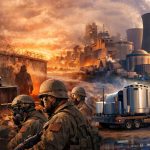
At 2:01 a.m. on January 3, 2026, American helicopters touched down inside the largest military complex in Venezuela. Thirty minutes later, Nicolás Maduro and his wife Cilia Flores were airborne, heading for a US aircraft carrier. Special operations forces from multiple service branches and more than 150 military aircraft were involved in what Washington called Operation Absolute Resolve — the first time a sitting head of state had been seized by foreign military force since the fall of Panama’s Manuel Noriega thirty-six years earlier, on the same calendar date. More than 100 people were killed during the operation, which Trump described as “perfectly executed.”
The raid was a tactical triumph. It was also, according to a wide spectrum of international legal scholars, a violation of the bedrock rule that separates the international order from anarchy. A fresh analysis from India’s Observer Research Foundation argues the operation reveals something broader and more troubling — not an aberration of Trump’s foreign policy, but its purest expression: legal engineering, selective institutional engagement, and calculated indifference to international norms.
The Legal Architecture of a “Judicial Extraction”
The administration’s framework rested on a single document: a memo from the Office of Legal Counsel, drafted by Assistant Attorney General T. Elliot Gaiser. The memo reasoned that the president had “inherent constitutional authority” to deploy military forces to back an FBI arrest overseas, even if it violated international treaties. Gaiser drew heavily on a 1989 OLC opinion that preceded the Noriega operation, treating that memo as settled law and focusing his analysis on whether congressional authorization was needed. He took the earlier memo as a given and concluded, in both cases, the answer was no.
The internal contradictions were striking. Legal analysts noted that Gaiser states unequivocally that “the proposed operation will constitute an armed conflict under international law,” citing Article 2(4) of the UN Charter. Yet three paragraphs later, the memo reverses itself, claiming no definitive conclusion had been reached about how international law would apply. Yale Law professor Oona Hathaway and Professor Harold Koh both denounced the operation. Koh called it “a new low,” emphasizing it was “an act of war conducted without the proper congressional authorization and primarily driven by a desire for oil.”
The administration’s legal strategy operated on multiple layers simultaneously. By designating Maduro as the leader of the Cartel de los Soles — a group the Justice Department itself has since acknowledged may never have existed as described — Washington stripped him of diplomatic immunity. By framing the operation as a “judicial extraction” rather than an invasion, it sidestepped the Geneva Convention’s prisoner-of-war protections. Maduro told the Manhattan court at his arraignment: “I am the president of Venezuela, I consider myself a prisoner of war. I was captured at my home in Caracas.”
The Structural Trap of International Law
The ORF analysis makes a sharp structural point that goes beyond the specifics of Venezuela. The international system is designed in a way that makes accountability for great-power violations nearly impossible. If Venezuela were to file a state-to-state complaint before the International Court of Justice, the US would reject jurisdiction — as it has since withdrawing from the ICJ’s compulsory jurisdiction in 1986 after losing the Nicaragua case. Even if Venezuela obtained a favorable ruling, enforcement would require recourse to the UN Security Council, where the US holds a veto. The operation is “clearly a violation of the prohibition on the use of force in Article 2(4) of the UN Charter,” which is “the bedrock rule of the international system that separates the rule of law from anarchy.” The consequences of “flouting this rule so brazenly are likely to extend well beyond the case of Maduro’s forcible ouster.”
At the emergency Security Council session on January 5, China and Russia called for the immediate release of Maduro while the US representative rejected characterizations of US actions as military aggression, describing the operation as a targeted law enforcement measure. It was South Africa, as the ORF analysis highlights, that articulated the specific charter violations most precisely — positioning itself, as it did with the ICJ genocide case against Israel, as a voice of legal principle with no enforcement power behind it.
The ICC presents another dead end. In October 2025, the ICC Office of the Prosecutor declared that Venezuela had made “no meaningful progress” in its own domestic investigations. A sealed warrant for Maduro may already exist. But the crime of aggression — which the US operation could qualify as — cannot be prosecuted by the ICC when committed by nationals of a non-state party. The ICC is barred from exercising jurisdiction over the crime of aggression when committed by a non-state party’s nationals. Unless the Security Council refers the situation — a move subject to a US veto — “there is no legal mechanism to hold the US accountable.”
Oil, the “Donroe Doctrine,” and What Comes Next
Whatever the legal framing, the material objectives were never hidden. Trump characterized the action as an application of the Monroe Doctrine, which he styled as the “Donroe Doctrine,” and added that “American dominance in the western hemisphere will never be questioned again.” Trump and his administration made clear that access to Venezuelan oil was a core reason for the action, and the United States announced a 50-million-barrel oil supply deal with the remaining government. According to US Secretary of Energy Chris Wright, who visited Venezuela in February, oil sales have already reached over $1 billion since Maduro’s capture, with about $5 billion expected in the coming months.
The CSIS assessment was blunt: a military victory with no viable endgame. Maduro’s officials, including his vice president, remain in charge of Venezuela. The Trump administration proposes to work through these officials, not through the Venezuelan opposition. This will likely fail, requiring additional air and missile strikes. Senator Mark Warner captured the precedent question most succinctly: “Does this mean any large country can indict the ruler of a smaller adjacent country and take that person out?”
That question now echoes from Bogotá to Beijing. When asked whether military intervention similar to Venezuela was on the cards for Colombia, Trump said, “It sounds good to me.” The ORF analysis argues that the deliberate disorder of the Trump administration’s approach is not a glitch but a system — one that exploits the structural asymmetries of global governance to achieve fait accompli outcomes that no international institution can reverse. Whether one views this as a Trump-specific phenomenon or part of a broader shift in American statecraft, the disruptions it generates will outlast the administration that produced them.
Original analysis inspired by Lavanya Mani from Observer Research Foundation. Additional research and verification conducted through multiple sources.
By ThinkTanksMonitor