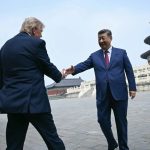
The post-Cold War fantasy of a globally integrated, rules-based international system is dissolving. In its place, the world is reorganizing into competing regional spheres, each dominated by a major power seeking to consolidate control over its immediate neighborhood. This shift reflects not merely ambitious leadership, but structural constraints that limit each power’s ability to project influence beyond its geographic core.
Major powers face an elementary geographical challenge: influence decays with distance. Maintaining authority over proximate territories—neighbors sharing land borders, adjacent seas, or regional cultural-economic networks—requires less expenditure of resources than projecting power across oceans and continents. Russia can sustain Belarus through energy dependencies more cheaply than competing for influence in Southeast Asia. China can leverage trade relationships with immediate neighbors at a fraction of the cost required for distant Pacific operations.
This basic logic explains why, despite variations in rhetoric and style, both Democratic and Republican U.S. administrations pursue similar objectives in the Americas: reducing drug trafficking, constraining irregular migration, and preventing rival powers from establishing footholds. President Barack Obama accomplished these goals through quiet institutional cooperation and diplomatic partnership framing; Trump relies on public coercion and tariff threats. The underlying agenda—maximizing American leverage over neighboring states—remains constant regardless of administration.
Russia’s Ruinous Regional Dominance
Russia’s strategy toward its neighbors has centered on territorial control, economic leverage, and military intimidation. Belarus, bound to Russia through energy dependence and security integration, has effectively surrendered sovereignty without formal annexation. Separatist enclaves in Moldova and Georgia, backed by Russian military presence, prevent these states from fully integrating with Western institutions. The 2014 annexation of Crimea and the subsequent full-scale invasion of Ukraine exemplify Moscow’s willingness to use direct military force.
However, the costs have proven extraordinary. An estimated 400,000 Russian casualties—killed and wounded—have been inflicted for territorial gains of less than one percent of Ukraine’s surface area. The Russian economy, already burdened by sanctions, is stagnating at growth rates of 0.6-0.8 percent annually—levels unseen outside recession periods since the Soviet collapse. Military expenditures, estimated at approximately two trillion dollars over the conflict’s duration, are consuming resources that could modernize Russia’s deteriorating infrastructure and education systems.
Despite these costs, Russia shows no signs of abandoning its regional ambitions. The Kremlin views its sphere of influence as non-negotiable to national security. However, the trajectory suggests that Russia’s capacity to expand or even maintain regional dominance faces hard physical limits.
China’s Economic Leverage and Mounting Vulnerabilities
China exercises regional influence primarily through economic mechanisms rather than military coercion. The Belt and Road Initiative, launched in 2013 as an ambitious infrastructure financing scheme, deployed Chinese capital to build ports, railways, and energy projects across Asia, Africa, and Latin America. Strategic benefits were implicit: nations indebted to Beijing and dependent on Chinese technology would align with Chinese interests.
Cambodia, heavily reliant on Chinese investment and trade, repeatedly blocked ASEAN statements criticizing Chinese maneuvers in the South China Sea. Greece, after Chinese state-owned shipping firm COSCO acquired a controlling stake in Piraeus port, vetoed EU statements critical of China at the UN Human Rights Council. These examples demonstrate China’s capacity to convert economic leverage into geopolitical gain.
However, the BRI model has encountered severe difficulties. An estimated eighty percent of China’s government loans to developing nations have gone to countries now experiencing debt distress. Projects frequently underperform economically, leaving borrowers unable to service obligations or generate revenues sufficient to justify the original investments. China, facing demographic decline, slowing growth, and structural economic weaknesses, has begun restructuring rather than expanding BRI lending, signaling recognition that global capital export at this scale is unsustainable.
The United States’ Americas Pivot and Alliance Management
The Trump administration’s recent assertiveness regarding Greenland, Canada, and the Panama Canal has been portrayed as unprecedented disruption. In reality, it reflects the logic described above: the U.S. seeks to maximize operational autonomy in its regional sphere while denying rivals access to strategically significant locations. The U.S. explored purchasing Greenland in the 19th century, occupied it during World War II, offered to buy it in 1946, and maintained continuous military presence afterward. Arctic strategic value has increased as climate change opens new sea routes and geopolitical competition intensifies.
The U.S. also faces structural constraints that drive regional assertiveness. Seven million migrant encounters occurred at the U.S. border during 2021-2024; approximately eighty-six percent of heroin and ninety-three percent of cocaine consumed in the United States enter from Mexico. Domestic solutions—reducing drug consumption through treatment and prevention, eliminating poverty and violence in origin countries—are expensive, long-term, and uncertain. Pressuring neighbors to constrain migration and drug trafficking offers more immediate, visible policy outcomes.
Different U.S. administrations have pursued these objectives using distinct rhetorical frameworks and diplomatic styles. Obama emphasized partnership and institutional cooperation; Trump employs confrontation and threat. The underlying structural imperative—shaping neighbors’ policies to serve American interests—remains constant.
Spheres of Influence Without Clear Boundaries
The three-power structure (U.S., China, Russia) competing for regional hegemony is neither unique to Trump nor irrational, despite criticism portraying it as crude or absurd. It reflects how geography, power, and constraints interact. Each major power seeks to maximize control over its immediate neighborhood precisely because constraints increase exponentially with distance.
However, this regional competition creates risks. Spheres of influence without clear, agreed boundaries generate friction and miscalculation. Middle powers—Finland, Poland, Vietnam, India—find themselves pressured to choose alignment while seeking maximum autonomy. The absence of clear rules increases uncertainty and raises the potential for conflicts escalating beyond intended limits.
Conclusion: The Limits of Regional Dominance
Structural forces, not individual personalities, drive the reassertion of regional spheres. Russia’s expansion has proven ruinously expensive without decisive victory. China faces mounting domestic constraints that limit its capacity for global capital export. The United States increasingly recognizes that hemispheric dominance requires functional alliances rather than coercion alone.
Recognizing these structural limits creates space for compromise. Great powers may negotiate accepted spheres of influence, reducing the competition and friction that characterized the Cold War. Alternatively, if powers continue seeking expansion without acknowledging constraints, regional conflicts risk escalating into wider confrontations. The trajectory depends not on individual leaders’ preferences, but on whether structural incentives toward regional consolidation can accommodate simultaneous recognition of mutual constraints.
Original analysis by Nancy Qian, Project Syndicate (February 2026). Restructured and expanded by ThinkTanksMonitor.