The geopolitical landscape across the eastern Mediterranean basin is undergoing a profound transformation. What began as an energy-focused partnership among three democracies—Israel, Greece, and Cyprus—has rapidly evolved into an operational military architecture with significant implications for transatlantic security, Gulf cooperation, and the broader balance of power in a contested region. Fueled by wartime lessons, major arms transactions, and escalating tensions with Ankara, this emerging defense bloc is now the most consequential strategic realignment in the basin since the end of the Cold War.
Wartime Catalysts and the Mediterranean Battlespace
The multi-front conflict that consumed the eastern Mediterranean between 2023 and 2025 shattered a longstanding assumption: that military confrontations in the Middle East could be geographically contained. Iranian proxies—including Hezbollah, the Houthis, and militia groups operating from Iraq—exploited Mediterranean maritime and airspace corridors to route attack drones toward Israeli territory, deliberately circumventing land-based detection grids. While most of these platforms were neutralized before impact, the pattern confirmed that the sea separating Europe from the Levant now functions as an active theater of operations rather than a buffer zone.
Athens and Nicosia absorbed this reality firsthand. Both governments accepted substantial political exposure when Israeli civilian aircraft were relocated to Greek and Cypriot airports ahead of major military operations, and allied logistics passed through their infrastructure during active hostilities. Far from a symbolic gesture, this coordination embedded real risk-sharing into the trilateral relationship and provided tangible evidence that joint planning could produce operational dividends under pressure.
Israel’s combat performance throughout the conflict further reinforced its credentials as a basin-wide security provider. An unprecedented air campaign sustained freedom of action across multiple fronts without a single manned aircraft loss, while missile and drone interception rates remained remarkably high during sustained barrages. These results reverberated among southeastern European capitals, catalyzing a wave of defense procurement decisions that had been under consideration for years but lacked urgency.
Arms Acquisitions Anchoring the Trilateral Architecture
The shift from diplomatic communiqués to hardware deliveries marks the most tangible indicator of deepening integration. Nicosia completed its acquisition of the Barak MX air defense platform from Israel Aerospace Industries in late 2024, giving Cyprus its first modern multi-layered intercept capability—a system capable of engaging aircraft, cruise missiles, and drones at ranges exceeding 150 kilometers. Turkey’s reaction was immediate, with Ankara characterizing the procurement as destabilizing to the island’s fragile status quo.
Greece has pursued an even more ambitious path. In December 2025, the Hellenic Parliament approved the purchase of LORA precision-guided ballistic missiles for deployment on Aegean islands and along the northeastern border, adding a deep-strike deterrent layer to Greek defenses. Simultaneously, Athens is negotiating the centerpiece of its modernization effort: the Achilles Shield program, a multi-tier air and missile defense umbrella estimated at approximately $3.5 billion and built around Israeli-developed Barak MX and David’s Sling technologies. When operational, this system would give Greece a defensive canopy comparable in concept—though not in scale—to Israel’s own integrated air defense network.
These procurement decisions collectively transform national shopping lists into the foundation of a basin-wide defensive grid. Counter-drone interoperability, shared early-warning architectures, and common munition standards create the technical preconditions for coordinated response rather than parallel but isolated national defenses.
The Jerusalem Summit and Institutional Maturation
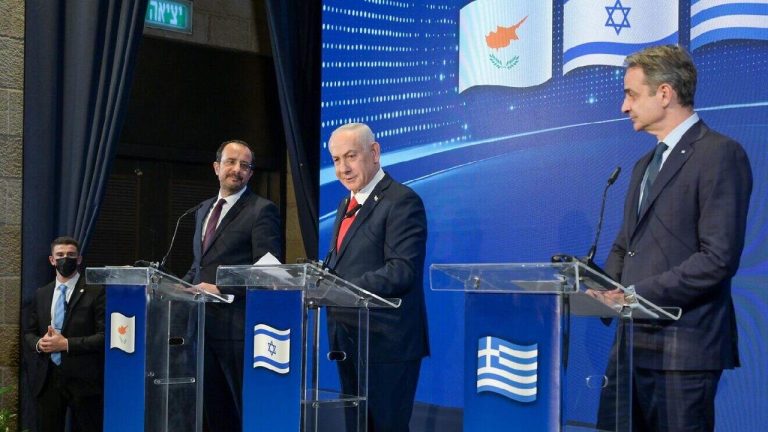
The tenth trilateral summit convened in Jerusalem on December 22, 2025, and the joint declaration issued by all three leaders signaled a fundamental departure from the partnership’s origins. Previous gatherings since the format’s inception in 2016 had prioritized natural gas exploration, pipeline development, and electricity interconnectivity as the economic scaffolding for cooperation and alternatives to Russian energy dependency. Those pillars remain relevant, but the strategic center of gravity has unmistakably shifted toward defense.
The declaration’s explicit foregrounding of security, defense, and military cooperation—combined with a joint action plan signed by senior military officials of all three countries laying out expanded air and naval exercises through 2026—represented institutional depth previously absent from the framework. Equally significant was the announcement of a Maritime Cybersecurity Center of Excellence to be headquartered in Cyprus, targeting threats to undersea cables, port infrastructure, and vessel navigation systems that underpin both commercial shipping and military logistics throughout the basin.
This maturation from periodic military drills into standing institutional structures mirrors patterns seen in other successful multilateral defense architectures. The trilateral format is beginning to resemble a regional security organization in embryonic form, complete with regularized senior-level engagement, dedicated working groups, and integrated planning cycles.
Gulf Convergence and the Euro-Mediterranean Bridge
Perhaps the most strategically consequential dimension of the evolving architecture is its potential to link Washington’s European and Gulf partners under a shared security umbrella. Multiple developments since mid-2025 point toward convergence between the eastern Mediterranean trilateral and Arab states aligned with the United States. Bahrain and Cyprus signed a landmark security agreement in November 2025 connecting their respective supreme defense and national security councils, while Greece and the UAE concluded a defense innovation pact during the same period.
Joint military exercises have accelerated this trajectory. Both Bahrain and the UAE participated in Greek-led air force drills alongside Israeli and American units, demonstrating interoperability across geographic and political boundaries that would have been unthinkable a decade ago. The UAE president’s first-ever state visit to Cyprus further underscored the expanding political bandwidth for cooperation between Gulf monarchies and EU member states in the eastern Mediterranean.
These parallel tracks—trilateral defense deepening on one hand and Gulf-Mediterranean convergence on the other—suggest the outlines of a broader U.S.-aligned architecture spanning from the Persian Gulf through the Levant to southeastern Europe. Such a framework would represent a significant strategic achievement, connecting America’s Middle Eastern and European alliance networks through a geographic corridor that has historically been under-institutionalized.
Turkish Assertiveness as a Structural Challenge
Ankara’s response to the emerging bloc has been sharp and multidimensional. The consolidation of a defense partnership among states with which Turkey maintains active territorial disputes has triggered alarm in both government circles and pro-government media. President Erdogan has framed the trilateral framework as a threat to Turkish maritime claims under the expansive Mavi Vatan or “Blue Homeland” naval doctrine, which asserts jurisdiction over vast swaths of the Aegean and eastern Mediterranean.
The most volatile friction point is Syria, where Turkish and Israeli military operations now overlap in the wake of the Assad regime’s December 2024 collapse. Ankara moved rapidly to consolidate influence in post-Assad Syria, advancing plans for air-defense-equipped positions at strategic facilities. Israel conducted preemptive strikes against several planned Turkish deployments in early 2025, precipitating urgent deconfliction channels between the two countries. Turkey’s simultaneous effort to deploy radar systems capable of tracking Israeli aircraft over Syrian airspace added another layer of tension, potentially constraining Israeli operational flexibility on critical strike corridors toward Iran.
Structural disputes predating the current crisis compound these flash points. Turkish military aircraft conducted hundreds of airspace violations over the Aegean in 2025, and fresh incursions were reported within days of the December trilateral summit, with additional violations following in early 2026. Ankara simultaneously maintains over 100,000 troops in occupied northern Cyprus while rejecting the Republic of Cyprus’s sovereignty—a posture incompatible with any genuine regional stabilization.
The F-35 Question and the Arms Transfer Dilemma
Overlaying these tensions is Ankara’s campaign to rejoin the F-35 Joint Strike Fighter program. During a January 5, 2026, call with President Trump, Erdogan pressed for Turkey’s reentry into the consortium, framing the move as essential for NATO cohesion. Turkey was removed from the program in 2019 after acquiring Russia’s S-400 air defense system, a decision that triggered sanctions under CAATSA and generated one of the most significant intra-alliance disputes in recent NATO history.
Restoring Turkish access to the F-35 would fundamentally alter capability balances across the basin. Israel already operates the platform, and Greece is scheduled to receive deliveries beginning in 2028. Adding Turkey—which has simultaneously escalated pressure against both countries and their Cypriot partner—would provide Ankara with a fifth-generation power-projection tool without the behavioral moderation that proponents of engagement have long predicted. The 2024 sale of upgraded F-16s to Turkey was followed not by diplomatic restraint but by intensified coercive signaling toward Greece and Cyprus, undermining the theoretical logic of arms transfers as stabilizing instruments.
Any congressional or executive action on F-35 reentry should therefore incorporate enforceable conditionality: cessation of support for designated organizations, normalization of relations with Israel, termination of systematic airspace violations over Greece, and verifiable steps toward reducing military pressure on Cyprus. Without such benchmarks, restoring access to America’s most advanced combat aircraft risks subsidizing the very revisionism that the trilateral framework was built to counter.
Washington’s Missing Role and the Path Forward
The statutory foundation for American participation already exists. The Eastern Mediterranean Security and Energy Partnership Act of 2019 established the 3+1 dialogue format, affirmed the security of Greece, Cyprus, and Israel as critical to U.S. and European interests, authorized military training programs and arms sales to Cyprus, and expressed congressional opposition to actions warranting CAATSA enforcement. Yet despite this legislative mandate, American engagement has remained episodic—a succession of ad hoc summits rather than institutionalized participation in a framework that already advances core U.S. strategic objectives.
Formalizing Washington’s role would require relatively modest bureaucratic investments with outsized returns: establishing a standing coordinating committee at the assistant-secretary level, designating a U.S. coordinator for eastern Mediterranean security, and integrating American participation into the trilateral exercise calendar and working groups on counter-drone defense, maritime domain awareness, and energy infrastructure protection. Positioning Cyprus as a forward logistics and intelligence node for allied operations would further anchor American presence in the basin without requiring new basing agreements.
The eastern Mediterranean’s democratic defense architecture is advancing with or without Washington. The question is whether the United States will shape a framework that already serves its interests or remain a bystander as three of its closest partners build the region’s security future independently. Given the convergence of European, Gulf, and Levantine security dynamics in this narrow maritime corridor, the cost of continued passivity far exceeds the modest investment required for meaningful leadership.
Original analysis inspired by Blaise Misztal, Yoni Tobin, and Jonah Brody from JINSA (Jewish Institute for National Security of America). Additional research and verification conducted through multiple sources.