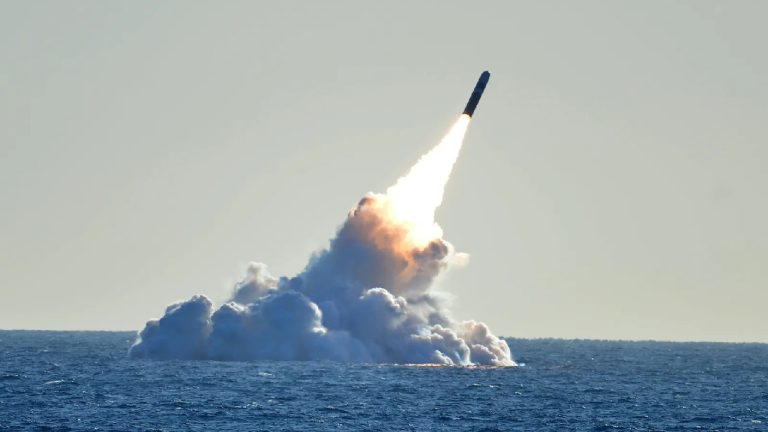
The nightmare scenario is no longer confined to fiction. Kathryn Bigelow’s 2025 Netflix thriller A House of Dynamite dramatized what defense planners have long feared: an unattributed ballistic missile streaking toward the American homeland while decision-makers scramble for clarity under impossible time constraints. Yet the film’s most troubling implication may not be the missile itself but the strategic gap it exposes — a defense architecture that treats intercontinental threats as exclusively an American problem, even when they originate in waters patrolled by capable allied navies.
The Unique Instability of Submarine-Launched Threats
Ballistic missiles fired from submarines present fundamentally different challenges than those launched from fixed or mobile sites on land. When a missile rises from a known territorial launch point, satellite-based infrared sensors and ground radar stations can rapidly establish its origin, trajectory, and probable target. A submarine launch from the Sea of Japan or adjacent waters, however, introduces profound ambiguity at every stage. The firing position is uncertain, early-warning detection may be delayed by seconds or minutes that matter enormously, and a reliable trajectory solution may not materialize until well after the boost phase has ended.
This compression of timelines has direct consequences for political decision-making. When attribution is unclear — was the launch authorized by Pyongyang, or could it involve another actor? — the options facing a national leader narrow dangerously. North Korea’s submarine-launched ballistic missile program, while still maturing, represents exactly this kind of emerging destabilizing capability according to CSIS analysis. Pyongyang unveiled an 8,700-ton nuclear-powered ballistic missile submarine in late 2025, and its Pukguksong series of SLBMs continues to develop alongside advances in solid-fueled propulsion. The scenario depicted in A House of Dynamite — where American ground-based interceptors in Alaska represent the sole defensive option — overlooks the substantial and growing capabilities that allied forces in the western Pacific could bring to bear.
Tokyo’s Maritime Shield: Aegis Vessels and the SPY-7 Advantage
Japan’s ballistic missile defense infrastructure has evolved well beyond a supporting role in the regional security architecture. The Japan Maritime Self-Defense Force currently operates eight Aegis-equipped destroyers across its Kongō, Atago, and Maya classes, armed with SM-3 interceptors capable of engaging ballistic missiles during the midcourse phase of flight outside Earth’s atmosphere. The SM-3 Block IIA variant, jointly developed by Washington and Tokyo, demonstrated a confirmed ability to intercept an ICBM-class target during a landmark test in November 2020 — a result that elevated the system’s strategic significance far beyond regional theater defense.
More consequentially, Japan is building a dedicated missile defense backbone through its Aegis System Equipped Vessels program. These purpose-built platforms, centered on the Lockheed Martin AN/SPY-7 radar, are designed to maintain continuous ballistic missile defense patrols without pulling multi-mission destroyers from other duties. With commissioning anticipated for 2027 and 2028, the vessels will represent a permanent forward-deployed sensor and engagement layer in waters where a submarine-launched missile would first become visible to allied radars. Positioned in the Sea of Japan, these platforms could detect, track, and attempt interception during early midcourse flight — buying critical minutes for the broader alliance before any threat reaches American homeland defenses. The contribution is fundamentally geometric: forward-positioned interceptors expand the engagement envelope and create shot opportunities that simply do not exist when defense relies solely on Alaska-based ground-based interceptors located thousands of kilometers away.
Seoul’s Strategic Pivot Toward Midcourse Defense
South Korea’s missile defense posture has historically concentrated on short- and medium-range threats consistent with the immediate dangers posed by North Korea’s massive conventional and tactical missile arsenal. That framework is now undergoing a significant transformation. Seoul’s 2024 decision to procure SM-3 interceptors for integration aboard its KDX-III Batch II Aegis destroyers marks a deliberate expansion into sea-based midcourse interception — a mission that positions the Republic of Korea Navy as a meaningful participant in defending against longer-range ballistic threats, including those targeting allied territory or the American homeland.
Equipping South Korean Aegis ships with SM-3 creates what defense planners term azimuth diversity: the ability to engage incoming warheads from multiple angles and positions simultaneously. When Japanese and South Korean naval vessels operate in complementary patrol sectors, the intercept geometry becomes far more challenging for an adversary employing countermeasures or decoys. Multiple engagement attempts from different bearings reduce dependence on any single shot, transforming the defense from a binary success-or-failure gamble into a layered contest with compounding probabilities. Reporting from the Chosun Ilbo has noted challenges with procurement timelines for both SM-3 and SM-6 interceptors, underscoring that translating capability ambitions into operational readiness requires sustained investment and political commitment.
Beyond interceptors, Seoul’s pursuit of nuclear-powered attack submarines introduces an entirely different dimension of strategic value. Unlike conventional diesel-electric boats constrained by limited underwater endurance and predictable charging cycles, an SSN can maintain continuous submerged operations across vast ocean areas. The Lowy Institute has assessed that Washington’s approval of Seoul’s SSN program reflects not only bilateral defense cooperation but also recognition that persistent undersea surveillance could deny North Korean ballistic missile submarines the ability to reach firing positions undetected. This represents a denial strategy — preventing the crisis scenario from materializing rather than merely reacting once a missile is airborne.
From Sole Defender to Layered Alliance Architecture
The central strategic insight is that the current framework — where American homeland defense serves as both the first and last line against an SLBM launched from the western Pacific — is neither necessary nor optimal. The Ground-Based Midcourse Defense system at Fort Greely, Alaska, now hosts 64 interceptor silos following a Boeing-led expansion completed in early 2025, but this system was designed to address a limited threat from a rogue state, not to serve as the sole defensive layer in a complex attribution crisis. Its test record, while improving, remains imperfect — and the consequences of failure against a nuclear-armed warhead are absolute.
A trilateral layered architecture would fundamentally restructure the defensive sequence. Japanese forward-deployed vessels in the Sea of Japan would constitute the first engagement layer, attempting interception during early midcourse when the missile has cleared the atmosphere but remains relatively close to its launch point. South Korean Aegis destroyers operating in complementary sectors would provide a second engagement window from different geometries. Only if both allied layers fail would the engagement responsibility shift to American ground-based interceptors — and by that point, commanders would possess substantially more tracking data, higher attribution confidence, and greater diplomatic maneuver space. The three allies took a concrete step toward this vision when they activated real-time North Korean missile warning data sharing in December 2023, and subsequent trilateral exercises including Freedom Edge have rehearsed multi-domain coordination.
Translating Strategic Logic Into Operational Reality
The technological foundations for this layered approach largely exist or are under active development. What remains underdeveloped is the operational and institutional architecture to make it function under the extreme time pressures of an actual SLBM crisis. Trilateral missile defense exercises must move beyond general naval cooperation and explicitly rehearse ICBM-class intercept scenarios with realistic timelines. Standing patrol arrangements need to replace ad hoc deployments, ensuring that Aegis-capable vessels are consistently positioned in optimal intercept geometries rather than being surged into position only during periods of elevated tension.
Japan’s defense establishment should treat the ASEV program as the cornerstone of its regional security contribution, not a secondary procurement initiative. South Korea must invest not only in SM-3 hardware but in the training pipelines, doctrinal frameworks, and sustainment infrastructure required for persistent midcourse defense operations — a mission fundamentally different from the terminal-phase intercepts its forces have traditionally practiced. Washington, for its part, needs to enable deeper interoperability through shared fire-control data and coordinated engagement protocols that allow allied ships to participate meaningfully in homeland defense scenarios. The Camp David trilateral framework established in 2023 provides a political foundation, but institutionalizing missile defense coordination into standing military arrangements requires sustained diplomatic effort.
Alliance Design as the Decisive Variable
The scenario that A House of Dynamite portrays — a lone superpower scrambling to defend itself against an ambiguous submarine-launched threat — reflects a strategic design choice, not an inevitability. The film’s tension derives from isolation: a single nation’s defense system bearing the full weight of an existential threat with no allied contribution. The western Pacific alliance network possesses the naval platforms, sensor capabilities, and interceptor technology to distribute that burden across multiple layers and multiple nations. Whether these capabilities are integrated into a functioning defense architecture before a crisis erupts depends not on technology but on political will, alliance management, and the willingness of Tokyo and Seoul to accept expanded roles in a mission that extends beyond their immediate territorial defense. The tools exist. The question is whether the alliance will be designed to use them.
Original analysis inspired by Ju Hyung Kim from Global Security Review. Additional research and verification conducted through multiple sources.