
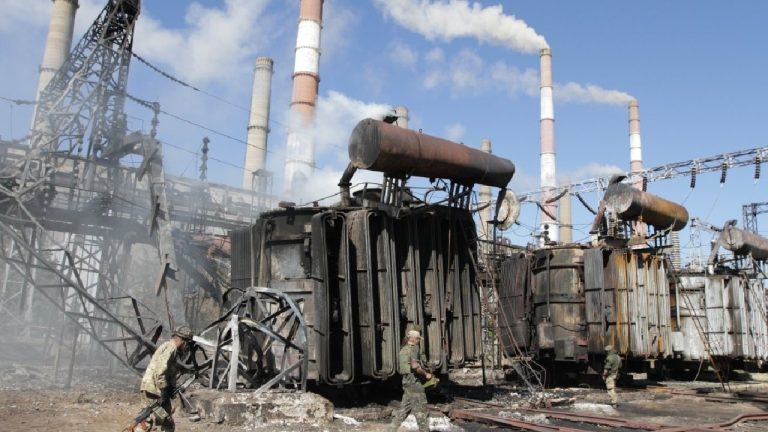
The war in Ukraine did more than redraw front lines. It stress-tested a Western deterrence model built around expectations of short wars, controllable escalation, and insulated economies—and it revealed how fragile those assumptions were once Russia chose a full-scale invasion.
The “Short War” Assumption That Shaped Early Decisions
In the run-up to February 2022, much Western planning implicitly treated Ukrainian resistance as a delaying action rather than a foundation for sustained defense. Reporting at the time captured how widely officials expected a rapid collapse, including assessments that the capital could fall within days. (Reuters) That framing mattered, because it pushes policymakers toward contingency management—evacuations, sanctions packages, refugee planning—instead of building a credible long-haul posture.
Once Ukraine held, the operational question shifted from “How do we respond to a quick defeat?” to “How do we resource a grinding, high-intensity war in Europe?” The West’s early improvisation wasn’t simply a communications problem; it reflected the absence of pre-built plans for sustained material support, continuous munitions flows, and industrial backfill at scale.
A second-order effect was psychological: when an adversary believes the coalition expects a short war, it may also believe the coalition lacks the political stamina for a long one. That credibility gap becomes a deterrence variable in its own right, because deterrence is as much about expected endurance as it is about immediate capability.
Deterrence Without Depth: When Signaling Replaced Stockpiles
Deterrence is easiest to sell politically when it is expressed as “messages” and “red lines,” and hardest when it requires sustained production capacity, procurement discipline, and readiness investments that compete with domestic spending priorities. Yet the Ukraine war revalidated a basic principle: deterrence collapses when the arsenal behind it is too shallow.
The industrial dimension is now openly discussed in official and semi-official policy ecosystems. For example, the U.S. government’s efforts to organize and expand output for Ukraine-related needs are summarized in a Congressional Research Service brief on defense production constraints, which highlights how replacing transferred inventories and expanding throughput become strategic tasks, not administrative chores. (Congress.gov) That reality is not unique to the United States; it is a coalition-wide problem of surge capacity, supply chains, and predictable multi-year contracting.
The scale of allied rearmament is also visible in alliance data. NATO regularly publishes the figures that anchor burden-sharing debates, including its defense expenditure report covering 2014–2025 estimates. (NATO) Numbers alone do not guarantee capability, but they reveal whether governments are funding the prerequisites of deterrence—training, maintenance, munitions, and modernization—rather than relying on diplomatic posture.
Independent datasets reinforce the same point. The Stockholm International Peace Research Institute’s snapshot on world military expenditure shows the breadth of spending increases and the way the war accelerated defense prioritization across Europe. (SIPRI) Even so, spending surges take time to become deployable units and replenished depots, which is exactly why the “deterrence by signaling” era proved brittle once the war became a contest of production and endurance.
Alliance Mechanics: Consensus, Escalation Ceilings, and Credibility
Western caution in 2022–2024 was often explained as prudence: avoid direct alliance–Russia confrontation, manage nuclear risk, keep unity. Those are legitimate objectives. But the war exposed a more structural issue—how coalition decision-making, escalation fears, and asymmetric risk-sharing can create a built-in ceiling on action.
Within NATO, formal decisions require unanimity, and the alliance explicitly emphasizes a process of consultations until all members can accept a result. That is described in NATO’s own explainer on consensus decision-making. (NATO) Consensus can be a strength—unity is credibility—but it also means adversaries watch for internal veto points and political hesitation, especially when members face different exposure levels to retaliation.
This interacts with the legal and political ambiguity of collective defense commitments. NATO’s public guidance on Article 5 and collective defense emphasizes solidarity while also noting that the nature of assistance is determined by each ally. (NATO) That flexibility is a feature, but it also means credibility rests on perceived willingness, not just treaty text.
The strategic answer is not to abandon consensus or inflate promises; it is to reduce the distance between declaratory policy and executable plans. NATO’s NATO updated framework for deterrence—reflected in the 2022 Strategic Concept—explicitly calls for strengthening deterrence and defense as the backbone of Article 5. (act.nato.int) The Ukraine war shows why: when deterrence depends on improvisation, adversaries learn to probe the seams between alliance rhetoric and alliance readiness.
Energy Dependence as a Deterrence Variable, Not an Economic Detail
The war also demonstrated that deterrence is not purely military. Economic resilience—especially energy supply—shapes whether governments believe they can sustain pressure on an adversary without destabilizing themselves.
Europe’s pre-war exposure was not subtle. The International Energy Agency estimated that Russian gas accounted for close to 40% of total EU gas consumption in 2021, a concentration that created obvious coercive leverage. That assessment is summarized in the IEA’s 10-point plan to reduce reliance on Russian natural gas. (IEA) When an adversary can raise your domestic energy costs, it can indirectly cap the aggressiveness of your deterrence posture.
Even after the invasion, the financial arithmetic remained uncomfortable. A widely cited estimate found that EU imports of Russian fossil fuels in 2024 exceeded the EU’s reported financial aid to Ukraine that year—an imbalance that undercuts the logic of sanctions and support. The analysis is detailed in the Centre for Research on Energy and Clean Air briefing on EU imports of Russian fossil fuels surpassing financial aid sent to Ukraine in 2024. (energyandcleanair.org) The implication is not moralistic; it is strategic: deterrence weakens when revenue streams to the adversary remain partially intact.
European policy has moved, but the lag illustrates how long it takes to reverse structural dependencies. Reuters reporting on the EU’s decision to phase out Russian gas imports by late 2027 notes that Russia once supplied over 40% of EU gas, and that the share had fallen sharply by 2025. This is captured in coverage of the EU’s gas ban timetable and its impact on supply shares. (Reuters) Yet even rapid diversification generates new dependencies—on LNG infrastructure, on alternative suppliers, and on domestic political acceptance of higher energy costs.
Energy choices also intersected with baseload reliability. Germany’s move to end nuclear power reduced one low-carbon, high-reliability source and increased the premium on gas and imports during tight periods. The German government’s own summary of the phase-out notes that the last plants shut down on 15 April 2023, which is explained in the official overview of Germany’s nuclear phase-out. (base.bund.de) From a deterrence standpoint, the key point is not the climate debate; it is that energy vulnerability can translate into political vulnerability, which then shapes strategic options.
From Improvisation to Shared Deterrence: What a Correction Looks Like
The hard lesson of Ukraine is not simply “spend more.” It is that deterrence fails when responsibility, capability, and risk are misaligned across a coalition. The corrective is regional shared deterrence: European states taking visibly larger responsibility for Europe’s conventional defense, while the United States retains decisive leadership without carrying the alliance alone.
Some building blocks already exist. When Boris Johnson signed security declarations with Sweden and Finland in May 2022, the move strengthened forward reassurance at a politically sensitive moment; the UK government described this as a step-change in cooperation in its announcement of the security declarations with Sweden and Finland. (GOV.UK) Such steps matter because deterrence is reinforced when commitments are concrete, not just procedural.
Credibility also depends on transparent accounting of who is providing what. The Kiel Institute for the World Economy provides a widely used dataset quantifying assistance flows through its Ukraine Support Tracker. (kielinstitut.de) Whether one agrees with every policy choice or not, public clarity on contributions reduces the space for adversaries to exploit alliance ambiguity.
Finally, alliance targets are shifting upward, which suggests that leaders increasingly treat deterrence as capacity, not merely intent. NATO’s updated guidance on the new spending pledge—summarized in its explainer on defense expenditures and the 5% commitment pathway—signals a move toward funding the full stack of requirements, including core defense and resilience investments. (NATO) The risk is that targets become symbolic again unless paired with industrial policies that expand production lines and shorten replenishment timelines.
Conclusion: Deterrence After Ukraine Means Capacity, Resilience, and Aligned Risk
Ukraine’s resistance disproved the idea that major war in Europe would be brief, politically containable, or economically compartmentalized. It also revealed that deterrence cannot be “performed” through rhetoric when production capacity, energy resilience, and coalition responsibility are not aligned.
The strategic correction is straightforward to describe and difficult to execute: build depth in inventories and output, harden energy sovereignty, and rebalance regional responsibility so that adversaries see not only unity, but also endurance. If that correction holds, the Ukraine war may be remembered as the moment Western deterrence assumptions were finally replaced with a model designed for reality.
Original analysis inspired by Kirk Fansher from Global Security Review. Additional research and verification conducted through multiple sources.


