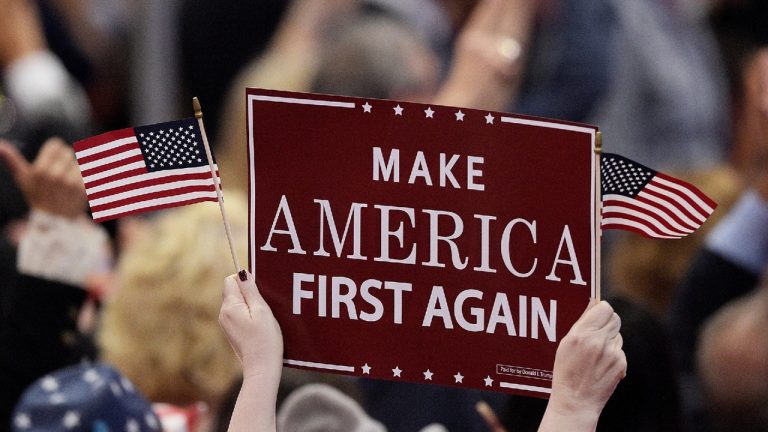
Washington’s current foreign policy presents a striking contradiction: an administration elected on promises of restraint has overseen historic military spending increases while simultaneously fracturing longstanding alliances through unprecedented economic coercion. This dissonance between campaign rhetoric and governing reality reveals fundamental tensions in contemporary American strategic thinking.
Defense Budgets Reach Historic Heights Despite Anti-Interventionist Messaging
The Trump administration’s fiscal approach contradicts its isolationist branding. Defense spending reached approximately $1 trillion for fiscal year 2026, representing a 13% increase from previous levels. This expansion includes an additional $150 billion allocated through congressional reconciliation bills intended to “fundamentally change the direction of the Pentagon.”
Such escalation raises questions about strategic priorities. Nuclear modernization alone will consume $946 billion over the next decade, while military operations continue across multiple theaters. The contradiction becomes sharper when considering that public support for reducing defense spending has reached its highest point in three years, with 40% of Americans now favoring cuts.
The budgetary trajectory suggests priorities divorced from the campaign’s core message. Rather than consolidating resources for critical challenges, Washington maintains expansive global commitments while increasing their cost. This pattern reflects not strategic discipline but institutional momentum—the persistent expansion of military capacity regardless of declared policy objectives.
Economic Warfare Against Trading Partners Undermines Security Cooperation
Washington’s trade policy has evolved into a blunt instrument wielded indiscriminately. The administration imposed 25% tariffs on Canada and Mexico under national emergency provisions, alongside 30% levies on the European Union. These measures, justified through claims about fentanyl trafficking and trade imbalances, triggered retaliatory actions from Ottawa and Brussels.
The economic logic appears flawed. Average American households face tax increases of $1,200 annually from these tariffs, while domestic industries dependent on integrated North American supply chains face disruption. Ford’s CEO warned that 25% cross-border tariffs would “blow a hole in the US industry that we have never seen”.
More critically, this approach contradicts stated security objectives. Washington demands that allies increase defense spending to 5% of GDP while simultaneously damaging their economic foundations. Germany, pressured to double military expenditures, faces tariffs that constrain fiscal capacity. The strategy resembles demanding a neighbor strengthen their fence while undermining their income.
Diplomatic Volatility Replaces Predictable Partnership Frameworks
Traditional alliance management emphasized consistency and mutual obligation. The current approach substitutes transactional calculation for institutional commitment. European allies received criticism for their governance approaches during Vice President Vance’s Munich Security Conference address, where he suggested internal threats exceeded external dangers.
This represents a fundamental reorientation. Rather than viewing alliances as force multipliers amplifying American power, Washington now treats partnerships as bilateral service contracts requiring constant renegotiation. The Trump administration’s national security strategy explicitly critiques European political systems while encouraging “patriotic European parties”—unprecedented interference in allied domestic politics.
The practical consequences manifest in policy incoherence. Washington maintains troops across Europe while questioning NATO’s value, demands burden-sharing while imposing economic penalties, and insists on collective defense while undermining collective trust. This pattern suggests not strategic innovation but the absence of strategy—foreign policy reduced to presidential instinct and domestic political calculation.
Ukraine Negotiations Expose Contradictory Objectives
Washington’s mediation efforts reveal core tensions. The leaked 28-point peace proposal called for Ukrainian territorial concessions beyond current Russian occupation, including de facto recognition of Crimea, Luhansk, and Donetsk as Russian territory. The plan demanded Ukraine withdraw from additional areas to create demilitarized buffer zones formally recognized as Russian Federation territory.
This framework contradicts decades of American policy rejecting territorial changes through force. The proposal caps Ukrainian military forces at 600,000 personnel—below current mobilization but substantially above peacetime levels—while offering NATO Article 5-style security guarantees treating future Russian attacks as threats to “transatlantic community” security.
European reactions ranged from skepticism to alarm. Observers characterized the terms as “essentially the Kremlin’s wish list” rewarding aggression with territorial gains. Yet the initiative also reflects genuine strategic questions about sustainable European security architecture. The challenge lies not in asking difficult questions but in pursuing contradictory answers simultaneously.
The Monroe Doctrine Revival and Hemispheric Ambitions
Washington’s renewed focus on the Western Hemisphere represents both continuity and departure. The administration invoked a “Trump Corollary” to the Monroe Doctrine, asserting restored American preeminence while conducting military strikes against alleged drug trafficking vessels in the Caribbean and Pacific.
This activism contradicts noninterventionist rhetoric. Rather than reducing foreign entanglements, Washington expands them closer to home. The strategy document emphasizes “targeted deployments to secure the border and defeat cartels, including where necessary the use of lethal force”—effectively endorsing military action in sovereign nations based on narcotics policy.
The approach reveals selective application of restraint principles. Operations deemed excessive when directed at Middle Eastern autocracies become acceptable when targeting Latin American cartels. This inconsistency suggests that “America First” functions less as doctrine than as rhetorical cover for preferences determined by other factors.
Realism Versus Reality: What Strategic Discipline Requires
Genuine foreign policy realism demands clear prioritization based on vital interests. First, protecting American territory and citizens from direct threats—not inflating every regional dispute into existential crisis. Second, maintaining access to global commons essential for commerce—without requiring dominance over every waterway. Third, preventing peer competitor emergence across multiple domains—suggesting focus on the most serious challenge rather than simultaneous confrontations.
Fourth, sustaining capable allied networks sharing interests in stability and open commerce. This requires treating partnerships as strategic investments yielding compound returns, not protection rackets demanding immediate payment. Effective alliances multiply power; transactional relationships at best maintain it and at worst erode it through accumulated resentment.
Current policy diverges from these principles. Washington pursues aggressive postures without strategic selection, maintains global commitments while complaining about their costs, and damages alliance structures without constructing superior alternatives. The result resembles strategic drift masked by activist rhetoric—busy without being purposeful.
Institutional Foundations of American Power Face Erosion
Power derives from multiple sources beyond military capacity and economic size. Credibility matters: allies must believe commitments will be honored. Institutional strength matters: bureaucracies must implement policy effectively. Attraction matters: others must see value in partnership beyond coercion.
These foundations face systematic degradation. Federal agencies experience dramatic restructuring, with State Department funding cut by 83.9% ($49.1 billion) while defense increases. This imbalance suggests military solutions for diplomatic problems—an expensive and often counterproductive approach.
The long-term consequences extend beyond immediate policy disputes. International systems function through accumulated trust and shared expectations. When the system’s architect behaves unpredictably, others prepare alternatives. Canadian leadership spoke of assembling “coalitions of like-minded countries” to create alternatives to American leadership, declaring the 80-year period of American economic leadership “over.”
Such statements reflect not anti-American sentiment but rational hedging against unreliable partnership. The damage accumulates gradually, then manifests suddenly when alternatives exist.
Conclusion: Branding Without Substance
The fundamental question persists: does current policy advance American interests more effectively than alternatives? Sometimes yes—questioning the value of defending territories with marginal strategic importance addresses real concerns establishment thinking has avoided. Demanding wealthy allies contribute proportionally to collective defense addresses genuine imbalances. Prioritizing economic competition over ideological crusades acknowledges multipolar realities where values-based diplomacy has limited traction.
But when policy confuses friends with enemies, pursues contradictory objectives simultaneously, and destroys institutions without building better replacements, it serves neither realism nor American interests. “America First” has become a brand applied retroactively to whatever decisions emerge from internal deliberations, not a guiding framework producing consistent strategy.
The slogan’s appeal lies precisely in suggesting clear priorities and disciplined resource allocation. The reality demonstrates something different: foreign policy driven by personal instinct and domestic political calculations more than coherent strategic framework. Americans seeking extraction from unnecessary foreign entanglements may find instead a president who enjoys exercising American power abroad—just without the traditional constraints of diplomatic protocol or strategic consistency.
That may represent change, but whether it constitutes improvement remains doubtful. Power recklessly wielded diminishes through use. Alliances treated transactionally weaken over time. International systems built over decades can be dismantled quickly but rebuilt only slowly. The question isn’t whether American can afford to be selective about global commitments—it must. The question is whether current selectivity follows strategic logic or political impulse.
Original analysis inspired by Leon Hadar from Asia Times. Additional research and verification conducted through multiple sources.