
Tag: Global Security Review

An artistic illustration showing four missiles descending towards four large, glowing orange mushroom clouds on a textured blue and gold background.

Nuclear Arms Control Faces a Pivotal Reckoning in 2026

The New START treaty’s February 2026 expiration ended the era of bilateral arms control. With China’s arsenal exceeding 600 warheads and Iran’s enrichment nearing weapons-grade, the April NPT Review Conference faces a terminal crisis. Global stability now hinges on managing hypersonic technology and AI-integrated command systems amidst total verification collapse.
Read More »
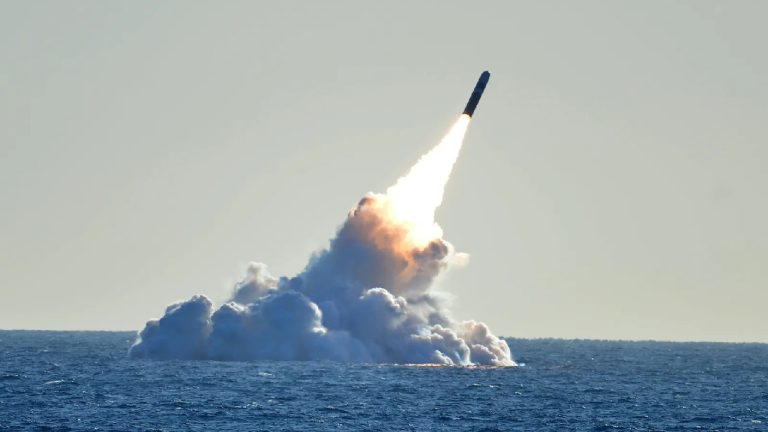
A dark missile launching vertically from the blue ocean with a large plume of white smoke and a bright fire trail at its base.

Allied Missile Defense Could Reshape East Asia’s SLBM Threat

This analysis examines how a trilateral, sea-based missile defense architecture between the U.S., Japan, and South Korea could neutralize the evolving North Korean Submarine-Launched Ballistic Missile (SLBM) threat. By moving away from the “sole defender” model depicted in the 2025 thriller A House of Dynamite, the alliance can leverage forward-deployed Aegis assets to create a layered, multi-azimuth defense that buys critical decision-making time.

Read More »
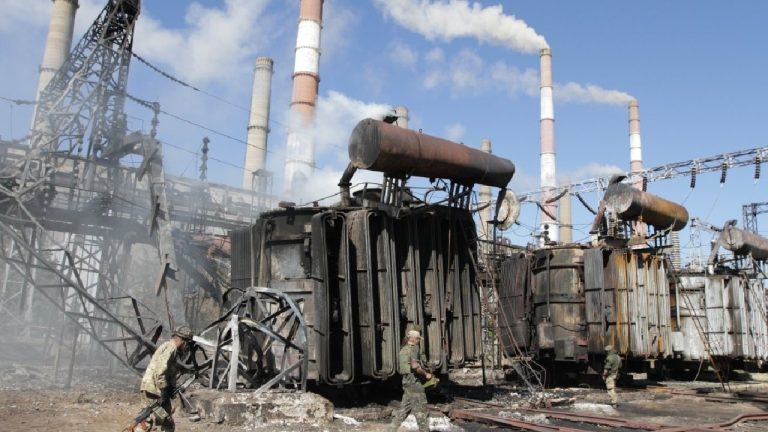
A wide shot of a heavily damaged industrial power plant in Ukraine, showing collapsed roofs, charred metal structures, and debris scattered across the site.

Ukraine War Exposed the Failure of Western Deterrence Assumptions

In January 2026, the strategic fallout from the Ukraine war has fundamentally dismantled the “post-Cold War” playbook. Western leaders now operate under a new, grimmer set of assumptions: that war is a contest of industrial stamina, not just initial tech; that economic ties can be weapons of coercion; and that “red lines” mean nothing without the munitions to back them up.

Read More »
A digital globe made of light particles next to a large grey radioactive symbol.

Digital Triggers for Nuclear Response: Cyber Warfare’s Escalation Risk

As cyberattacks increasingly target critical infrastructure and nuclear command systems, the risk of “accidental” nuclear escalation has reached a historic peak. Strategists are now debating whether to explicitly classify massive digital offensives as triggers for a nuclear response to restore deterrence in the “gray zone” of modern warfare.

Read More »
The exterior of the Association of Southeast Asian Nations (ASEAN) headquarters building with lush green landscaping and the "Symbol of Unity" monument.

Indo-Pacific Strategic Geography Challenges US Extended Deterrence Framework

The Indo-Pacific has replaced the Cold War-era European theater as the primary arena for American strategic competition, presenting unique geographic and military challenges. As China targets 2027 for regional dominance and control over Taiwan, the U.S. is rapidly adapting its alliance structures with Japan, Australia, and the Philippines to counter advanced missile threats and navigate a complex new era of nuclear deterrence.

Read More »