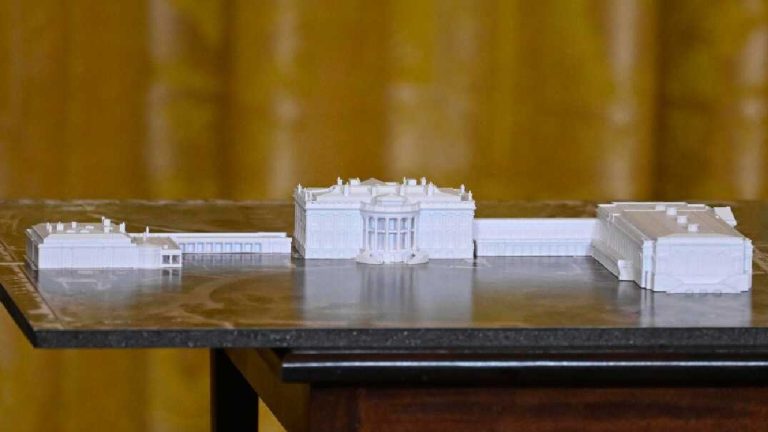
President Donald Trump’s $300 million, 90,000-square-foot ballroom construction replacing East Wing structures bypassed standard regulatory processes through White House exemption from National Historic Preservation Act. National Trust for Historic Preservation President Dr. Carol Quillen urged October 21 administration and National Park Service to “pause demolition until plans for proposed ballroom go through legally required public review processes,” noting demolition had already begun October 20. However, White House sits in regulatory loophole, “expressly exempt” from protections preventing demolition.
Seven-member US Commission of Fine Arts, which must approve ballroom design, was purged of existing members by White House in October. New members have not yet been announced, though architect James McCrery was appointed to commission by Trump during first term. Donors to construction fund include Miriam Adelson’s Family Foundation, Amazon, Apple, and Altria Group (formerly Philip Morris).
Architectural Design and Historical Context
The ballroom features coffered ceiling, arched windows, gold chandeliers, and exterior marked by at least two separate sets of Corinthian columns. However, critics characterize the 90,000-square-foot structure as fundamentally “just a box”—scale comparable to highway retail stores like Best Buy or Walmart rather than White House residence’s modest proportions where presidents have lived, worked, and socialized for centuries.
Thomas Jefferson’s vision for Washington DC emphasized classical architecture conveying both stateliness and openness of popular government. Working with French-born architect Pierre Charles L’Enfant, Jefferson developed plans for new capital including domed Congressional building echoing Rome’s Pantheon. He entered (but didn’t win) 1792 competition for president’s residence design, also topped by dome invoking self-rule notion.
Trump has inserted this idealistic public architecture vision in various texts and executive orders yet demonstrates inability practicing what he preaches. His approach treats DC not as democracy city but as empire control room bending to ruler’s will—affixing his name to every building, golf course, and property he’s developed.
Demolition History and Preservation Conflicts
Trump’s 1979 purchase of Art Deco Bonwit Teller building for $15 million, designed by Warren and Wetmore (Grand Central Terminal architects), exemplifies his preservation record. Despite promising Metropolitan Museum of Art the building’s 15-foot bas-relief sculptures of dancing women and large nickel-plated grille, Trump’s demolition crew jackhammered everything into oblivion.
A Trump “spokesman” identifying as John Baron (pseudonym often used by Trump) explained to Daily News reporter that sculptures weren’t worth saving and preservation work would have delayed construction schedule two weeks—indicating Trump’s respect for traditional architecture only extends until it obstructs his plans.
Trump’s architect Der Scutt reportedly tried persuading Trump that Fifth Avenue site called for something more sober and traditional. However, Trump insisted on bronze-colored glass skyscraper. Scutt told New York Magazine in 1980: “If Donald hasn’t built it, it’s not any good. And it has to flash to be good.”
Broader Architectural Ambitions
Beyond ballroom, Trump revived plans for National Garden of American Heroes—sculpture garden stocked Madame Tussaud-style with 250 Americans chosen by White House task force, including founding fathers whose ideas he fails to grasp. He also proposes triumphal arch at Arlington National Cemetery entrance, supposedly commemorating 250th independence anniversary.
The arch evokes tradition not of classical republicanism and democracy but of bombastic overstatement. Renderings—particularly its positioning on axis leading to Lincoln Memorial—recall Albert Speer’s Germania, Hitler’s unbuilt plan to remake Berlin with monumental Great Hall connected by broad highway to gargantuan arch.
During first Trump term, ambitious nationwide infrastructure construction program was promised but never materialized; “Infrastructure Week” became running joke. This time, Trump isn’t discussing airports, bridges, or obviously useful projects. Instead, he’s lately defunding significant infrastructure projects like new rail tunnel connecting New York City and New Jersey to punish perceived enemies.
Public Ownership and Regulatory Framework
In Washington DC, landmark buildings’ public ownership isn’t illusory—they genuinely belong to American people. White House is maintained on public behalf by National Parks Service, never exclusive property of any occupants. Normally, ballroom construction and East Wing demolition would be subject to complex regulatory process routinely involving multitude of agencies and commissions. Building or destroying publicly owned structures is generally difficult in DC.
National Trust letter emphasized: “These processes provide crucial opportunity for transparency and broad engagement—values that have guided preservation of the White House under every administration going back to public competition in 1792 that produced building’s original design.” Public process, like columns and domes, constitutes tradition—yet, like buildings, processes can be bulldozed.
The ballroom represents symbolic contrast to Statue of Liberty—emblematic not of highest ideals but of basest instincts, monument not to generosity and opportunity but to corruption and graft. It constitutes rebuke in bricks and mortar to “We the People” notion. While Washington DC has never entirely lived up to democratic vision, founders gave it their all. Trump’s gold-trim-festooned Oval Office suggests czarist theme park, while newly remodeled Lincoln Bathroom suggests plush mausoleum.
Original analysis by Karrie Jacobs from The Nation. Republished with additional research and verification by ThinkTanksMonitor.