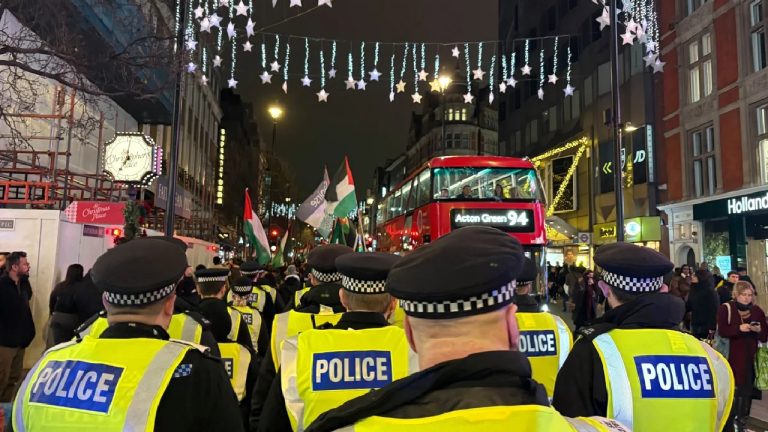
Metropolitan Police and Greater Manchester Police December 2025 announcement that protesters chanting “globalise the intifada” face arrest sparked immediate controversy over free speech rights, anti-Palestinian discrimination, and selective enforcement. Within hours of the policy declaration, London police arrested two people “who shouted slogans involving calls for intifada for racially aggravated public order offences” at a pro-Palestinian demonstration, with total arrests reaching four by evening plus a fifth person detained for obstructing officers.
The policy shift followed December 15, 2025 Bondi Beach Hanukkah festival shooting in Sydney killing 15 people, yet Australian investigators identified the attack as Islamic State-inspired, not Palestinian-organized. Despite this determination, UK Prime Minister Keir Starmer denounced the rampage as “antisemitic terrorist attack against Jewish families,” while British politicians, Israeli embassy officials, and media rushed to connect Bondi to Palestinian protest slogans without supporting evidence.
Joint Police Statement and Legal Framework
Metropolitan Police Commissioner Mark Rowley and Greater Manchester Police Chief Constable Stephen Watson declared in rare joint statement: “We know communities are concerned about placards and chants such as ‘globalise the intifada,’ and those using it at future protests or in a targeted way should expect the Met and GMP to take action. Violent acts have taken place, the context has changed – words have meaning and consequence. We will act decisively and make arrests.”
Chief Rabbi Ephraim Mirvis welcomed the announcement as “important step towards challenging the hateful rhetoric we have seen on our streets, which has inspired acts of violence and terror.” The policy followed October 2025 Yom Kippur attack on Manchester’s Heaton Park synagogue, which Mirvis linked to protest slogans.
However, existing UK criminal law already contains clear thresholds for criminalizing speech. Terrorism Act requires “encouragement of terrorism” statements likely understood as direct or indirect calls to commit terrorist offences, while Crime and Disorder Act 1998 prosecutions for racially or religiously aggravated public order offences rest on demonstrable harm, intent, and context. Crown Prosecution Service and statutory frameworks establish these tests—not discretionary police interpretations responding to lobby pressure.
Linguistic Meaning and Historical Context
“Intifada” is Arabic word meaning “shake off” or “uprising,” not Islamic terminology. Palestine Solidarity Campaign’s Ben Jamal emphasized “the Arabic word intifada means shaking off or uprising against injustice,” criticizing police for lack of consultation and stating the announcement “marks another low in the political repression of protest for Palestinian rights.”
The term gained prominence during 1987 First Intifada—Palestinian mass uprising against Israeli occupation characterized by civil disobedience, general strikes, and stone-throwing confronting heavily armed Israeli forces. The Second Intifada (2000-2005) saw increased violence including suicide bombings killing hundreds of Israelis, which Israeli government and supporters cite when characterizing all intifada references as violence incitement.
Middle East Eye analysis documented that pro-Palestine activists and civil society organizations reject characterization of the chant as antisemitic violence call, providing examples of historical usage and highlighting roles of prominent British Jewish figures in Palestinian rights movement.
Selective Enforcement and Double Standards
Journalist Asa Winstanley characterized the policy as “pure anti-Palestinian racism,” stating “‘intifada’ is simply the Arabic word for ‘uprising'” and adding “Palestinians are the only people in the world the British state says aren’t allow[ed] to revolt against occupation.”
The crackdown occurred at protests supporting eight imprisoned Palestine Action hunger strikers, whose lives were reportedly in peril. Palestine Action was proscribed as terrorist organization earlier in 2025, with Wednesday’s demonstration outside Ministry of Justice calling for ban reversal.
Crown Prosecution Service data indicates hate crime referrals and completed prosecutions rose 17% to 15,561 in year to June 2025. Chief prosecutor Lionel Idan stated CPS was “already working closely with police and communities to identify, charge and prosecute antisemitic hate crimes,” pledging to “always look at ways we can do more.”
However, critics note British citizens who materially support Israeli military operations through weapons sales, financial contributions, or political rhetoric face minimal scrutiny despite international legal questions surrounding Gaza military campaign. This selective application reinforces institutional racism charges, as authorities suppress Palestinian solidarity while tolerating actions potentially facilitating violations of international humanitarian law.
Comparative Authoritarianism and Democratic Erosion
The policy parallels Hong Kong authorities’ 2019 response to pro-democracy protests, where Chinese government branded “Liberate Hong Kong, revolution of our times” as sedition, arresting chanters and using slogan interpretation to justify broad prosecutions suffocating dissent. Foreign policy analyst Jasmine el-Gamal called UK policy “a dark, dark turn of events.”
Social media commentary warned against implications for free speech: “And it won’t stop with Palestine. The draconian legislation has already been used against striking workers and climate activists. The sight of police snatch squads violently arresting young people for allegedly using a word, should be chilling to anyone that cares about democracy.”
Banning slogans creates chilling effects making peaceful mobilization harder. Repression of protest rights saps organizations relying on open public participation while doing little deterring clandestine individuals. The predictable result is extermination of peaceful protest and further radicalization of isolated actors—outcomes democratic politicians should find deeply concerning.
Legal Standards and Accountability Mechanisms
If UK government genuinely feared street violence, evidence-based approaches would prevail: investigating British citizens traveling to fight, ceasing weapons transfers to parties accused of international crimes, and prosecuting those supporting illegal occupation, starvation, and potential genocide charges rather than criminalizing vague political speech calling for justice.
The solution requires police chiefs demonstrating how new approaches align with legal standards Parliament and Crown Prosecution Service established. Ministers must resist converting politics into security games pleasing powerful lobbies. Courts must remember criminal law is not stage for political drama.
Democracy endures through tolerating uncomfortable, even ugly, speech. Democracy withers when states decide which Arabic words are dangerous and whose voices require silencing. While violent terrorism and hatred demand eradication, law must apply fairly. Arresting people for chanting vague slogans without violence plans constitutes repression masquerading as public safety—institutionalized anti-Palestinian racism undermining principles of equal protection under law.
Original analysis by Ismail Patel from Middle East Eye. Republished with additional research and verification by ThinkTanksMonitor.