Europe faces a critical choice: pursue rhetorical independence from Washington at the moment when shared security interests demand coordinated Western response, or accept that genuine strategic autonomy requires alignment on existential threats. The escalating Iranian situation exposes the contradictions inherent in European attempts to construct separate foreign policies while remaining dependent on American security guarantees.
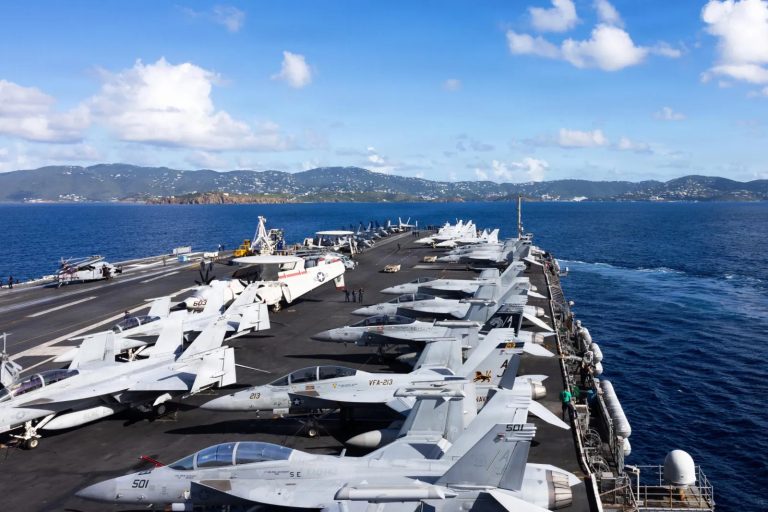
The Trump administration has issued Iran explicit demands that amount to comprehensive dismantling of Iranian strategic capacity. Complete nuclear program cessation, ballistic missile elimination, and termination of proxy support constitute near-impossible objectives for any regime dependent on these capabilities for survival. Simultaneously, multiple aircraft carriers have deployed toward the Persian Gulf, creating conditions where military escalation appears increasingly probable if negotiations fail.
The logic appears deliberate: set demands so comprehensive that Iranian rejection appears inevitable, then justify military action as response to Iranian intransigence. Whether this constitutes negotiating strategy or preparation for predetermined conflict escalation remains ambiguous—intentionally so, since ambiguity maintains pressure on Iranian decision-making.
Iran’s response pattern suggests limited willingness to compromise on core strategic assets. The Revolutionary Guard Corps views nuclear weapons and regional proxy networks not as bargaining chips but as existential security infrastructure and ideological commitments. The organization has demonstrated repeatedly that it will endure catastrophic costs to maintain strategic autonomy and regional influence.
The Ideological Dimension: When Negotiation Fails
Analyzing Iranian negotiating behavior requires understanding that the regime operates within ideological frameworks resistant to transactional compromise. Iran’s proxy strategy across the region—from Hezbollah in Lebanon to Houthi forces in Yemen—serves multiple functions simultaneously: military deterrence, ideological expansion, and regional power projection. These cannot be simply abandoned through diplomatic agreement because they constitute fundamental regime strategy.
Similarly, nuclear capability represents both practical military advantage and symbolic affirmation of Iran’s status as regional power capable of resisting external domination. The symbolic dimension matters as much as military utility—surrendering nuclear weapons would constitute admission that external pressure successfully coerced strategic retreat. Authoritarian regimes dependent on revolutionary legitimacy rarely make such admissions.
This ideological rigidity creates negotiating impasse. American demands assume Iran will eventually calculate that economic costs and military threats justify strategic retreat. Iranian leadership operates from assumption that regime survival depends on refusing coercive capitulation. These positions appear mathematically incompatible, suggesting that either negotiation succeeds through dramatic compromise on one side, or military escalation becomes probable.
The European Evasion: Anti-Americanism as Strategic Alternative
European leaders respond to this escalation dynamic through rhetorical distancing from Washington. Post-Munich Security Conference commentary emphasized European commitment to “peace” implicitly contrasted with American “belligerence.” This framing suggests that European diplomatic engagement offers alternative to American military confrontation, permitting Iran to negotiate without perceived capitulation to American demands.
However, this European positioning misunderstands both American strategy and Iranian behavior. The US military deployment serves not as alternative to diplomacy but as leverage enabling diplomacy. Conversely, American demands—however comprehensive—align with European security interests. Iran’s proxy networks and nuclear capabilities threaten European security interests directly. Iranian missiles can reach European territory. Iranian proxy operations affect European interests throughout the Middle East.
European rhetorical independence thus serves neither practical nor principled purposes. It provides Iran no new negotiating space since American demands remain unchanged regardless of European commentary. It simultaneously alienates the Western military power essential for European security if Iranian escalation occurs. The positioning amounts to symbolic opposition to American policy without offering alternative security arrangements.
The Shared Threat Assessment: When Geography Aligns Interests
The uncomfortable reality for European leaders is that European capitals sit within range of Iranian missile systems. Vatican territory lies even closer to Iranian threat range. European deterrence depends fundamentally on American military capacity and willingness to employ force if necessary. This dependence creates structural reality that rhetorical independence cannot alter.
Moreover, Iran’s ideological worldview does not distinguish between Western powers. Iran views all Western nations—European and American alike—as adversaries in existential conflict. Asserting European independence from American policy does not purchase exemption from Iranian hostility; it merely complicates Western strategic coordination at moment when coordination proves essential.
The Alliance Dilemma: Strategic Autonomy Versus Credible Defense
European pursuit of strategic autonomy runs directly counter to requirements for effective deterrence against Iranian escalation. Deterrence requires potential adversaries to perceive unified Western will and capacity. When European states publicly distance themselves from American strategy while remaining dependent on American military protection, they signal to Iran that Western unity has fractured.
This signaling creates perverse incentives. If Iran perceives insufficient Western coordination, the cost of escalation decreases from its perspective. If Iran believes European opposition to military action might prevent American response, Iran’s incentives to accept American demands diminish further. European rhetorical independence thus inadvertently strengthens Iranian negotiating position.
The deeper tension involves timing. European efforts to develop genuine defense capabilities independent of American protection remain decades away from fruition. During this interim period, European security depends entirely on NATO structures and American commitment. Strategic autonomy pursued before defense infrastructure exists merely creates vulnerability without providing compensation.
The Russian Coordinate: When Convergent Threats Demand Unity
The situation becomes more urgent when considering Iranian-Russian coordination. Iran and Russia increasingly align strategic interests, with Russia providing military support and diplomatic coordination. The combination of Russian and Iranian capabilities creates unprecedented challenges for European security that cannot be addressed through unilateral European action.
Escalation involving Iran simultaneously creates risks of Russian intervention. This convergent threat structure demands Western unity, not division. European distancing from American strategy at moment when Russian-Iranian coordination intensifies amounts to strategic own-goal—weakening precisely the alliance structure essential for managing this integrated threat.
Conclusion: Strategic Clarity Versus Comfortable Illusions
The choice before Europe involves recognizing that genuine strategic autonomy requires developed military capacity, integrated command structures, and independent deterrent capability. These prerequisites do not exist. Until they do, pursuing autonomy while remaining dependent on American protection produces the worst outcome: alienation from the protective power while remaining vulnerable to threats that require Western coordination for defense.
Europe’s challenge involves not choosing between American domination and independent power, but managing the interim period where genuine independence remains aspirational while threat environment grows more dangerous. This requires either accepting continued American-led alliance structures as necessary consequence of remaining dependent on American military capacity, or accelerating genuine European defense development with full awareness of costs and timelines involved.
Rhetorical distancing from America while depending on America for security protection satisfies neither strategic nor principled requirements. It serves primarily as comfortable escape from difficult choices about European defense investment and alliance commitment.
Original analysis inspired by JCFA. Additional research and verification conducted through multiple sources.