The Trump administration’s pursuit of Greenland has intensified dramatically following the U.S. military operation in Venezuela that captured President Nicolás Maduro. What began as widely dismissed rhetoric in 2019 has evolved into serious geopolitical tension, with Danish and Greenlandic officials expressing alarm at Washington’s increasingly aggressive posture toward the Arctic territory.
From Mockery to Genuine Concern
When President Trump first floated the idea of purchasing Greenland during his initial term, the proposal drew ridicule from international observers. The atmosphere has shifted considerably. Hours after American forces seized Maduro, Katie Miller—wife of Deputy Chief of Staff Stephen Miller—posted on social media a U.S. flag-draped map of Greenland with the caption “SOON,” triggering immediate diplomatic protests from Copenhagen and Nuuk.
President Trump subsequently reinforced these concerns in an Atlantic magazine interview, declaring that America needs Greenland “absolutely” for defense purposes. He made the erroneous claim that the island faces encirclement by Russian and Chinese vessels. Danish Prime Minister Mette Frederiksen responded categorically, stating that the United States has no right to annex any of the three countries comprising the Danish Kingdom and demanding Washington cease its threats against a historic ally.
Denmark’s Military Response
Denmark has taken unprecedented steps in response to American pressure. In her New Year’s address, Frederiksen signaled a hardening stance against Washington’s ambitions, announcing that Denmark had never before increased its military strength so significantly or rapidly. The heightened tensions represent a dramatic shift in relations between two longstanding NATO partners.
For the first time ever, Denmark’s intelligence service has identified America as a possible security threat. Trump has threatened military force or economic coercion to acquire Greenland from Denmark, proposing steep tariffs if Copenhagen refuses to relinquish the territory. His statements questioning whether Denmark possesses legal rights to Greenland have further inflamed diplomatic relations.
Diplomatic Pressure Campaign
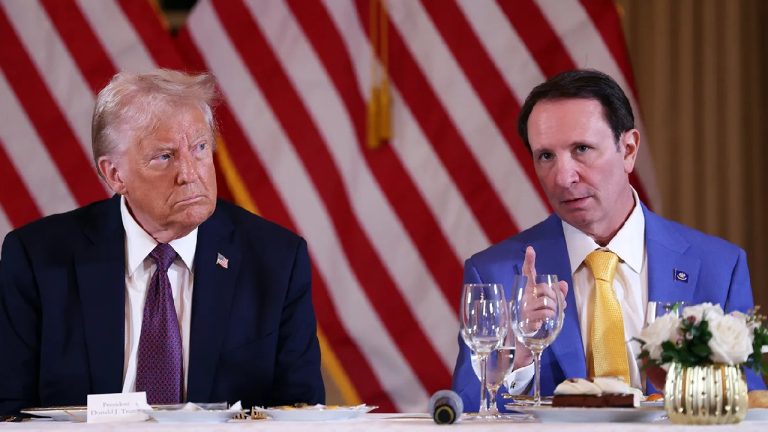
The Trump administration has appointed Louisiana Governor Jeff Landry as special envoy to Greenland, with Landry openly declaring his mission to “make Greenland a part of the U.S.” Danish Foreign Minister Lars Løkke Rasmussen characterized the appointment as “deeply upsetting” and Landry’s comments as “completely unacceptable.”
Washington’s influence campaign has employed multiple tactics. In January 2025, Donald Trump Jr. visited Greenland ostensibly as a tourist to shoot video for his podcast. Danish media reported that many Trump supporters appearing in his videos were homeless and socially disadvantaged locals who received free meals and MAGA merchandise in exchange for participating. Vice President JD Vance’s March visit encountered widespread local resistance—after businesses and residents declined meetings with Second Lady Usha Vance, the Vances limited their visit to the remote Pituffik Space Base.
By August, Danish media documented American operatives conducting influence operations in Greenland aimed at promoting secession from Denmark. Denmark’s foreign ministry summoned the U.S. envoy for rebuke. A White House official responded dismissively, suggesting “the Danes need to calm down.” U.S. intelligence agencies reportedly received orders in May to intensify espionage activities in Greenland.
Greenlandic Sentiment Firmly Against U.S. Annexation
The local population has rejected American overtures decisively. A January 2025 poll revealed that 85% of Greenlanders oppose joining the United States, with only 6% in favor and 9% undecided. While approximately 84% of Greenlanders support independence from Denmark, nearly half indicate they would only support independence if it doesn’t negatively impact their standard of living.
Greenland’s March 2025 parliamentary election reflected these sentiments. The center-right Demokraatit party, which has strongly criticized Trump’s approach, won the election. Party leader Jens-Frederik Nielsen characterized Trump as “a threat to our political independence.” Following Trump’s Sunday comments linking Greenland to Venezuela and military intervention, Nielsen issued a forceful statement: “When the President of the United States says that ‘we need Greenland’ and links us to Venezuela and military intervention, it’s not just wrong. It’s disrespectful.”
Existing Security Framework Already Serves U.S. Interests
America’s legitimate security and economic interests in Greenland can be advanced more effectively through respectful partnership than aggressive acquisition. The 1951 Greenland Defense Agreement already grants the United States extensive military rights in Greenland. This framework provides American forces access to Pituffik Space Base (previously Thule Air Base), a crucial installation for missile defense and early warning systems.
Pituffik Space Base serves as a vital link in Western and NATO defenses, supporting missile warning, missile defense, and space surveillance operations. The installation hosts approximately 150 U.S. service members and functions as the northernmost component of America’s defense infrastructure. Trump’s rhetoric conflates the entire island with the military base, insisting that securing Pituffik requires territorial ownership—a position lacking strategic foundation.
Trump’s Arctic Security Mischaracterization
President Trump’s justification for seizing Greenland demonstrates fundamental misunderstanding of Arctic security dynamics. His repeated claims that Russian and Chinese ships operate extensively along Greenland’s coast conflate distinct Arctic regions. While Russia and China do deploy vessels in Arctic waters, these operations occur in the Barents and Bering Seas—thousands of miles from Greenland.
The U.S. Coast Guard has encountered Chinese and Russian warships, bombers, and coast guard vessels operating jointly near Alaska’s coast. Arctic security concerns center on these Alaskan approaches rather than Greenland. American strategic attention would yield better results if directed toward actual areas of Sino-Russian Arctic activity rather than manufacturing threats around Greenland.
Counterproductive Approach Undermines U.S. Objectives
Rather than threatening coercion or force, Washington should pursue agreements benefiting all parties while respecting Greenland’s right to self-governance. This requires treating Greenland’s government as a legitimate partner rather than a territorial prize. Denmark’s intelligence service warns that America’s unpredictable approach pushes countries toward accommodation with China instead.
Ironically, Trump’s campaign to acquire Greenland for countering Chinese influence could backfire, making Beijing appear as a more stable and reasonable partner compared to Washington’s aggressive posture. The administration should abandon annexation rhetoric and work within existing agreements, support Greenland’s development goals, and demonstrate that American leadership operates through building strong partnerships rather than issuing ultimatums.
Economic Engagement Without Political Coercion
If the United States seeks access to Greenland’s critical mineral resources, legitimate business deals and joint ventures can provide pathways forward while allowing Greenlandic communities to benefit. Greenlandic leaders have articulated their position clearly: Greenland welcomes business relationships but rejects territorial acquisition.
Expert analysis suggests that Trump’s bullying approach more likely harms American interests than advances them. The United States has successfully worked with Denmark and Greenland previously when Chinese companies pursued contracts for Greenland airport expansions. American and Danish cooperation produced a more attractive proposal that Greenland ultimately accepted, demonstrating that diplomatic engagement yields results.
European Solidarity with Denmark
The controversy has generated statements of support from European leaders for Denmark and Greenland. European Union foreign policy representatives emphasized the bloc’s commitment to defending member states’ territorial integrity. British Prime Minister Keir Starmer stated that only Greenland and the Kingdom of Denmark can decide the territory’s future, with similar sentiments expressed by leaders from Finland, Sweden, and other European nations.
French foreign ministry officials told local media that borders cannot be changed by force and expressed solidarity with Denmark. Frederiksen warned that any U.S. military attack on a NATO country would effectively end NATO and post-World War II security architecture. Unlike Venezuela, Denmark’s NATO membership means an armed attack constitutes an attack on all alliance members—a scenario previously considered inconceivable.
Strategic Implications
The Greenland controversy exposes tensions within American foreign policy and alliance relationships. Academic analysis indicates that while Greenland’s independence movement predates Trump’s attention, his aggressive rhetoric has accelerated independence discussions and complicated Western strategic planning. An independent Greenland without proper integration into Western security and economic structures could become vulnerable to competing influences from Russia and China.
Western nations and businesses should invest in Greenland to facilitate economic development and stability while tying its economy to Western institutions. Promoting Greenlandic tourism and sustainably developing mining industries to access vast mineral deposits would prove advantageous. Strong trade ties with Europe could facilitate potential Greenland entry into the European Union, further integrating the territory’s economy with the West. Such investment would counter potential Chinese economic influence, given Beijing’s history of leveraging economic relationships for geopolitical objectives.
Conclusion
Trump’s Greenland campaign following the Venezuela operation has transformed from rhetorical flourish to serious diplomatic crisis between NATO allies. The aggressive approach contradicts stated American national security interests in maintaining a “peaceful, stable, prosperous, and cooperative” Arctic region. Washington already enjoys broad access to Greenland through existing defense agreements that have functioned effectively for over seven decades.
The administration should refocus on strengthening partnerships with Denmark and Greenland rather than pursuing territorial acquisition that alienates allies and undermines American credibility. Greenlanders have decisively rejected annexation while expressing openness to mutually beneficial economic and security cooperation. Respecting this position while supporting Greenland’s development aspirations serves American interests far more effectively than threats and ultimatums that push Copenhagen and Nuuk toward alternative partnerships.
Original analysis by Pavel Devyatkin from Responsible Statecraft. Republished with additional research and verification by ThinkTanksMonitor.