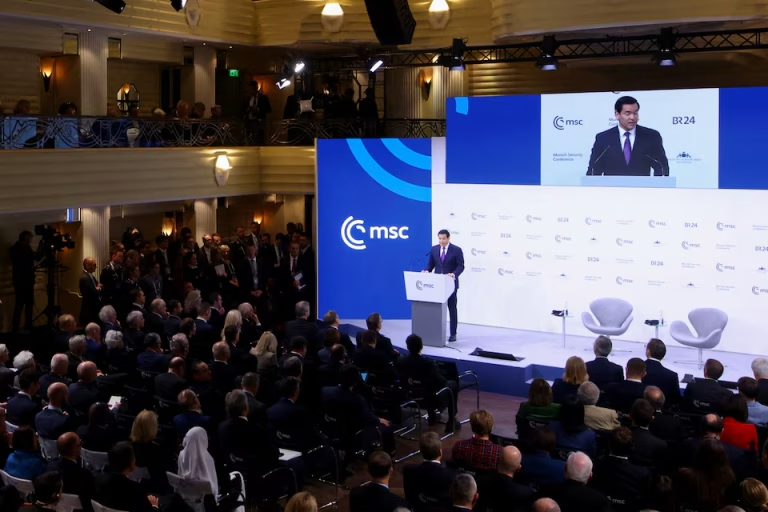
Secretary of State Marco Rubio delivered a carefully calibrated message of alliance solidarity at the 2026 Munich Security Conference, declaring that the United States and Europe “belong together.” Yet the speech’s conspicuous omission of Russia, NATO, and concrete security commitments — combined with persistent ideological critiques of European governance — reveals a transatlantic relationship in which the vocabulary of unity barely conceals a widening strategic divergence. European leaders, already accelerating plans for defense autonomy including a continental nuclear deterrent, received Rubio’s words with relief but little illusion about the depth of the underlying rift.
A Softer Messenger, a Familiar Message
Rubio’s appearance at the annual Munich gathering represented a deliberate shift in tone from the previous year, when Vice President JD Vance used the same platform to deliver a blistering attack on European leaders, accusing them of suppressing free speech, failing to control migration, and posing a greater danger to continental stability than external threats like Moscow. That speech stunned European diplomats and marked a low point in postwar transatlantic discourse. Rubio, by contrast, opened with appeals to shared civilizational heritage, invoking his own European forebears and praising the continent’s cultural and architectural achievements.
The framing was personal and emotional rather than strategic or operational. “In a time of headlines heralding the end of the transatlantic era, let it be known and clear to all that this is neither our goal nor our wish,” Rubio told the assembled diplomats and security officials. Yet beneath the warmer register, the substantive critique remained intact. Rubio echoed the administration’s persistent attacks on European migration policy and climate commitments, framing them as symptoms of a continent that had turned its back on its own heritage. He called for allies “willing and able to defend” Western civilization, implying that Europe’s current leadership had failed that test.
Democratic Senator Andy Kim, present at the conference, told Reuters that the speech reached “a lot of the same dynamics” as Vance’s address, only “without the fiery tone.” Kim noted the conspicuous absence of references to Ukraine, Russia, or China — the security challenges that dominate European strategic thinking — and the substitution of internal cultural critiques that did little to address the continent’s most urgent concerns.
The Strategic Silences in Rubio’s Address
What Rubio chose not to say proved as consequential as what he did. Across a roughly thirty-minute speech, the Secretary of State failed to mention Russia by name, did not reference NATO — the institutional backbone of transatlantic security — and offered no explicit commitment to Europe’s defense. For an audience whose primary security concern remains Moscow’s ongoing aggression, these omissions carried unmistakable weight.
This silence reflects a deliberate strategic calculation rather than an oversight. The December 2025 US National Security Strategy — the administration’s most comprehensive articulation of its worldview — had already alarmed European capitals by warning that the continent faced “civilizational erasure” due to immigration policies and free speech restrictions. The CSIS analysis of the document characterized it as potentially destructive to the NATO alliance, noting its emphasis on cultural grievances over traditional security cooperation. Brookings researchers observed that the strategy represented a systematically articulated ideological assault on the European Union itself — an institution Washington’s current leadership views less as a partner than as a bureaucratic obstacle to the kind of bilateral deal-making the administration prefers.
The gap between Rubio’s conciliatory language and the administration’s documented strategic posture creates what one senior European diplomat described as a relationship where “emotional notes” signal that cooperation is possible, but the institutional architecture and policy substance to support that cooperation remain absent. Washington wants culturally aligned partners willing to follow American leadership on migration, technology regulation, and trade — not the autonomous, multilateral Europe that Brussels and key European capitals are building.
Europe’s Accelerating Strategic Independence
The backdrop against which Rubio spoke tells a story of continental transformation that his address barely acknowledged. On the conference’s opening day, German Chancellor Friedrich Merz announced that Berlin had begun discussions with Paris about a European nuclear deterrent, a development that would have been unthinkable even two years ago. President Emmanuel Macron reinforced this trajectory by declaring that Europe must become a “geopolitical power in its own right,” with a planned speech later in February outlining France’s vision for extending its nuclear umbrella across the continent.
These are not incremental adjustments to existing arrangements. They represent the early architecture of a European security framework designed to function with reduced American involvement. The Munich Security Report 2026 documented how Russia’s ongoing aggression and uncertainty about US commitment are jointly driving what it described as European “detachment” from Washington. Polling commissioned for the report showed Europeans increasingly willing to operate without American leadership and broadly receptive to the proposition that US strategic direction is no longer necessary for continental security.
The practical dimensions of this shift extend well beyond nuclear deterrence. Politico reported that the EU has initiated systematic efforts to reduce reliance on the United States across technology, energy, payments, and defense — a comprehensive decoupling agenda that predates the current conference but has been dramatically accelerated by thirteen months of transatlantic friction. Carnegie Endowment analysts have argued that Europe’s posture of subservience toward Washington has definitively failed, and that only a more assertive, independent European stance will command the respect necessary for a functional partnership.
The Greenland Shadow and Trust Deficit
The current state of transatlantic relations cannot be understood without reference to the crises that preceded Munich. Washington’s threats to impose tariffs on European allies for failing to support its campaign to wrest Greenland from Danish sovereignty — a dispute that involved threats against a NATO ally’s territorial integrity by the alliance’s leading member — inflicted damage to institutional trust that no single speech can repair. Although the immediate crisis has subsided following a framework agreement, the episode crystallized European anxieties about the reliability of American commitments and the willingness of Washington to use coercive economic tools against its own allies.
The Chatham House analysis of the 2025 National Security Strategy noted that the document frames the transatlantic relationship in explicitly transactional terms, treating European alignment on cultural and migration issues as a precondition for continued American security engagement rather than viewing alliance obligations as unconditional. This conditionality — alliance solidarity contingent on ideological conformity — represents a fundamental departure from the postwar consensus that bound Washington and European capitals for seven decades.
The LSE European Politics blog assessed that the divide has moved beyond damage control into structural territory. European leaders are not merely managing a difficult American president; they are redesigning institutional frameworks to ensure that continental security does not depend on the outcome of any single American election cycle. The Merz-Macron nuclear discussions, the EU’s anti-coercion trade instruments, and the continent-wide defense spending increases all point in the same direction: a Europe that hedges against American unreliability as a permanent condition rather than a temporary aberration.
Recalibrating the Partnership or Managing Its Decline
Rubio’s Munich address leaves open two interpretations of the transatlantic trajectory. The optimistic reading — favored by some diplomats present — is that Washington recognizes the costs of alienation and is seeking a new formula for partnership, one in which the United States acts as a “critical friend” rather than a dominant patron. The warmer tone, the invocation of shared heritage, and the explicit rejection of abandonment as a goal could, on this view, provide the foundation for renegotiated terms of engagement.
The more skeptical reading, supported by the speech’s substantive gaps, is that Rubio offered reassurance without content — a rhetorical gesture designed to maintain alliance frameworks useful to Washington while continuing to pressure European governments toward ideological alignment on the administration’s domestic priorities. The absence of commitments on Russia, the omission of NATO, and the persistent focus on migration and cultural critique all point toward a relationship in which American engagement is conditional, issue-selective, and driven by domestic political considerations rather than shared strategic assessments.
The National Interest observed that Europe’s path toward genuine defense independence faces substantial roadblocks — dependence on American military equipment, differing national priorities, and the sheer scale of investment required to replace capabilities currently provided by the United States. These constraints ensure that the transatlantic bond will not dissolve quickly, regardless of political frictions. But the direction of travel is increasingly clear: a Europe that plans for a future in which American commitment can no longer be assumed, and a Washington that regards the continent less as an indispensable ally than as a civilizational project requiring correction. Whether this trajectory leads to a recalibrated partnership or a managed decline will depend on whether either side can translate the language of unity into the institutional substance that Rubio’s Munich speech conspicuously lacked.
Original analysis inspired by Humeyra Pamuk from Reuters. Additional research and verification conducted through multiple sources.