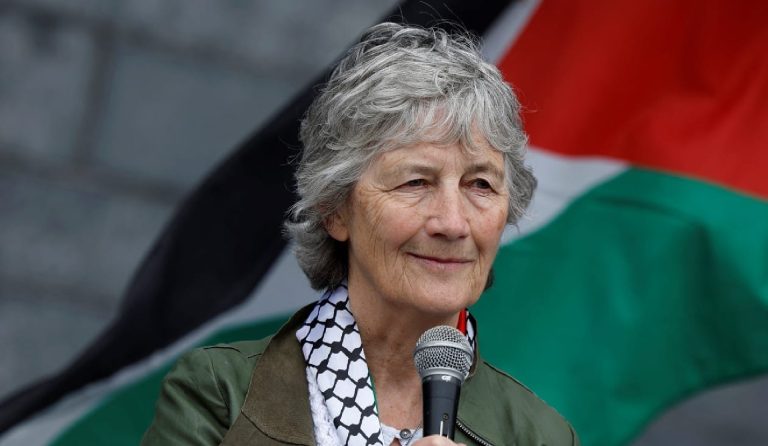
The election of Catherine Connolly as the 10th President of Ireland in October 2025 signifies a watershed moment in Dublin’s foreign policy, cementing a transition from critical neutrality to what many analysts view as open hostility toward Israel. While the Irish presidency is constitutionally ceremonial, the landslide victory of a candidate who has described Hamas as “part of the fabric” of Palestinian society suggests a profound shift in the Irish electorate’s geopolitical orientation—one that poses significant diplomatic challenges for Jerusalem and Brussels alike.
The ‘Fabric’ of Controversy: Legitimizing Hamas
At the heart of the concerns regarding President Connolly is her refusal to adhere to the standard Western diplomatic consensus on Hamas.3 During the 2025 presidential campaign, Connolly drew sharp rebuke from then-Taoiseach Micheál Martin for comments made in a BBC News interview, where she characterized the militant group as a legitimate political entity deeply woven into Palestinian society.
Although she later clarified her position to “utterly condemn” the atrocities of October 7, 2023, her initial reluctance to isolate Hamas politically aligns with a growing segment of the Irish left. Unlike her predecessors, who maintained a careful diplomatic distance, Connolly’s rhetoric challenges the EU’s designation of Hamas as a terrorist organization. Her victory suggests that for a significant portion of Irish voters, anti-Zionist positions have become a prerequisite rather than a liability for high office.
The Syria Connection: A History of Radicalism
Beyond the immediate context of the Gaza war, Connolly’s foreign policy record includes controversial engagements in the Middle East that critics argue border on support for authoritarian regimes.4 In 2018, while serving as a Teachta Dála (TD), Connolly participated in a trip to Syria that came under intense scrutiny from political rivals.
Opponents, including members of Fine Gael, characterized the visit not as a fact-finding mission, but as a “guided tour” chaperoned by militia leaders loyal to Bashar al-Assad.5 Reports from the time alleged her delegation met with figures accused of war crimes against Palestinians in the Yarmouk refugee camp.6 While Connolly defended the trip as necessary research into the humanitarian impact of Western sanctions, her willingness to engage with the Assad regime—dubbed “the butcher of Damascus”—establishes a pattern of “anti-imperialist” positioning that frequently places her at odds with NATO and EU foreign policy norms.
From Higgins to Connolly: The Normalization of Hostility
Connolly’s ascent is not an aberration but the culmination of a decade-long trend, notably accelerated by her predecessor, Michael D. Higgins. The former President frequently tested the boundaries of his office’s neutrality, most notably in January 2025, when his address at the National Holocaust Memorial Day ceremony sparked a diplomatic incident.
Higgins used the solemn occasion to critique Israel’s conduct in Gaza, leading to walkouts by members of the Jewish community and security forcibly removing protestors. By transforming a memorial for the six million Jews murdered in Europe into a platform for contemporary geopolitical critique, Higgins set a precedent that Connolly appears poised to escalate. The transition from Higgins to Connolly represents a shift from “critical friendship” to what Israeli diplomats now fear is institutionalized antagonism.
The 2011 Parallel: How the Electorate Has Changed
The evolution of Irish public sentiment is starkest when compared to the 2011 presidential election. In that cycle, Senator David Norris, a charismatic frontrunner and champion of civil rights, saw his campaign implode due to an Israel-related scandal. Norris was forced to withdraw after it emerged he had written letters pleading for clemency for his former partner, Ezra Nawi, who had been convicted in an Israeli court of statutory rape.
Fourteen years ago, the mere association with a scandal involving the Israeli legal system—and the perception of intervening inappropriately—was sufficient to derail a presidency. In 2025, however, Connolly’s far more direct and controversial stances on Hamas and Syria did not hinder her; rather, they galvanized a base that views opposition to Israel as a moral imperative. This reversal highlights a dramatic restructuring of Irish political priorities, where “solidarity with resistance” has eclipsed traditional diplomatic caution.
Conclusion
Catherine Connolly’s presidency presents a unique challenge to Israel-Europe relations. Unlike typical European critics who frame their objections in the language of international law and a two-state solution, Connolly represents a strain of ideology that questions the fundamental legitimacy of Israeli security measures and sympathizes with “resistance” movements. With the Irish head of state now openly aligned with these views, Jerusalem faces a diplomatic freeze in Dublin that is likely to persist for the next seven years, potentially influencing broader EU consensus on the Middle East.
Original analysis inspired by Asher Maoz from The New Arab. Additional research and verification conducted through multiple sources.