In October 1956, British and French forces invaded Egypt alongside Israel to retake the Suez Canal. The military operation was going well. Then Washington intervened — not with troops, but with financial pressure. Appalled that military operations had begun without his knowledge, President Eisenhower put pressure on the IMF to deny Britain any financial assistance. With few options, Prime Minister Anthony Eden reluctantly accepted a UN ceasefire. It had lasted just two days, and Britain had been left humiliated. The lesson for London and Paris was unambiguous: it was now clear that, in terms of power and influence, Britain was no longer in the same league as the United States. In future, any major British operation would need American support and approval.
Nearly seven decades later, the tables have turned — and the waterway at the center of the story has changed too. The Strait of Hormuz, effectively shut since Iran declared it closed on March 2, has become the defining chokepoint of the current crisis. Brent crude surpassed $100 a barrel in early March for the first time in four years, rising to $126 at its peak. The closure has been described as the largest disruption to the energy supply since the 1970s energy crisis. This time, it is Washington that launched a war without consulting its allies — and it is Washington that now demands European navies clean up the consequences.
The Alliance Cracks Open
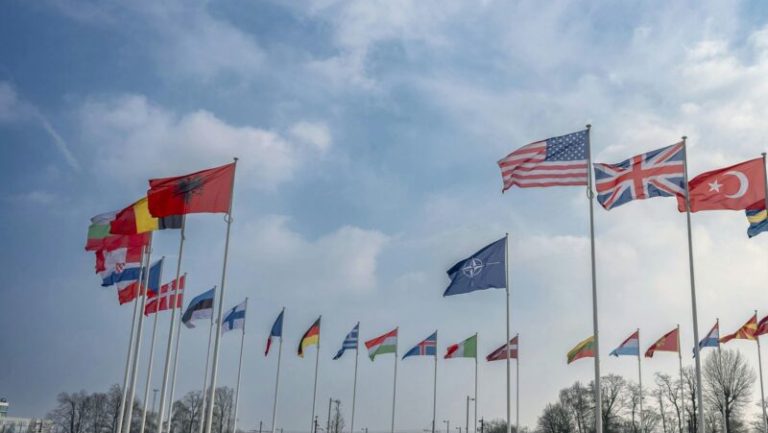
Transatlantic relations were tense before the February 28 US-Israeli attack on Iran. But the war turned what was already the most turbulent period in transatlantic relations into a full-blown crisis. Trump launched the war without consulting allies but then demanded that their navies reopen the Strait of Hormuz, which Iran had closed, bottling up at least a fifth of global oil exports.
Europe’s response has been almost uniformly negative. Germany’s Defense Minister Boris Pistorius said bluntly: “This is not our war. We have not started it. What does Trump expect a handful or two handfuls of European frigates to do in the Strait of Hormuz that the powerful US Navy cannot do?” UK Prime Minister Keir Starmer was equally direct: “Let me be clear: that won’t be, and it’s never been envisioned to be, a NATO mission.” Germany, Spain, Italy, Estonia, the United Kingdom, Australia, South Korea, Japan, and the EU all rejected Trump’s request.
Washington’s reaction was predictably furious. Trump lambasted NATO, calling members “cowards” and asserting that “without the US, NATO is a paper tiger.” Senator Lindsey Graham went further, warning that “the repercussions of providing little assistance to keep the Strait of Hormuz functioning are going to be wide and deep,” and saying the situation made him “second guess the value of these alliances.” Trump then escalated, threatening to withhold Ukraine weapons if Europe refused to join the Hormuz coalition — using one crisis as leverage across another.
The irony is sharp. For decades, European governments absorbed American pressure, supported US wars in Iraq and Afghanistan, and paid the diplomatic cost of alignment with Washington’s strategic choices. Burden-sharing had created discord within the alliance well before Trump’s first term began, but once his presidency got underway, what had been admonitions on defense spending turned into bluntly-delivered ultimatums. Now, when the US needs reciprocal support for a war it started unilaterally, it finds allies unwilling to follow — and calls it betrayal.
A Moment That Mirrors 1956
The Suez analogy is not just rhetorical. The Suez Crisis of 1956 was a defining moment in Cold War history, reflecting shifting power dynamics and highlighting the strategic significance of the Middle East. It underscored the waning influence of European colonial powers and marked the rise of the US and USSR as the primary global superpowers. The crisis didn’t end British or French relevance — but it permanently redefined the terms of Western leadership, forcing both countries to accept that unilateral action was no longer available to them.
The parallel today cuts differently. There is now a power ready to take over the system not only militarily, but economically and financially. In 1956, the US was ready. Today, China is ready. Therefore, Suez was the end — and Hormuz could be the beginning of a new era. China and Russia have both opposed the UN Security Council resolution that would authorize military force to open the strait, effectively shielding Iran from multilateral pressure while allowing Beijing to benefit from preferential transit arrangements and the energy shock hitting its competitors.
Trump’s threat to reconsider America’s NATO commitment may ultimately prove to be tactical leverage rather than genuine intent. But the underlying damage — to habits of consultation, to assumptions of shared purpose, to the basic expectation that allies inform one another before going to war — is real, and will not dissolve once the immediate crisis passes.
Who Will Actually Reopen the Strait?
Faced with Washington’s insistence that Europeans handle the aftermath, a coalition of over 40 countries has assembled — led, notably, by Britain. The multinational coalition will pursue “the collective mobilisation of our full range of diplomatic and economic tools” to enable a “safe and sustained opening” of the strait. But the gap between declaration and action is wide. French President Macron said it was not feasible to launch a military operation to force open the strait. “This was never the option we have supported because it is unrealistic,” he said, adding it would expose those crossing to “coastal threats” from the IRGC, which has “significant resources as well as ballistic missiles.”
The diplomatic track, paradoxically, may be the one avenue where European soft power still has genuine utility. Macron has suggested the best way to ensure the strait’s opening is by talking directly to Iran. That is a path Washington has so far rejected — but Trump himself recently extended an open invitation to European diplomacy, suggesting he would welcome others taking the lead on the post-conflict settlement. It is a remarkable inversion: the hegemon that started the war now asking its reluctant partners to negotiate its way out.
Britain and France lost most of their influence in the Middle East as a result of the Suez episode. Whether the United States loses influence through Hormuz depends less on what happens in the strait than on what happens inside the alliance. Trump’s continual disparagement of the alliance, key NATO allies’ refusal to help reopen the strait, and Trump’s threat to ditch the alliance altogether have created the gravest internal crisis in NATO’s history. The alliance will likely survive it — but Europe should start figuring out how it will defend itself if the American security guarantee it has counted on for nearly 80 years doesn’t last much longer. Alliances, as history reliably demonstrates, are always about interests. The question is whose interests now define the West — and whether there is still enough common ground to answer it.