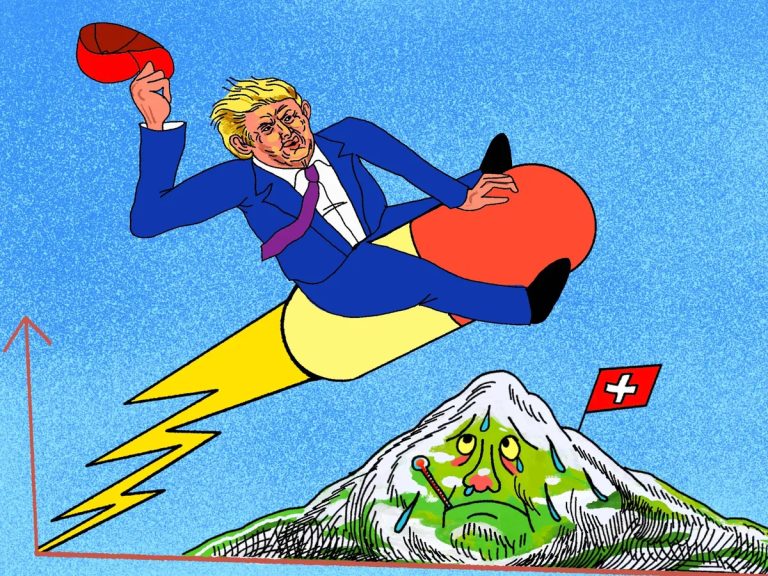
Washington’s push to benchmark American prescription costs against prices in smaller economies is triggering a cascade of consequences across the Atlantic. Switzerland, home to two of the world’s largest pharmaceutical companies, now finds itself at the center of an intensifying transatlantic dispute over who should bear the cost of biomedical innovation. Rather than lowering prices in the United States, the executive order signed in May 2025 is prompting drugmakers to raise prices abroad, withdraw treatments from small markets, and reconsider long-standing investment commitments in the Alpine nation.
The Most-Favored-Nation Gamble
The mechanism driving the disruption is straightforward in theory but corrosive in practice. In May 2025, President Donald Trump signed an executive order directing the Department of Health and Human Services to deliver most-favored-nation prescription drug pricing to American patients, effectively mandating that U.S. purchasers pay no more than the lowest price charged in comparable developed nations. The order frames the existing arrangement as “global freeloading,” arguing that Americans fund roughly three-quarters of worldwide pharmaceutical profits despite comprising less than five percent of the global population.
The logic assumes drug companies will respond by cutting U.S. prices to match European benchmarks. In practice, the opposite dynamic has emerged. With American revenue constituting the majority of their earnings, manufacturers have strong incentives to raise prices in reference countries or exit small markets altogether, thereby lifting the benchmark that U.S. regulators would use. A comprehensive RAND Corporation study using 2022 data found that U.S. drug prices already averaged 2.78 times those in 33 other OECD nations, a gap that widened to 4.22 times for brand-name products. That differential creates an enormous financial incentive for companies to protect their U.S. margins at the expense of smaller markets.
Lunsumio and the Fracture in Swiss Drug Access
The real-world consequences became visible in Switzerland when Roche, headquartered in Basel, withdrew its promising cancer drug mosunetuzumab, marketed as Lunsumio, from the Swiss market in July 2025. The treatment, approved for patients with a rare and aggressive form of follicular lymphoma, had been the pilot case for an accelerated early-access reimbursement procedure designed to shorten the gap between regulatory approval and insurance coverage. Negotiations between Roche and the Federal Office of Public Health collapsed over pricing and evidence requirements, and instead of seeking case-by-case reimbursement, the company pulled the drug entirely from the Swiss market.
The withdrawal stunned oncologists and patient groups. Christoph Renner, a Swiss oncologist who had treated blood cancer patients with Lunsumio, learned that the therapy would simply no longer be available through normal channels. Roche subsequently offered the treatment free to eligible patients through a non-profit patient access program, but the episode revealed the fragility of a system caught between international pricing pressures and domestic cost containment. Lunsumio, which achieved an 80 percent response rate in a global Phase II trial of 90 patients and has been approved in over 60 countries, was priced at approximately CHF 7,470 per dose in Switzerland, placing total treatment costs between CHF 60,000 and CHF 120,000.
The standoff also highlights a deeper structural tension. Swiss regulators argued that acceding to Roche’s demand to shift from a provisional evidence-linked pricing model to full reimbursement would set a precedent that other manufacturers would exploit. Some industry analysts suggest the withdrawal was partly strategic, designed to send a signal that authorities cannot indefinitely compress margins in one of the industry’s traditional stronghold markets.
An Economy Built on Pharmaceuticals
For Switzerland, the dispute carries outsized economic weight. The pharmaceutical and chemical sectors generate approximately seven to eight percent of Swiss GDP and account for more than half of the country’s total exports, with pharma exports alone valued at around CHF 114.5 billion. The industry directly employs more than 50,000 people and supports an estimated 250,000 additional jobs indirectly. An analysis by ETH Zurich’s KOF Swiss Economic Institute described the pharmaceutical sector as the most important growth driver of the Swiss economy in the twenty-first century, while simultaneously warning of its vulnerability to international policy shifts.
The sector’s contribution, however, has begun to contract. Bloomberg Businessweek reported that pharma’s share of Switzerland’s economic output has fallen to its lowest level since 1990. Job cuts have compounded the concern. In late 2025, Novartis announced the elimination of hundreds of manufacturing positions at its Swiss facilities, while Pfizer downsized its Swiss workforce from roughly 300 to approximately 70, and Johnson & Johnson signaled its exit from Swiss vaccine production. These decisions reflect both industry-wide cost pressures and specific anxieties about the sustainability of operating in a high-cost country whose pricing power is eroding.
Meanwhile, access to new treatments is narrowing. Swiss insurers now cover only about 47 percent of new drugs, a sharp decline from roughly two-thirds in 2018. Germany, by contrast, reimburses approximately 90 percent of newly approved therapies. The widening gap threatens to turn Switzerland from a first-launch market into one that drugmakers deprioritize, particularly as U.S. most-favored-nation rules make benchmark prices in small countries a direct liability.
The Diplomatic Balancing Act
Switzerland’s government has attempted to navigate the tension between maintaining a globally competitive pharmaceutical sector and protecting domestic health insurance premiums. Home Affairs Minister Elisabeth Baume-Schneider stated plainly that “the Swiss cannot and must not pay for price reductions in the USA with their health insurance premiums,” framing the issue as one of national sovereignty over healthcare costs. At the World Economic Forum in Davos in January 2026, Swiss trade negotiator Helene Budliger Artieda emphasized the need for flexibility, arguing that “Switzerland works because we talk with each other” and insisting that the pharmaceutical industry should not be demonized even as it faces mounting global criticism.
The diplomatic challenge is that Switzerland simultaneously needs to preserve its relationship with Washington, protect its pharmaceutical tax base, and keep healthcare affordable for nine million residents. René Buholzer, head of Interpharma, the Swiss pharmaceutical industry association, has advocated for a more pragmatic approach to domestic pricing that reflects clinical and societal value rather than rigid international benchmarks. But the room for compromise is shrinking as U.S. policy explicitly targets the pricing structures that have sustained the Swiss model.
A Global Precedent With Uncertain Outcomes
The Swiss case is not occurring in isolation. Across Europe, drugmakers are bracing for a broader pricing confrontation as U.S. policy reshapes the economics of international pharmaceutical distribution. The fundamental question is whether most-favored-nation pricing will actually lower costs for American patients or merely redistribute the pain to smaller markets that lack the bargaining power to resist. If companies respond by raising reference prices in Europe or withdrawing from small markets, the net effect could be higher global costs and reduced access without meaningful relief for U.S. consumers.
Health economists have long warned about this dynamic. Thomas Hofmarcher, of the Swedish Institute for Health Economics, noted that small markets risk having products pulled entirely because companies calculate they can afford to lose those patients rather than accept prices that would drag down their U.S. benchmarks. Kerstin Noëlle Vokinger, a pharmaceutical law specialist at the University of Zurich and ETH Zurich, has called for greater transparency in accelerated drug approvals, arguing that companies benefit financially from early market entry while regulators bear the risk of approving treatments with incomplete efficacy data.
The Lunsumio withdrawal, the job cuts across Basel and Zurich, and the diplomatic friction at Davos all point toward a structural realignment in global pharmaceutical economics. Washington’s attempt to leverage its purchasing power has not produced the intended price convergence; instead, it has introduced a new form of regulatory arbitrage in which smaller nations pay the adjustment costs. Whether Switzerland can reform its pricing framework quickly enough to remain both an attractive market for innovation and an affordable healthcare provider for its citizens is the central unresolved question. What is already clear is that the era of stable transatlantic drug pricing arrangements is over, and the new equilibrium has yet to take shape.
Originally published by Fabienne Kinzelmann, Bloomberg Businessweek. Additional research and contextual analysis conducted through multiple independent sources.