The administration’s simultaneous push to nationalize state elections and deploy federal enforcement agencies against Democratic-led cities reveals a governing logic that applies the same playbook of delegitimization and coercion to domestic political opponents and foreign states alike.
When President Trump called on Republicans to “nationalize” and “take over” voting in at least 15 unspecified jurisdictions in early February, the proposal triggered alarm well beyond partisan lines. Senate Majority Leader John Thune publicly rejected the idea, and bipartisan state election officials warned of an unprecedented threat to the constitutional framework that has governed American elections for nearly 250 years. Yet the significance of this moment extends beyond any single policy proposal. What is emerging across multiple fronts—the federal enforcement surge in Minneapolis, the demand for state voter rolls, the intervention in Venezuela—is a coherent pattern in which both domestic and foreign territories that resist the administration’s political preferences are reframed as disordered spaces requiring forcible correction.
Minneapolis as a Proving Ground for Domestic Coercion
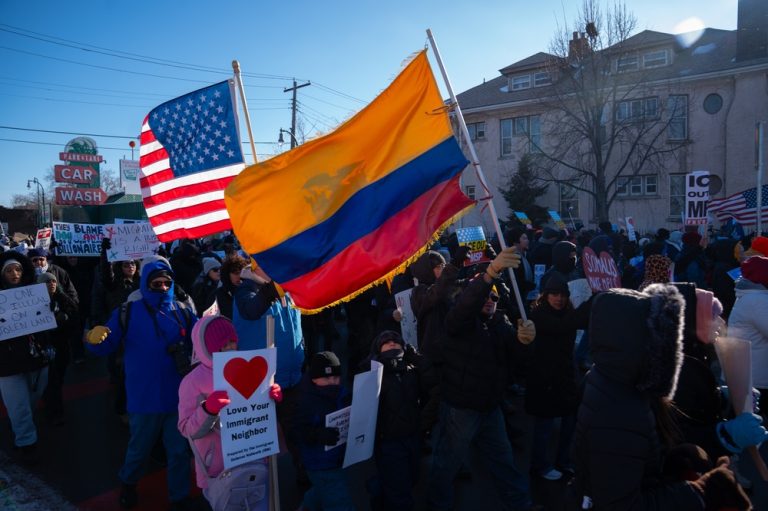
The federal operation in Minneapolis has become the most visceral illustration of this dynamic. What began as a targeted immigration enforcement effort escalated into something far more expansive, with hundreds of federal agents deployed across the Twin Cities in an operation that Governor Tim Walz described as an “occupation.” The scale and character of the deployment—the use of tear gas, the resulting civilian casualties, the pervasive atmosphere of fear that drove families indoors for weeks—bore little resemblance to routine law enforcement and far more to the kind of pacification operations historically associated with foreign interventions.
The linkage between enforcement pressure and political demands became explicit when Attorney General Pam Bondi sent a letter to Governor Walz demanding that Minnesota surrender its voter registration records to the federal government, directly connecting the ongoing enforcement actions to state compliance on election matters. A federal judge in Oregon subsequently noted that Bondi’s letter reinforced concerns about the Justice Department’s underlying motives, and U.S. senators from both parties characterized the demand as an attempt to coerce states into relinquishing control over sensitive electoral infrastructure. The message embedded in this sequence was difficult to misread: cooperate on the administration’s political priorities, or face sustained coercive pressure through federal agencies.
This represents a fundamental departure from the traditional relationship between Washington and the states. American federalism has always involved tension between national and state authority, but the deliberate deployment of enforcement agencies as instruments of political leverage against jurisdictions that voted for the opposing party introduces a qualitatively different dynamic—one in which federal power operates not as a neutral arbiter of national law but as a partisan tool for territorial dominance.
The Venezuela Parallel: From Foreign Template to Domestic Application
The administration’s approach to Democratic-led states becomes more legible when examined alongside its conduct toward foreign governments that resist its directives. The January 2026 military operation in Venezuela—codenamed Operation Absolute Resolve, which resulted in the capture of President Nicolás Maduro—demonstrated Washington’s willingness to use direct force against a sovereign government whose political character was deemed unacceptable. The Council on Foreign Relations observed that much of the post-intervention policy appeared improvised, with Trump publicly stating that the United States would “run” Venezuela and oversee its political transition.
The conceptual framework underlying both operations shares striking characteristics. In each case, the targeted jurisdiction is portrayed as fundamentally dysfunctional—too corrupt, too disorderly, too resistant to produce legitimate political outcomes on its own. This delegitimization justifies extraordinary measures: military force abroad, federal enforcement surges at home. The distinction between foreign and domestic application narrows considerably when the underlying logic—that non-compliant political communities forfeit their right to self-governance—remains constant.
This pattern has deep roots in American foreign policy. The CIA-orchestrated overthrow of Guatemala’s democratically elected government in 1954 established a template that was subsequently applied across Latin America: label a government as threatening or illegitimate, delegitimize its electoral mandate, and intervene to install a more compliant regime. What distinguishes the current moment is not the existence of this repertoire but its simultaneous application to domestic political opponents—a development that collapses the boundary between the foreign and domestic exercise of coercive power.
Election Nationalization and the Erosion of Constitutional Limits
The push to federalize state elections represents perhaps the most structurally consequential dimension of this emerging order. Time Magazine’s analysis of the nationalization proposal detailed how the administration has framed unsubstantiated claims of widespread voter fraud as justification for unprecedented federal intervention in election administration—a domain the Constitution explicitly reserves to the states. The framing follows a familiar pattern: elections that produce unfavorable results are recharacterized not as legitimate expressions of political disagreement but as evidence of corruption requiring external correction.
Thune’s public dissent—declaring that he is “not in favor of federalizing elections” and emphasizing the security advantages of decentralized election systems—demonstrated that institutional resistance persists even within the president’s own party. State election officials from both parties, including Republican officials in Utah, have pushed back against what they characterize as a direct threat to the constitutional architecture. Yet the administration’s capacity to sustain pressure through executive agencies—demanding voter rolls, linking compliance to enforcement decisions, publicly delegitimizing state electoral processes—means that formal legislative authority is not the only avenue through which centralization can advance.
The Brookings Institution’s analysis of executive power under the current administration identified a broader pattern in which constitutional constraints are treated not as binding limits but as obstacles to be circumvented through executive action, enforcement discretion, and political pressure. When elections are recoded from expressions of popular sovereignty into loyalty tests—where the “wrong” outcome signals corruption rather than disagreement—the constitutional framework that sustains democratic self-governance begins to hollow from within.
Institutional Resistance and the Limits of Coercive Governance
The coercive model faces significant structural constraints that will determine whether it deepens or recedes. Constitutional federalism, for all the pressure it faces, retains meaningful institutional weight. The judiciary has intervened in several states to limit the scope of federal enforcement actions, and congressional resistance—however tentative—has complicated the legislative path toward election nationalization. The New York Times documented how communities in the Twin Cities have mobilized in response to the federal enforcement surge, generating civic solidarity that may complicate the administration’s ability to sustain these operations politically.
The deeper question is whether this moment represents an aberration—an aggressive but ultimately contained assertion of executive authority that institutional checks will moderate—or the emergence of a durable governing logic in which coercion displaces consent as the primary mechanism for integrating resistant populations, whether those populations reside in Minneapolis or Caracas. The answer depends less on any single policy outcome than on whether the conceptual boundary between legitimate political opposition and territorial disorder continues to erode. When a democratic system begins treating its own constituent communities as spaces requiring pacification rather than persuasion, the distance between domestic governance and imperial administration narrows in ways that pose fundamental risks to constitutional self-rule.
Original analysis inspired by Richard W. Coughlin from Foreign Policy In Focus. Additional research and verification conducted through multiple sources.