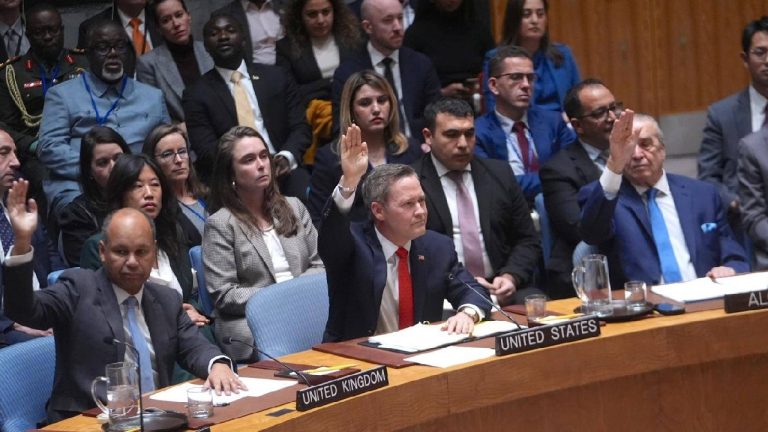
The geopolitical landscape of the Levant shifted decisively in late 2025 with the United Nations Security Council’s adoption of Resolution 2803, a measure that formally endorses the United States’ strategy for the post-war governance of the Gaza Strip.1 Passed with 13 votes in favor and abstentions from Russia and China, the resolution provides international legal scaffolding for what is colloquially known as the “Trump Plan.”2 By mandating the creation of a transitional administration and an international security apparatus, the Council has effectively initiated a new phase of the conflict—one defined by complex disarmament mandates, territorial segmentation, and deep internal Palestinian divisions.3
Institutionalizing the “Board of Peace”
At the core of this new legal framework is the establishment of the Board of Peace (BoP), a transitional governing body granted international legal personality.4 Unlike previous ad hoc arrangements, the BoP is tasked with a comprehensive dual mandate: overseeing the entry and distribution of humanitarian aid and laying the groundwork for future civil governance. This body is designed to function until at least December 31, 2027, serving as a bridge until the Palestinian Authority (PA) can demonstrate the capacity to assume full control.
Operating under the BoP’s supervision is the International Stabilization Force (ISF), a multinational security entity deployed in coordination with Egypt and Israel.5 The ISF’s rules of engagement are robust and controversial; they include securing borders, facilitating aid, and, most critically, enforcing the demilitarization of the Strip. This includes the physical destruction of military infrastructure and the prevention of rearmament. The resolution explicitly links the withdrawal of Israeli Defense Forces (IDF) to the ISF’s success, creating a condition-based exit strategy that requires the total elimination of security threats before a full Israeli pullout can occur.
The “Green Zone” Strategy: A Bifurcated Gaza
Implementation efforts have already commenced at the newly established Civil-Military Coordination Center in Kiryat Gat, where representatives from 21 nations are drafting the operational specifics.6 Early intelligence suggests a strategy of geographic segmentation, effectively dividing the Strip into two distinct zones.7 A “Green Zone,” initially under Israeli security control, is projected to house between 200,000 and 300,000 Palestinians. Here, reconstruction efforts—including the rebuilding of Rafah and parts of Khan Yunis—will be prioritized to incentivize population movement.
Conversely, the “Red Zone” will encompass areas where Hamas maintains de facto administrative control, housing approximately two million residents. The strategic logic appears to be one of attrition and containment: by restricting the flow of reconstruction materials to Hamas-held areas while developing the Green Zone, the plan aims to erode the group’s civil authority gradually. This “housing committee” approach, which links infrastructure development like water and electricity to security compliance, represents a stark application of soft power coercive tactics alongside military pressure.8
Israel’s Political Calculus and Internal Friction
For the Israeli leadership, Resolution 2803 presents a complex tactical victory. Prime Minister Benjamin Netanyahu has publicly welcomed the resolution, interpreting the mandate for disarmament as a vindication of his war goals.9 However, the domestic political landscape remains fraught. To manage the implementation, Netanyahu has formed a high-level ministerial committee that includes far-right figures such as Finance Minister Bezalel Smotrich and National Security Minister Itamar Ben-Gvir—both of whom originally opposed the Trump plan in the cabinet.
This inclusion serves a dual purpose: it binds the far-right to the process, preventing government collapse, while ensuring hardline oversight over the withdrawal mechanisms. The looming Israeli elections in October 2026 cast a long shadow over these proceedings. With public opinion polls indicating that 68% of Jewish Israelis oppose a Palestinian state, the government is likely to stall on the resolution’s vague promises of Palestinian self-determination while aggressively pursuing the disarmament clauses. The friction point lies in the “statehood” language inserted by the Trump administration; while currently viewed as a nominal concession, Israeli strategists fear a future US administration could use this legal precedent to force substantive political concessions.
The Palestinian Rift: Opportunity vs. Occupation
The resolution has deepened the schism within Palestinian politics. The Palestinian Authority has embraced the resolution, viewing the theoretical timeline for its return to Gaza in 2027 as a lifeline for its legitimacy and a reaffirmation of the two-state solution. For Ramallah, the BoP represents a necessary interim step toward unifying the West Bank and Gaza under a single political system, countering Israeli efforts to keep the territories permanently fragmented.10
In stark contrast, Hamas and allied factions have rejected the resolution as a violation of sovereignty, characterizing the ISF as a hostile occupation force designed to impose external guardianship.11 They favor alternative proposals, such as the Egyptian-mediated “Community Support Committee,” which relies on inter-factional consensus rather than international mandates. The fundamental disconnect lies in the disarmament clause: while the UN mandate requires it, participating nations in the ISF are reportedly unwilling to engage in direct combat to achieve it. This hesitation suggests a likely scenario where the ISF secures the Green Zone while leaving the “Red Zone” in a volatile stalemate, potentially forcing Israel to continue unilateral military operations to degrade Hamas’s capabilities.
Conclusion: A Fragile Path Forward
As the Civil-Military Coordination Center begins its work, the implementation of Resolution 2803 faces hurdles that are as much political as they are operational. The reluctance of international forces to engage in combat, combined with Hamas’s entrenched position in the “Red Zone,” suggests that disarmament may only be achievable through negotiation—a prospect Israel deeply mistrusts. With the clock ticking toward the 2027 transition deadline and the 2026 Israeli elections, the risk is that the “temporary” partitioning of Gaza becomes a permanent reality, managed rather than resolved by the new international architecture.
Original analysis inspired by the Israel and Palestine Studies Unit from the Emirates Policy Center. Additional research and verification conducted through multiple sources.