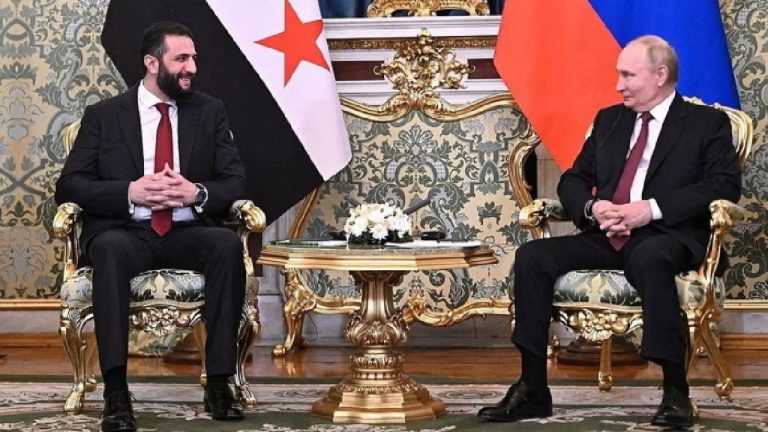
The October 2025 summit in Moscow between Vladimir Putin and Ahmed al-Sharaa—the leader of Syria’s post-Assad government—represents a masterclass in diplomatic realpolitik. Following the sudden collapse of the Ba’athist regime earlier this year, many observers predicted a total eclipse of Russian influence in the Levant. Instead, the Kremlin has executed a swift pivot, trading ideological loyalty for transactional pragmatism.1 By engaging the very forces it once fought, Russia aims to salvage its strategic assets in the Mediterranean, proving once again that its foreign policy is driven not by sentiment, but by hard interests.
Securing the Mediterranean Foothold
For the Kremlin, the survival of the Assad regime was always secondary to the preservation of its geostrategic infrastructure. The primary imperative remains the retention of the naval facility at Tartus and the airbase at Hmeimim. These installations are not merely remnants of the Syrian civil war; they have evolved into critical logistical hubs for the Russian Africa Corps operations across the Sahel and North Africa.
While Moscow has reportedly explored alternative basing options in Libya, the security environment there remains too volatile to serve as a reliable replacement. Consequently, negotiations with Damascus have focused on a “reformatted” military presence. The Kremlin appears willing to scale back its combat footprint—acknowledging that it can no longer act as Syria’s primary security guarantor—in exchange for guaranteed access rights. This reduction in visibility serves Sharaa’s domestic political needs while allowing Russia to maintain its power projection capabilities in the Eastern Mediterranean.
Sanctions-Proof Economic Diplomacy
The economic dimension of this new relationship is defined by mutual isolation. With both Damascus and Moscow heavily sanctioned by Western powers, a “market of pariahs” has emerged. The visit by Russian Deputy Prime Minister Alexander Novak to Syria in September 2025 underscored this dynamic, focusing on revitalizing energy and extraction contracts that date back to the previous era.2
Russia possesses a unique comparative advantage: an indifference to Western compliance mechanisms. While international investors remain deterred by the US Caesar Syria Civilian Protection Act, Russian state-linked entities are willing to operate in high-risk environments. Moscow is leveraging this by offering vital commodities—specifically Arctic oil and wheat—at below-market rates. This “grain diplomacy” is crucial for the new Syrian administration as it grapples with severe drought conditions and food insecurity, creating a dependency that Russia can exploit to protect its 50-year phosphate extraction contracts in Palmyra.
The Autocrat’s Red Line: The Fate of Assad
Despite the warming ties, the status of the deposed Bashar al-Assad remains a volatile point of contention. The new government in Damascus, under pressure from a populace demanding accountability, has issued arrest warrants and hinted at extradition requests.3 For Vladimir Putin, however, handing over a former ally is a non-starter.
The Kremlin’s reputation as a reliable patron for embattled autocrats—from Central Asia to Sub-Saharan Africa—rests on its refusal to abandon clients to international tribunals. Analysts argue that extraditing Assad would shatter the credibility of Russian security guarantees globally. Instead, Moscow is likely proposing a compromise: strict asylum conditions that bar Assad from political activity, ensuring he cannot destabilize the transition, while firmly rejecting any transfer of custody or payment of war reparations.
Leveraging Minority Rights and Regional Security
Lacking the overwhelming military force it deployed in 2015, Russia is turning to asymmetric levers to maintain influence. One such tool is the protection of ethnic and religious minorities. By positioning itself as a guarantor of minority safety in a fractured Syria, Moscow retains the ability to intervene diplomatically—or militarily via limited “peacekeeping” contingents—should the new Sunni-dominated leadership threaten these communities.
Furthermore, Russia is remarketing itself as a necessary balancer against regional rivals. The resumption of Russian military patrols in Qamishli and potentially in southern Syria signals a desire to mediate between Damascus, Ankara, and Jerusalem.4 With the U.S. preoccupied and relations with Israel strained, Sharaa’s government may view a limited Russian presence in the south as a useful buffer to deter Israeli airstrikes and incursions. By embedding itself in the security architecture of Syria’s borders, Russia ensures it cannot be easily evicted, regardless of who sits in the presidential palace in Damascus.
Conclusion
The transformation of Russian-Syrian relations from a patron-client model to a transactional partnership highlights the adaptability of Moscow’s foreign policy. While the era of unconditional support is over, a new phase of “interest-based coexistence” has begun. For the West, this development presents a sobering reality: the fall of a dictator does not necessarily lead to the exit of his great-power backer. Through a combination of economic lifelines, legacy military infrastructure, and diplomatic maneuvering, Russia is carving out a durable, if diminished, role in the future of the Levant.
Original analysis inspired by the Levant Studies Unit from the Emirates Policy Center. Additional research and verification conducted through multiple sources.