The Trump administration’s approach to Venezuela has escalated from economic sanctions to military strikes, raising fundamental questions about presidential war powers, the effectiveness of regime-change strategies, and the legal basis for using military force against drug traffickers. As maritime strikes have killed over 100 people and military assets accumulate in the Caribbean, experts across the political spectrum are questioning whether this represents sound policy or a dangerous drift toward an undeclared war.
The Evolution of Operation Southern Spear
Since September 2025, the United States has conducted more than twenty strikes on alleged drug trafficking boats in the Caribbean Sea and Eastern Pacific Ocean, part of what Defense Secretary Pete Hegseth formally designated as Operation Southern Spear in November. The Pentagon describes this as a “counter-narco-terrorism campaign,” but the scope extends far beyond traditional counternarcotics operations.
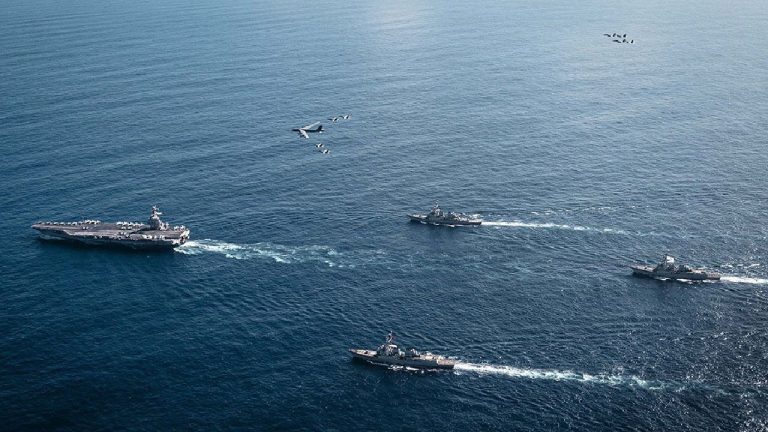
The military buildup is unprecedented since the 1962 Cuban Missile Crisis, according to the Quincy Institute’s analysis. Approximately 15,000 U.S. military personnel have been deployed, including the USS Gerald R. Ford aircraft carrier strike group, amphibious assault ships, bombers, and drones. The Roosevelt Roads Naval Station in Puerto Rico has been reopened to support operations.
In December 2025, President Trump announced that the United States had struck “a big facility” in Venezuela—the first known land-based attack as part of this campaign. U.S. officials confirmed it was a drug-related facility but provided no details about its location, how the strike was carried out, or what role it played in narcotics trafficking.
The Legal and Constitutional Controversy
Presidential War Powers
The Trump administration’s military operations have ignited sharp debate over constitutional war powers. The Quincy Institute argues these strikes violate the Constitution’s Article I, Section 8 reservation of war-making power to Congress and the War Powers Resolution of 1973, which requires congressional authorization within 60 days of military engagement.
The administration claims legal authority through an unusual theory: that the United States is engaged in a “non-international armed conflict” with Venezuelan drug cartels, designated as foreign terrorist organizations. This designation, combined with labeling cartel members as “unlawful combatants,” purportedly permits the use of lethal military force without traditional law enforcement procedures.
“The administration calls the current situation a ‘non-international armed conflict,'” notes CFR’s Will Freeman. “The use of that term seems to allow arbitrary designation of combatants; certainly, near-total discretion for the president, possibly violating Article II of the Constitution.”
The Senate rejected a bipartisan war powers resolution in November that would have blocked military force against Venezuela without congressional authorization. A similar attempt in the House failed in December, leaving presidential authority essentially unchecked.
The Fentanyl-as-WMD Designation
In December 2025, President Trump signed an executive order classifying fentanyl as a “weapon of mass destruction”, a designation that legal scholars view as legally questionable and potentially dangerous precedent. The move echoes the George W. Bush administration’s use of WMD allegations to justify the 2003 Iraq invasion, weapons that were never found.
National Review’s Andrew C. McCarthy provides a detailed legal critique: “Fentanyl is not a weapon of mass destruction, even if the ‘horse’ sign in this instance happens to be an executive order.” He argues that Congress has already defined both narcotic drugs (in Title 21) and weapons of mass destruction (in Title 18) as distinct categories, and the president lacks constitutional authority to reclassify them.
The legal definition of WMD, established in 18 U.S.C. § 2332a, specifically refers to destructive devices like bombs and grenades, poison gas, biological agents, and chemical weapons “designed or intended to cause death or serious bodily injury.” Fentanyl, though deadly when abused, is a Schedule II controlled substance with accepted medical uses as anesthesia and pain relief.
“The former are controlled substances targeted to cause specific bodily effects in specific people,” McCarthy writes. “WMD, in stark contrast, are objects designed to kill indiscriminately.”
The Brennan Center’s Elizabeth Goitein warns the designation could theoretically justify domestic use of military force: “The type of threat the law contemplates is too immediate and specific to be addressed through a presidential declaration.”
Drug Trafficking or Regime Change?
The Counternarcotics Rationale
The administration frames its Venezuela policy as essential to combating drug trafficking. Trump has described Venezuelan President Nicolás Maduro as “one of the largest drug traffickers in the world” and the State Department designated his alleged cartel organization as a foreign terrorist organization in November 2025.
However, multiple analysts question whether Venezuela represents a significant drug threat to the United States. The Trump administration’s own 2025 National Drug Threat Assessment identifies Mexico as the primary source of opiates and Colombia as the primary source of cocaine—not Venezuela. The Quincy Institute notes that less than 15% of U.S.-bound cocaine transits through Venezuela, which is neither a major producer nor a transit hub for fentanyl, which causes the vast majority of U.S. overdose deaths.
“Whatever actions are taken in the Caribbean have no effect on fentanyl,” Brookings Institution expert Vanda Felbab-Brown told NPR, noting that virtually all fentanyl comes from Mexico.
CFR’s Roxanna Vigil observes the scale mismatch: “There’s a lot of mismatch… the United States is using a huge naval deployment against small, little drug boats.” Traditional law enforcement interdiction methods have historically been the standard approach to maritime drug trafficking.
The Regime Change Question
Despite counternarcotics framing, evidence suggests broader regime-change objectives. Trump has reportedly pressed Maduro to step down in direct calls, and the United States offers a $50 million reward for his capture. The administration has also authorized covert CIA operations inside Venezuela.
Former Trump administration official Elliott Abrams, who served as special representative for Venezuela, argues: “If Maduro is not the legitimate leader of Venezuela and is instead a narco-terrorist and a cartel kingpin, it would be difficult to understand why the Trump administration would surround the country with a gigantic armada only to leave him in power.”
The administration has layered additional pressure beyond military strikes. In December, the United States seized Venezuelan oil tankers for alleged sanctions violations and announced a naval blockade on sanctioned oil entering and leaving Venezuela. New sanctions target Venezuelan shipping companies and members of Maduro’s family.
National Review’s Michael Brendan Dougherty observes that Trump’s policy has been “drifting toward regime change,” noting with concern that “far too many opinion-influencers are waiting to see how the policy turns out before telling us what they think about it.”
The Case Against Military Escalation
Historical Lessons and Failed Negotiations
CFR’s Roxanna Vigil provides detailed analysis of past negotiation attempts between the Venezuelan opposition and Maduro regime. Four major efforts between 2014 and 2019 failed, largely because the United States was either lukewarm or openly opposed to dialogue.
The 2016 Vatican-facilitated talks collapsed after Maduro failed to follow through on agreements. The 2017-2018 Dominican Republic negotiations broke down as the first Trump administration increased sanctions pressure. The 2019 Oslo-Barbados talks ended the day after the United States announced new comprehensive sanctions.
Success came only when Washington engaged directly. The 2022-2023 Mexico City talks, with active U.S. participation and parallel negotiations, produced the October 2023 Barbados Agreement establishing an electoral roadmap. This led to María Corina Machado’s overwhelming victory in opposition primaries with over 90% of the vote—and Maduro’s subsequent violations of the agreement. Machado was later awarded the 2025 Nobel Peace Prize for her democratic advocacy.
“The United States position on past talks between Maduro and the opposition has significantly influenced their outcome,” Vigil concludes. “Until now, the United States has been involved behind-the-scenes or remained publicly opposed to these discussions.”
Risks of Chaos and Regional Instability
The Quincy Institute warns that forced regime change could unleash chaos comparable to Iraq. Venezuela’s 30 million population exceeds Iraq’s in 2003, and the country’s land area is twice as large. The Maduro government controls over 100,000 regular military forces plus substantial paramilitary personnel, while numerous other armed factions operate within the country.
“All of the ingredients are present within Venezuela for a chaotic civil war, comparable in scope if not in detail to the one that erupted in Iraq after the U.S. invasion,” the Quincy analysis states. “With a population of 30 million… it is unlikely that the United States could keep order at a reasonable cost.”
Dougherty echoes this concern from a conservative perspective: “National institutions have their own logic and even their own nationalistic pride. Maduro was able to keep the loyalty of his military officers and other government institutions, likely because those breaking with him would have trouble gaining native legitimacy, acting so openly—as they would have been—in concert with the U.S. State Department.”
Regional spillover effects could be severe. Trump has already labeled Colombian President Gustavo Petro an “illegal drug leader,” raising concerns about expanding conflict. Civil war in Venezuela would likely increase refugee flows to Colombia and eventually Mexico, straining countries whose cooperation the United States needs for border security.
Caribbean nations have expressed concerns about impacts on their fishing, tourism, and energy industries. After the 1989 U.S. invasion of Panama (Operation Just Cause), drug trafficking through that country did not stop and may have actually increased, demonstrating the limitations of military solutions to drug trafficking.
Strategic Contradictions
The Trump administration’s 2025 National Security Strategy explicitly discourages direct intervention to achieve “a reasonably stable and well-governed” Western Hemisphere. CFR’s Vigil notes this contradiction: “Doing things the hard way could mean war with Venezuela. This would be a mistake. It would also be inconsistent with Trump’s National Security Strategy.”
Freeman emphasizes the military limitations: “The United States has not unilaterally achieved regime change through air power alone, and a ground invasion remains unlikely.” He adds that “only a ground invasion or assassination is likely to remove Maduro, at potentially high cost to U.S. lives and with very uncertain outcomes.”
Dougherty argues that previous Trump administration policies contributed to current instability: “The sanctions layered on top of a crisis created by Chavista misrule and foreclosed paths to stabilization. Millions fled the country in a vast exodus, fueling northward migration. As the United States pulled the rug out from under Venezuela, Caracas turned to Beijing, Moscow, and Tehran.”
Diplomatic Alternatives and Strategic Recommendations
Lessons for Future Negotiations
Despite skepticism about military escalation, experts across the spectrum agree that diplomatic engagement offers better prospects. CFR’s Vigil outlines three key lessons from the Barbados Agreement negotiations:
Avoid public humiliation. “The United States should issue its demands and ultimatums privately,” Vigil advises. “Private messaging will be more effective than public demands and ultimatums, which are likely to make Maduro dig in for fear of being publicly humiliated.” The Trump administration’s discreet direct engagements have provided Maduro cover for making concessions.
Avoid all-or-nothing demands. While the Barbados Agreement gave the opposition a strong platform, Machado’s overwhelming primary victory may have changed Maduro’s calculus about following through. “Future talks should consider how to strategically tie actions and progress to concessions,” Vigil writes, with the goal of increasing compliance likelihood.
Don’t overvalue sanctions relief. The Maduro regime has survived years of maximum pressure sanctions, suggesting limited value as a negotiating carrot. The regime’s violations of the Barbados Agreement after receiving sanctions relief indicate Maduro was only willing to go so far for this concession.
Law Enforcement-First Approach
The Quincy Institute advocates returning to traditional counternarcotics methods: increasing maritime interdictions, restoring funding to demand-reduction programs, prosecuting financial crimes, and strengthening governance in drug-producing regions.
“Boosting judicial cooperation and intelligence sharing, countering impunity and criminal governance in drug-producing regions, and restoring counter-narcotics assistance previously paused earlier this year will go far in weakening crime syndicates and rebuilding trust with U.S. security partners in the region,” the analysis concludes.
The report recommends the Democratic Transition Framework for Venezuela from 2020, a power-sharing roadmap that could be adapted to current circumstances. The administration should reengage mediators in Qatar, Norway, Mexico, and Brazil to pressure both Maduro and the Machado-led opposition to negotiate.
Direct U.S. Participation
The military buildup, despite its risks, has created leverage for negotiations. “The opposition and the Maduro regime will face a new variable at the negotiating table: the United States and its heavy military presence off Venezuela’s coast,” Vigil notes.
Direct U.S.-Venezuela negotiations running parallel to opposition talks have advantages. “Many of the things Maduro likely wants out of negotiations—such as amnesty and guarantees of safety—are things that he will need to negotiate directly with the United States.”
The administration has already indicated some results: since boat strikes began in September, there have been over twenty-five ICE deportation flights to Venezuela, returning approximately 5,000 Venezuelans according to Human Rights First’s monitoring.
Regional and International Responses
Regional reactions have been mixed. El Salvador and the Dominican Republic have expressed support and allowed U.S. forces access to bases. However, Colombia suspended intelligence-sharing with the United States in November, and Ecuador overwhelmingly rejected President Noboa’s proposal to allow foreign military bases.
“While the region’s response to U.S. actions in the Caribbean has so far been ad hoc, land strikes inside Venezuela would be a ‘test’ of the region’s willingness to push back on the U.S. military’s use of force,” Vigil observes. She notes Latin America is “quite divided,” with countries largely acting in pursuit of their own interests.
Russia has signaled strong support for Venezuela, a longtime ally. President Vladimir Putin reportedly called Maduro following the December tanker seizure to reaffirm Moscow’s support. The two countries finalized a major strategic partnership treaty in October 2024 expanding bilateral cooperation on energy, mining, defense, and counterterrorism—both nations are under extensive U.S. sanctions.
Conclusion: The Path Forward
The Trump administration’s Venezuela policy stands at a critical juncture. Military escalation has created unprecedented pressure on the Maduro regime while raising profound questions about constitutional authority, international law, and strategic wisdom.
Expert consensus across the political spectrum suggests current military operations exceed what counternarcotics objectives would require and risk outcomes contrary to U.S. interests. The legal classification of fentanyl as a weapon of mass destruction lacks statutory basis and sets concerning precedents for presidential authority. The maritime strikes operate without clear congressional authorization in potential violation of the War Powers Resolution.
Yet the military buildup has created leverage that previous maximum pressure sanctions alone could not achieve. The question is whether this leverage will be used to force Maduro to the negotiating table or to pursue regime change through military means—an outcome that historical experience suggests could unleash regional chaos.
As Vigil concludes: “The United States position on past talks between Maduro and the opposition has significantly influenced their outcome. Until now, the United States has been involved behind-the-scenes or remained publicly opposed to these discussions. That can no longer be the case. The U.S. military deployment now put Washington at center stage for any further developments.”
The choice between military escalation and diplomatic de-escalation will determine not only Venezuela’s future but also the precedent for presidential war powers, the effectiveness of U.S. policy in Latin America, and America’s commitment to constitutional governance. Congressional action to reassert its war-making authority may prove essential to preventing the worst outcomes of an unconstrained military campaign.
This analysis synthesizes perspectives from the New York Times, Council on Foreign Relations, Quincy Institute for Responsible Statecraft, National Review, and CNN to provide a comprehensive overview of the Trump administration’s evolving Venezuela policy and its implications.