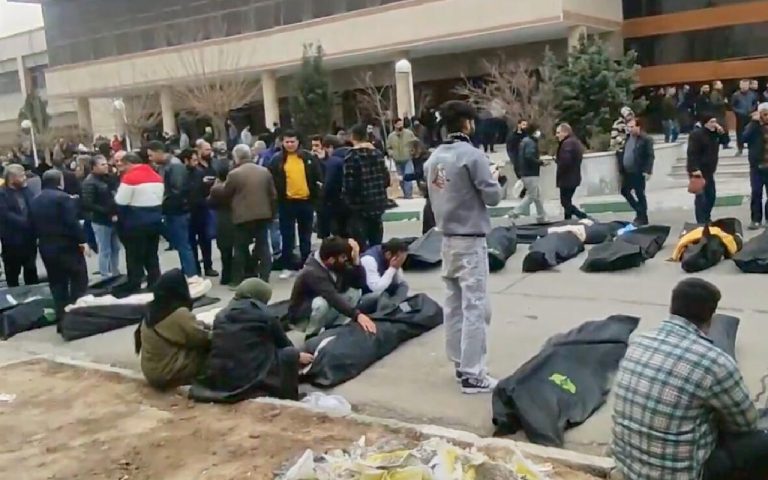
In recent waves of unrest in Iran, reported “death tolls” have traveled through the information ecosystem with unusual speed and certainty, often outpacing what can be independently verified under conditions of internet shutdowns and restricted access. When communications are disrupted, casualty accounting becomes inherently difficult, and that uncertainty can be exploited: competing actors can inject dramatic figures into public discourse, where repetition and media pickup can make claims feel “confirmed” even when underlying evidence remains opaque. Al Jazeera notes that blackouts make it “particularly difficult” to track actual numbers and that it cannot independently verify any of the competing claims.
This is where modern “atrocity numbers” function less like documentation and more like psychological warfare: figures are used to generate moral panic, delegitimize a targeted government, and create pressure for punitive external action. The UN’s Iran Fact-Finding Mission has stressed that the priority must be gathering evidence and establishing whether violations occurred, underscoring that verification is essential and warning that unilateral military intervention by third states is contrary to international law. That contrast—between evidence-first investigation and viral certainty—is central to understanding why inflated numbers can be politically useful even when unproven. OHCHR
Main Claims: Why the Death-Toll Figures Look Manufactured
A major red flag in any casualty narrative is extreme numerical instability—figures that swing from one magnitude to another without transparent methodology, case lists, or replicable counting standards. The article “Manufacturing martyrdom: The West’s cynical use of Iranian protest figures” describes claims ranging from thousands to tens of thousands, including a Canada-based NGO allegation of 43,000 killed and 350,000 wounded, presented without publicly verifiable forensic evidence, independently auditable documentation, or proof consistent with such massive events. This type of “scale shock” is not incidental: it overwhelms audiences emotionally and compresses the timeline for skepticism, debate, and verification. Source
Meanwhile, Iranian state television issued a much lower official figure of 3,117 deaths, citing the Martyrs Foundation and stating that 2,427 of those killed were civilians and security forces. This official number is also politically situated and contested, but its presence highlights the core problem: the public is being asked to choose between radically different realities in an environment where independent verification is structurally constrained. Al Jazeera
Even widely cited opposition-linked counting projects can be difficult to audit from the outside. In its explainer, Al Jazeera reports that HRANA declined to disclose members or funding sources and does not provide its collection and analysis methodology publicly, while also stating that it cannot reveal identities of corroborating sources inside Iran. These constraints may be understandable for security reasons, but they also mean media consumers should treat precise claims as provisional rather than definitive. Source
How the Numbers Are Produced and Laundered Into “Truth”
The mechanics described in The Cradle’s account resemble a modern propaganda pipeline: an explosive number is released by a politically aligned actor, boosted by high-visibility influencers, repeated across opposition channels, and then “laundered” into mainstream legitimacy through media citation chains. Once a figure is repeated enough times—especially by professional outlets—it begins to function as assumed background reality, even if its evidentiary basis remains thin. Source
Traditional media can unintentionally reinforce this dynamic when it publishes dramatic numbers sourced to anonymous officials. For example, TIME reported that “as many as 30,000 people could have been killed” over two days, attributed to two senior Iranian Ministry of Health officials, while stating explicitly it could not independently verify the figures. In narrative warfare terms, the disclaimer often does not neutralize the impact: the headline number is what travels, and the uncertainty is what gets dropped. Source
The Role of Digital Influence Campaigns (and Why It Matters)
Information operations are not theoretical in this space. A Haaretz investigation describes Persian-language online campaigns indirectly funded by Israel and notes research findings involving online networks and deepfakes, framed around promoting Reza Pahlavi and shaping Iranian political perceptions. Regardless of one’s politics, the key point is structural: if organized digital persuasion is active, casualty narratives can be amplified, steered, or strategically saturated to achieve political ends. Source
Historical Propaganda Parallels: From “Incubator Babies” to Iraq and Libya
Large, emotive atrocity claims have repeatedly been used to shape public consent for intervention. The best-known Gulf War example is the Nayirah testimony, in which sensational claims about babies removed from incubators helped galvanize opinion. The enduring lesson is not merely that specific stories can be contested later; it is that atrocity narratives can be engineered to short-circuit scrutiny in the moment. Source
The Iraq War demonstrates how high-stakes claims can be institutionalized even when the underlying evidence is weak or politicized. The U.S. Senate Intelligence Committee’s public record includes material related to prewar intelligence and postwar findings, illustrating how official narratives can harden into policy drivers—and how those narratives can later unravel. U.S. Senate Select Committee on Intelligence Source
Libya shows a related pattern: warnings of mass atrocities became central to the intervention argument, while scholarly debate continues about how threat framing interacted with political objectives. Alan J. Kuperman’s critique is among the frequently cited academic challenges to the “imminent genocide” framing, and it remains relevant as a cautionary reference point when casualty claims become a rhetorical bridge to foreign force. JSTOR (Kuperman, “Obama’s Libya Debacle” landing page) Source
Why Inflate the Death Toll? The Psychological and Political Objectives
Inflated death tolls can serve multiple overlapping objectives at once. Domestically, they intensify fear, rage, and hopelessness; internationally, they build a moral case for escalation by making diplomatic restraint look like abandonment. The UN Fact-Finding Mission’s statement underscores the need to break cycles of impunity through evidence and accountability—yet it also explicitly notes that threats or acts of unilateral military intervention are contrary to international law, highlighting how “humanitarian urgency” can be weaponized into unlawful pressure. OHCHR Source
In practice, once an audience accepts an atrocity scale claim (tens of thousands killed), the menu of “reasonable responses” shifts sharply toward sanctions, isolation, covert action, and—even if not openly stated—intervention logic. That is why a number does not need to be proven to be useful; it only needs to be believed long enough to move institutions, headlines, and policy debate in a desired direction. The laundering mechanism described in The Cradle is essentially a narrative supply chain designed to manufacture that belief. Source
Conclusion: Toward Evidence, Not Emotional Arithmetic
Deaths in Iran’s protests are real and deserve serious, impartial investigation. But the information environment described across the cited reporting shows how casualty figures can be used as psychological weapons: injected during blackouts, amplified through influencer-media loops, and presented with certainty disproportionate to what can be independently verified. The result is a propaganda-ready atmosphere in which outrage is directed not only at Tehran but also at policymakers in Washington—pressured to “do something” under the moral weight of numbers that may not withstand scrutiny. Al Jazeera
The safest public standard is simple: treat extreme figures as claims requiring transparent methods, favor evidence-based investigations, and track corrections with the same energy as headlines. That posture aligns with the UN Fact-Finding Mission’s emphasis on documentation and accountability—and reduces the risk that “dirty numbers” become a manufactured pretext for escalation. OHCHR