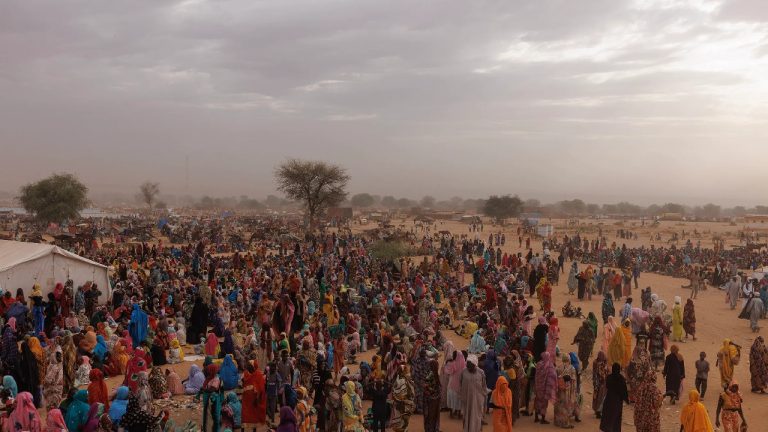
Follow line south and west from Gaza Strip, continue through Egypt, and you’ll end up in another place where genocide is in progress—one we don’t hear much about in United States, probably because it’s happening in African nation. Place is Sudan, 15th-largest country in world and third-largest in Africa, with area quarter size of United States and around 50 million inhabitants. Right now, about 45% of those people, 21.2 million of them, “are facing highest levels of acute food insecurity,” according to UN World Food Program.
Famine has been confirmed in at least two Sudanese cities, with 20 other areas on verge of it. Situation expected to worsen next year as food stocks dry up and fighting that has ravaged country since 2019 continues. At least 12 million people have been displaced. To put in perspective: compared to ongoing genocide two countries to north, number of starving people in Sudan is 10 times entire population of Gaza, while number of displaced Sudanese is almost six times that number. Sudan presents world’s worst humanitarian crisis.
Media Coverage Disparity
Like many people, Americans have spent years since Hamas’s October 2023 attack on Israel watching buildings fall down and bodies pile up in Gaza. In spring 2024, while American college students risked expulsion and deportation to raise hell about genocide already underway in Gaza, New York Times told its journalists to look other way, restricting use of terms like “genocide,” “ethnic cleansing,” “occupied territory,” and even “Palestine,” according to Intercept reporting.
By December 2024, Times was doing better, covering Amnesty International’s 296-page report accusing Israel of “carrying out genocide in Gaza.” By July 2025, paper was no longer afraid to use “G” word or run string of stories and op-eds, including coverage of UN’s determination that Israel “was committing genocide against Palestinians.” However, major US media were slow to recognize horror unfolding in Gaza.
But if media were slow to acknowledge unfolding genocide in Gaza, they have given far less coverage to one developing in Sudan. Important exception is work of Times’s chief African correspondent Declan Walsh who, along with Times staffers, won 2025 Pulitzer Prize in international reporting for his work on Sudan. Too bad so many of his articles initially appeared not on front page but inside paper’s print edition.
Civil War Origins
Civil war raged since massive nonviolent popular uprising dislodged Omar al-Bashir in 2019. Group of military officers formed Transitional Military Council, initially agreeing to establish transitional government with Sudanese Professionals Association. Soon after, Sudanese Armed Forces overthrew nascent government establishing military rule.
In April 2023, paramilitary Rapid Support Forces turned weapons on SAF. Fighting developed around capital Khartoum. SAF eventually drove RSF out and conflict moved to Darfur region, where RSF had deep roots. RSF emerged from Janjaweed, responsible for genocidal campaign in Darfur 2003-2005, supporting Arab herders against Black African farmers in climate-exacerbated drought conflict.
War is struggle between former allies: RSF commander Muhammad Hamdan Dagalo Musa (Hemedti) and General Abdel Fattah al-Burhan (SAF leader), who fell out over integrating RSF into Sudanese military.
El-Fasher Siege and Atrocities
Having lost Khartoum for 18 months, RSF besieged Darfurian city of el-Fasher, surrounding it with earthen berm, effectively walling in and starving inhabitants. In October 2025, they finally made their way into city, massacring civilians (including “500 patients and their companions” in Saudi Maternity Hospital), while committing mass rape. As UN top relief official Tom Fletcher reported, “Tens of thousands of terrified, starving civilians have fled [city] or are on move… Those able to flee—vast majority women, children, and elderly—face extortion, rape, and violence on perilous journey.”
According to BBC, “UN says less than half of 260,000 people estimated to have been in city before it fell have been accounted for.” Some made 44-mile trek east to humanitarian hub in Tawilah. Others went much farther to camp in SAF-controlled territory near town of al-Dabbah, 480 miles northeast of el-Fasher. Along way, they faced rape, extortion of anything they had left, and possibly death. “RSF fighters stripped us of everything we had—money, phones, even our nice clothes,” one refugee told BBC reporter.
US Role and Aid Cuts
When President Trump’s Elon Musk spent February 2025 weekend “feeding USAID [US Agency for International Development] into wood chipper,” he condemned thousands of people in poor countries to death. As Washington Post reported, “impact in Sudan was especially deadly.” In fact, “World Health Organization says estimated 5 million Sudanese people may lose access to lifesaving health services as result of US cuts.”
“When US-supported soup kitchens were forced to close, babies starved quietly, their mothers said, while older siblings died begging for food. Funding stoppages meant that critical medical supplies were never delivered, doctors said. Lack of US-funded disease response teams has made it harder to contain cholera outbreaks, which are claiming lives of those already weakened by hunger.”
Sudan is also among 19 countries for which President Trump has halted immigration applications, meaning none of refugees fleeing starvation and genocide there are welcome. US Citizenship and Immigration Services announced plans to “conduct comprehensive review” of status of nationals who received immigration benefits while Joe Biden was president. This includes several thousand Sudanese immigrants and refugees who arrived in those years.
Foreign Arms Supplies
Key US ally in Middle East, United Arab Emirates, appears to be main supplier of arms to RSF (although officials deny this). According to Amnesty International, arms for both sides come from manufacturers in countries including China, Turkey (US ally), Russia, and Serbia, in clear violation of international Arms Trade Treaty and international humanitarian law. For UAE, motive seems to be maintaining access to Red Sea, which lies along Sudan’s east coast and is UAE’s crucial shipping lane. In addition, there’s gold in Sudan.
After early attempts to facilitate détente between two sides, by February 2025, another US ally, Saudi Arabia, had tilted toward SAF, in widening rift with its one-time partner UAE. General al-Burhan visited Saudi Arabia at invitation of Crown Prince Mohammed Bin Salman. During crown prince’s November 2025 White House visit, he appears to have schooled Donald Trump on Sudanese crisis, prompting American president to announce that “his Majesty would like me to do something very powerful having to do with Sudan.”
Original reporting by Rebecca Gordon from Foreign Policy in Focus / TomDispatch. Republished with additional research and verification by ThinkTanksMonitor.