The violent scenes emerging from Iran in mid-January—families searching through bodies, security force assaults on unarmed protesters, and the rapid dissipation of public momentum—illustrate a fundamental paradox of revolutionary governance. Systems founded on promises of moral transformation and popular liberation inexorably evolve into regimes maintained principally through force. The Islamic Republic’s trajectory offers a case study in how ideologically-grounded political movements sacrifice their foundational principles upon encountering the exigencies of state survival.
The Platonic Framework and Revolutionary Reality
The conceptual architecture underlying Iran’s founding borrowed heavily from classical political theory, particularly Plato’s vision of governance by a specially educated guardian class led by philosopher-rulers capable of transcending narrow self-interest. Ayatollah Ruhollah Khomeini’s doctrine of clerical guardianship—the velayat-e faqih—translated this ancient ideal into contemporary theological language, positing that Iran could be governed by religious scholars guided by moral wisdom rather than by the narrow interests of secular politics or popular opinion.
Yet Plato himself harbored profound skepticism about whether absolute wisdom could coexist with absolute power. His Republic was conceived not as a political blueprint for actual implementation but as a philosophical thought experiment exposing the limits of human nature and the inevitable corruptions attending unchecked authority. Plato warned against the belief that virtue could govern without limits, and outlined a cyclical deterioration through which ideal regimes degenerate progressively into increasingly coercive systems.
The Islamic Republic encountered these Platonic constraints immediately upon consolidation of power. What distinguished Iran was not the collision between revolutionary ideals and historical reality—that collision has always been characteristic of radical state-building—but rather the specific circumstances under which the regime had to operate. From its inception, the Islamic Republic faced existential threats: an externally-imposed eight-year war with Iraq, comprehensive economic isolation, and relentless regional hostility that forced governance into a permanent emergency posture.
The Transformation of Moral Authority into Institutional Force
Under these pressures, the regime’s character fundamentally transformed. Early promises of liberty and expanded political participation—central to Khomeini’s pre-revolutionary messaging—gave way rapidly to systematic suppression of democratic practices once the revolutionary government consolidated control. Religion, originally positioned as moral philosophy guiding governance, became instead a mechanism for enforcing national cohesion in the face of external danger. Authority derived increasingly not from popular consent or philosophical wisdom but from the regime’s capacity to monopolize violence and guard national sovereignty.
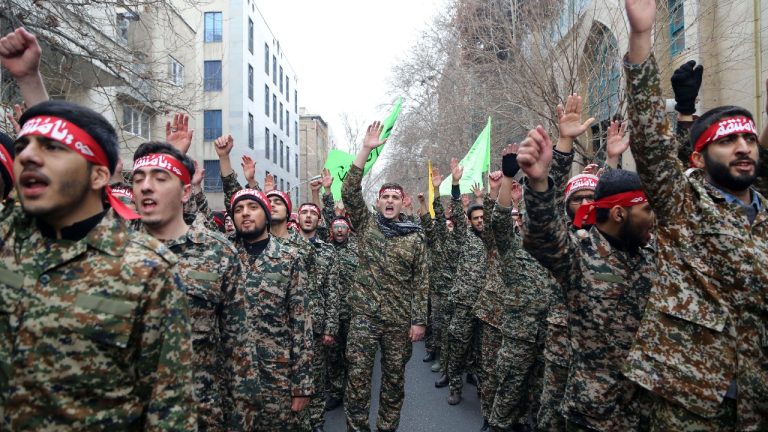
The Iranian Revolutionary Guard Corps (IRGC), originally conceived as defenders of revolutionary ideals against internal counter-revolution and external aggression, gradually metamorphosed into an institutional enforcer of regime survival through coercive means. What had once been revolutionary guardians protecting collective ideals became securitized operators maintaining power through bureaucratic control of state institutions, economic enterprises, and security apparatus. By the time Ali Khamenei assumed supreme leadership in 1989, the critical philosophical turning point had already passed. The guardians no longer ruled through reason; they ruled through force.
Economic Power and Institutional Capture
The scope of institutional entrenchment became impossible to conceal. The IRGC today controls approximately 50 percent of the Iranian economy through its command of major industrial sectors, financial services, and commercial enterprises, functioning less as a military organization than as a massive parallel state structure. This economic consolidation represented the logical terminus of the revolutionary regime’s evolution: the security apparatus became inseparable from economic governance, ideology became subordinate to material interests, and the language of revolutionary transformation served merely as rhetorical cover for institutional self-perpetuation.
The contradiction between the regime’s founding mythology and its operational reality had become impossible for the Iranian public to ignore. Many protest participants in early 2026 did not fundamentally reject the Islamic Republic’s original ideals but rather despaired of the regime’s persistent failure to live up to them. This disillusionment reflects what Plato identified as the crucial moment in any republic’s decay: when rulers lose touch with the society they govern, the social contract erodes.
The Fracture in Legitimacy and the Power Vacuum
The 2026 protests exposed an unmistakable fracture between the ruling class’s claims to moral authority and the public’s refusal to recognize that authority as legitimate. The regime still invoked revolutionary principles and Islamic governance, yet the governed no longer accepted the premise that clerical wisdom guided policy. Instead, Iranians saw corruption, economic mismanagement, suppression of basic freedoms, and the instrumentalization of religion as a tool of domination rather than a source of moral guidance.
Plato warned explicitly that in the republic’s final stages, as moral authority crumbles, opportunists rush to fill power vacuums left by fading legitimacy. This pattern manifests vividly in contemporary Iran. Internally, clerical factions competing for influence, IRGC commanders expanding institutional domains, reformist politicians seeking greater voice, and ethnic movements including Azeris, Kurds and Balochis positioning themselves for advantage all anticipate a future in which current power structures cannot persist indefinitely. Externally, regional rivals, global powers, and diaspora-backed groups maneuver to exploit any potential collapse of centralized authority.
The Armed Consolidation Scenario
Yet the most organized armed force within Iran is neither the protest movement nor democratic reformist factions. The IRGC maintains approximately 190,000 personnel across all military and paramilitary branches, making it far more capable of consolidating power than any other institutional actor or movement. Historical precedent suggests that when authoritarian regimes face simultaneous legitimacy crisis and security apparatus strength, the outcome typically involves institutional consolidation through intensified coercion rather than democratic opening.
Once moral legitimacy erodes, power becomes the primary currency motivating regime behavior. In such circumstances, survival trumps ideology, and authority becomes justified by claims of necessity—the requirement to maintain order, prevent chaos, and defend national integrity. These justifications, however self-serving, prove sufficient to sustain coercive systems so long as the security apparatus remains internally cohesive and possesses the material capacity to suppress resistance.
The Three Paths and the Probable Trajectory
Plato identified three potential outcomes for declining republics: genuine reform that restores legitimacy through institutional transformation; managed stagnation in which declining regimes maintain control through compromise and limited reforms; or authoritarian consolidation in which deteriorating legitimacy is compensated for through intensified coercive capacity. Iran appears to be moving inexorably toward the third path, a development reflecting the structural fusion of ideology and absolute power that makes genuine reform extraordinarily difficult.
The regime’s response to 2026 protests demonstrates this trajectory. Rather than acknowledging the legitimacy crisis and implementing substantive reforms that might restore public confidence, authorities deployed security forces with predictable brutality while simultaneously attempting to manage information, dispute casualty figures, and reframe unrest as externally-instigated subversion. This response—coercive suppression paired with defensive rhetoric—addresses symptoms rather than causes and further erodes the possibility that governance could be restored on any foundation other than force.
The Broader Philosophical Lesson
The Islamic Republic’s experience vindicates Plato’s deepest skepticism: the philosopher-king was never meant to navigate the messy realities of actual power. Revolutionary regimes from Lenin’s Soviet Union through Mao’s China to Khomeini’s Iran have pursued moral or ideological utopias, only to discover that survival requires force, and ideals weaponized become tools of domination rather than sources of legitimacy. The transformation of revolutionary guardianship into coercive institutional control represents not a moral failure specific to Iranian leadership but rather a philosophical impossibility inherent in attempts to fuse unchecked authority with ideological governance.
The tragedy is not that Iran’s leaders lacked virtue or failed to implement Khomeini’s vision with sufficient dedication. The tragedy is structural: the conditions required for Platonic governance—a stable, insulated polity free from existential threats, able to permit wisdom to guide decisions without constant coercive enforcement—could never exist in twentieth and twenty-first century Iran. The system was philosophically impossible from inception. The regime’s evolution toward coercive consolidation was not an aberration but an inevitable trajectory.
Original analysis inspired by Tanya Goudsouzian and Ibrahim Al-Marashi from New Arab. Additional research and verification conducted through multiple sources.