Category: Middle East

Busy city square in Amsterdam with historic buildings, crowded with locals and tourists, and street performers

The Silent Transformation: Demographic Shifts and the Crisis of Western Identity

Western democracies are experiencing a significant sociopolitical transformation due to demographic changes and new ideological alliances. Eliyahu Haddad’s analysis highlights that mass migration, declining birth rates, and “ideological paralysis” contribute to a “civilizational replacement,” which is now influencing electoral dynamics in Europe and North America and impacting social cohesion, domestic security, and transatlantic relations with Israel.

Read More »
Vladimir Putin seated across a table from a Syrian official, in a formal meeting setting with flags in the background

Moscow’s Survival Strategy: Navigating the Post-Assad Order in Syria

The October 2025 summit in Moscow between Vladimir Putin and Ahmed al-Sharaa highlights a shift in Russia’s diplomatic strategy following the collapse of the Ba’athist regime in Syria. Contrary to predictions of diminished Russian influence, the Kremlin has adapted its approach, favoring transactional pragmatism over ideological loyalty. By engaging with former adversaries, Russia seeks to preserve its strategic interests in the Mediterranean, underscoring that its foreign policy is primarily motivated by practical concerns.

Read More »
Turkish and Iranian officials shaking hands in a formal setting, flanked by the flags of Turkey and Iran

Ankara and Tehran: A New Regional Security Architecture Emerges

Turkish Foreign Minister Hakan Fidan’s visit to Tehran signifies a crucial shift in the Middle East’s geopolitical dynamics. Amid increasing regional instability, Türkiye and Iran are evolving from transactional diplomacy to a deep structural partnership. Fidan’s discussions with Iranian President Masoud Pezeshkian and Foreign Minister Abbas Araghchi aimed at integrating Iran into a framework for “regional solutions for regional problems,” beyond just preparation for the High-Level Cooperation Council.

Read More »
Donald Trump and Cyril Ramaphosa seated indoors, with Trump holding a document showing a couple's photo

The Crumbling Pillar: How Gaza and G20 Isolation Signal the End of Unipolarity

The decline of unipolar authority is now evident, particularly highlighted by the US’s absence from the G20 Summit in South Africa. For years, global diplomacy relied on American leadership to resolve crises. However, the situation in Gaza and the West’s isolation at major multilateral events in late 2025 indicate that this era of singular influence is over.

Read More »
Close-up of a map showing the region of Gaza, Israel, and surrounding towns like Rafah and Khan Yunus

Iraq 2.0: The Legal Architecture of the New American Occupation in Gaza

The adoption of UN Security Council Resolution 2803 in late 2025 signifies a significant change in governance for the Gaza Strip, shifting from Israeli military control to an American-led administration. The resolution, while citing “stabilization” and “transitional administration,” reflects strategies analogous to those used during the 2003 Iraq invasion. By forming a “Board of Peace” and a Civil-Military Coordination Center (CMCC), the U.S. positions itself as the new de facto occupying power, leveraging international mandates to obscure violations of Palestinian sovereignty.

Read More »
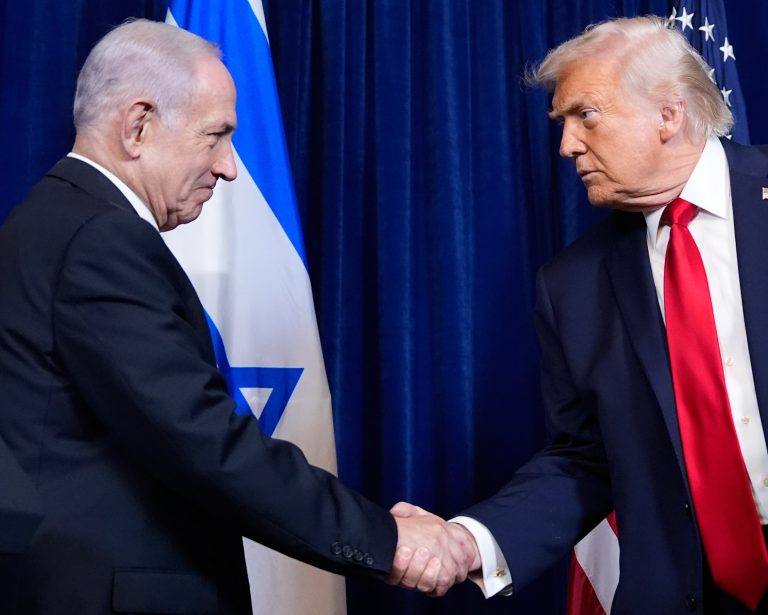
Trump and Netanyahu

Trump’s Gaza Stabilization Force Faces ‘Peace Enforcement’ Deadlock

The adoption of UN Security Council Resolution 2803 signifies a diplomatic win for the Trump administration, endorsing the “20-point plan” for Gaza. However, the initiative faces challenges due to major Arab powers’ refusal to participate in “peace enforcement” against Hamas, which may hinder the deployment of the authorized International Stabilization Force (ISF) aimed at securing the region.

Read More »