Category: Iran

A woman in a dark coat sets fire to a printed portrait of a man with a white beard and black turban using a lighter.

Converging Internal and External Pressures: Iran’s Strategic Vulnerability in a Changed Regional Order

This analysis examines Iran’s precarious position as it faces the convergence of historic domestic unrest and intensified external military pressure. With the collapse of its “social contract,” a devalued currency, and the erosion of its regional proxy networks, the regime is trapped in an escalatory cycle where traditional diplomatic off-ramps have vanished, leaving only pathways toward confrontation, capitulation, or institutional collapse.

Read More »
A group of people gathered in an outdoor courtyard where several black body bags are laid out on the ground.

The Death Toll in Iranian Protests: A Psychological Game to Provoke U.S. Intervention

In early February 2026, the debate over Iranian casualty figures has moved beyond mere counting into a high-stakes battle over the validity of human rights evidence versus strategic information warfare. The “January massacres” have produced a range of data so wide that it has effectively paralyzed the international community’s ability to respond with a single, unified voice.

Read More »
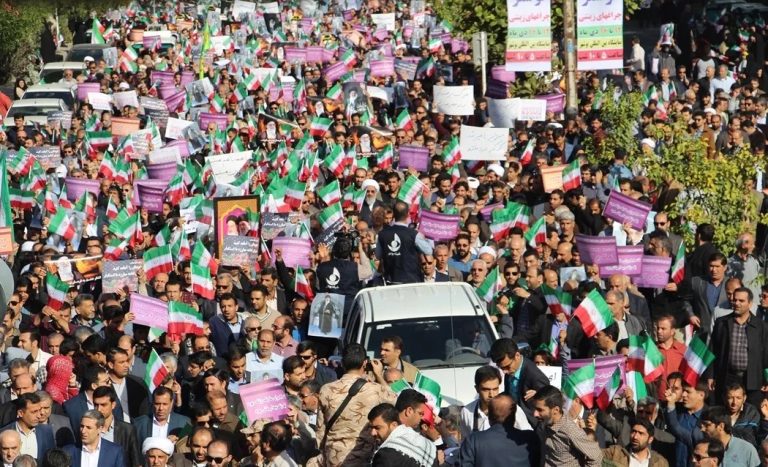
A large crowd of people holding up posters with a portrait of a bearded man in a black turban and glasses.

Strategic Miscalculation: Why Iranian Regime Change Would Destabilize the Region

In early February 2026, the debate over Iranian regime change has moved from theoretical policy papers to an active military and intelligence reality. Following the “Midnight Hammer” strikes of June 2025 and the massive, violent unrest of January 2026, the region stands at a precipice where the collapse of the Islamic Republic is no longer unthinkable, but potentially catastrophic.

Read More »
A strategic geographic map of the Middle East and Central Asia highlighting the maritime and land routes connecting Iran's Chabahar Port and Pakistan's Gwadar Port to landlocked nations.

Why Central Asia Prioritizes Iranian Ports Over Pakistan

In January 2026, the trade map of Eurasia reflects a stark reality: despite being hundreds of kilometers closer to the Central Asian Republics (CARs), Pakistan’s ports are frequently bypassed for Iranian alternatives. While geography favors Pakistan, operational reliability and security stability have solidified Iran’s position as the preferred gateway.

Read More »
A collection of various Iranian newspapers spread out on a wooden table, featuring headlines in Persian and a prominent photograph of Donald Trump on one of the front pages.

Iran’s Battle for Survival is the Arab World’s Fight Too

In early 2026, the Middle East has entered what analysts describe as a state of “Exhausted Realignment.” Following the kinetic “12-Day War” between Israel and Iran in June 2025 and the fall of the Assad regime in Syria in December 2024, the region is now caught between a “Maximum Pressure 2.0” campaign from Washington and a desperate diplomatic “hedging” strategy by the Gulf states.

Read More »
A large crowd of people walking down a city street, viewed from behind.

Iran’s Economic Crisis and Nationwide Protests

The protests that began on December 28, 2025, represent a critical inflection point for Iran, fueled by an economic “perfect storm” that has effectively hollowed out the country’s middle class. As of January 4, 2026, the movement has spread to over 100 locations across 22 provinces, marking it as one of the most geographically expansive challenges to the Islamic Republic since 1979.

Read More »
Iraqi Prime Minister Mohammed Shia' al-Sudani speaking at a green podium with a construction crane logo, surrounded by officials.

Iraq Government Formation: US-Iran Competition Over Militia Influence

As Prime Minister Al-Sudani navigates a fractured parliament following the November 2025 elections, Iraq has become the ultimate battleground for US and Iranian influence. With the Trump administration demanding the exclusion of sanctioned militias and Tehran leveraging its strategic assets, the race for the premiership—featuring figures like Nouri al-Maliki and Qasim al-Araji—will determine whether Iraq can maintain its sovereignty or fall deeper into a high-stakes geopolitical confrontation.

Read More »
Turkish and Iranian officials shaking hands in a formal setting, flanked by the flags of Turkey and Iran

Ankara and Tehran: A New Regional Security Architecture Emerges

Turkish Foreign Minister Hakan Fidan’s visit to Tehran signifies a crucial shift in the Middle East’s geopolitical dynamics. Amid increasing regional instability, Türkiye and Iran are evolving from transactional diplomacy to a deep structural partnership. Fidan’s discussions with Iranian President Masoud Pezeshkian and Foreign Minister Abbas Araghchi aimed at integrating Iran into a framework for “regional solutions for regional problems,” beyond just preparation for the High-Level Cooperation Council.

Read More »