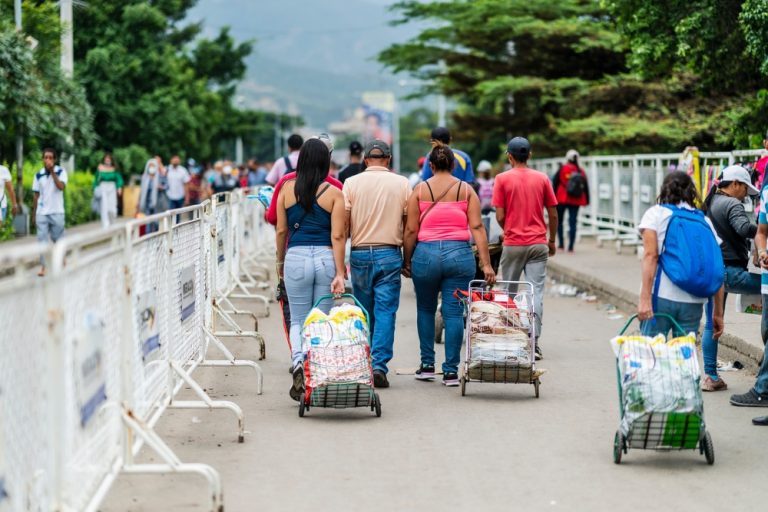
The U.S. military captured Nicolás Maduro in the early hours of January 3, 2026, pulling him from a fortified compound in Caracas and flying him to New York to face narcoterrorism charges. Trump declared the United States would now “run” the country for an indeterminate future. Some celebrated the fall of a dictator. But for the nearly 8 million Venezuelans scattered across dozens of countries, the reaction was something else entirely: dread. Because the removal of one man is now being used as a reason to strip them of the legal protections that keep them housed, employed, and safe from deportation.
The Venezuelan diaspora remains one of the largest in the world with at least 7.9 million people living outside the country as of early 2026, primarily due to nearly a decade of ongoing political and economic crises. Although around 4.5 million Venezuelans have managed to secure some form of regular status or protection, around 2.2 million remain undocumented. The political calculus has shifted overnight: host governments that once granted emergency permits tied to the Venezuelan crisis are now asking whether those permits still make sense with Maduro gone.
The Temporary Protection Trap
The problem is structural. Most Venezuelans abroad don’t hold permanent residency or refugee status. They live under temporary mechanisms — special permits, humanitarian visas, emergency residence cards — designed to respond to the scale of displacement but never intended to last forever. In Colombia, the region’s primary host with 2.8 million Venezuelans, the Temporary Protection Statute provides a 10-year residency permit. That’s the most generous offer in the hemisphere. Everywhere else, the clock is ticking.
In the United States, a temporary protected status for Venezuelans was revoked in late 2025 by the Trump administration, leaving more than 600,000 Venezuelans uncertain about their future and legal status to live and work there. The legal fight was fierce — a federal judge in San Francisco temporarily blocked the termination, calling DHS Secretary Noem’s conduct “unprecedented” and suggesting her decision had been “predicated on negative stereotypes” about Venezuelan migrants. But on October 3, 2025, the Supreme Court allowed the termination of the 2023 Venezuela TPS designation to take immediate effect. Justice Ketanji Brown Jackson, dissenting alone, warned the court had used its power “to allow this Administration to disrupt as many lives as possible, as quickly” as it could.
Peru tells a parallel story. Home to approximately 1.6 million Venezuelans — the second-largest host population globally — the government initially issued hundreds of thousands of permits in 2018, then halted the program and imposed restrictive visa requirements. Roughly half of Peru’s Venezuelan residents now lack legal status
Into this gap stepped Chile’s president-elect José Antonio Kast with a proposal that sounds benign on paper. Following a summit in Quito, Kast and Ecuadorean President Daniel Noboa discussed Kast’s proposal to establish a “humanitarian corridor” to facilitate the return of undocumented Venezuelan migrants to their home country. Kast detailed his plan to coordinate efforts with Argentina, Peru, Ecuador, Bolivia, and Colombia to create a secure transit route for migrants currently residing illegally in the Southern Cone and Andean regions.
The language is soft, but the intent is sharp. During Chile’s national presidential debate, Kast defended a hardline stance on irregular migration, stating that undocumented migrants would not be regularized and would be given 92 days to leave the country voluntarily. The United Nations and humanitarian organizations have cautioned that establishing “deportation corridors” could violate basic international rights unless voluntary return processes and safe conditions in destination countries are assured. Peru’s president dismissed the proposal entirely, saying “the option of a humanitarian corridor has been ruled out.”
The concept itself has troubling precedent. Academic research published in the International Journal
of Legal Information analyzed earlier Ecuadorean “humanitarian corridors” and found they didn’t serve the humanitarian purpose for which they were allegedly created — functioning instead as a mechanism to move Venezuelans out.
The core fiction behind the push to revoke protections is that Maduro’s removal equals a resolved crisis. It doesn’t. Maduro’s ouster came after months of U.S. lethal strikes on vessels allegedly transporting drugs, seizures of sanctioned Venezuelan oil tankers, and a drone strike that destroyed a port facility. Venezuela’s Supreme Court ordered Vice President Delcy Rodríguez to assume acting presidential powers, but Washington has made clear it intends to direct the transition. Secretary of State Marco Rubio has said that while restoring democracy remains a long-term goal, coercing the current government to address U.S. security, migration, and energy concerns is the immediate aim.
The economic collapse, shattered institutions, and political fragmentation that drove 8 million people out didn’t leave with Maduro’s helicopter. The prospect of return in the short to medium term remains unlikely for the majority of migrants and refugees, with the ongoing instability and uncertain political and socioeconomic outlook in their country of origin. Half of all refugees and migrants in Latin America and the Caribbean cannot afford three meals a day and lack access to adequate housing — and that’s while they still have permits.
Host governments face an impossible trilemma. Renewing temporary protections amounts to a diplomatic rebuke of Washington’s claim that it has fixed Venezuela. Revoking them sends people back into a country with no functioning safety net
, violating non-refoulement obligations. Letting permits quietly expire produces mass irregularity — millions of people pushed underground, vulnerable to exploitation, invisible to the state but still very much present.
The trap is real, and no option is costless. What hangs in the balance is whether international protection means anything when the politics change, or whether “temporary” was always just another word for disposable.

Original analysis inspired by Ernesto Fiocchetto from Foreign Policy In Focus. Additional research and verification conducted through multiple sources.
By ThinkTanksMonitor