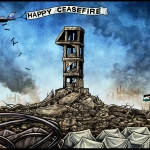
The arrival of U.S. naval vessels off Port-au-Prince in early February 2026 marked a return to a centuries-old script in which American military power enforces predetermined political outcomes in Haiti. The ships deployed as Haiti’s Transitional Presidential Council’s mandate expired, creating conditions that forced the council to relinquish power and consolidate authority around U.S.-backed Prime Minister Alix Didier Fils-Aimé. While the American embassy framed this as demonstrating “unwavering commitment” to Haitian stability, analysts recognized the deployment for what it was: a show of force designed to dictate political outcomes to a nation unable to resist.
The Structural Failure of U.S.-Installed Governance
Haiti’s trajectory since 2024 reveals the fundamental inadequacy of externally-imposed institutional solutions to internal state collapse. The Transitional Presidential Council, installed by Washington in April 2024 following the 2021 assassination of President Jovenel Moïse, was designed as a temporary apparatus to exercise presidential authority until elections could be held or institutional legitimacy restored.
The plan foundered almost immediately. Nearly six thousand people were killed in 2025 alone amid gang violence that now controls approximately ninety percent of Port-au-Prince. Kidnappings, human trafficking, and sexual violence reached epidemic proportions. Nearly half of Haiti’s population faced acute food insecurity. Presidential elections scheduled for February 7, 2026—the date of the council’s mandate expiration—became impossible to execute given the collapse of governmental authority and security conditions.
The council itself fragmented along factional lines. In late January, five of its nine members voted to remove Fils-Aimé from the prime minister position, a move that violated Washington’s strategic preference for maintaining him in power. The U.S. response was direct: deploy warships to the capital’s bay as a visible demonstration of American willingness to use military force to ensure preferred political outcomes.
Gunboat Diplomacy and Historical Precedent
The naval deployment represents the latest iteration of a pattern extending back two centuries. Haiti’s history includes a nineteen-year U.S. military occupation (1915-1934), during which the United States assumed complete control over Haitian finances and reserved the right to intervene whenever Washington deemed necessary. France, following Haiti’s independence, employed gunboat diplomacy in 1825 to force Haiti to pay indemnities for colonial losses.
Contemporary analysts have explicitly drawn parallels between recent U.S. actions and the nineteenth-century British gunboat diplomacy model. The warships served not as diplomatic gesture, but as coercive instrument communicating that Washington would “throw its weight around” when pursuing specific political objectives. As one expert noted, the message was unambiguous: “This is what you should decide, and it’s all we will recognize.”
This represents not aberration from normal U.S.-Haiti relations, but rather their essential character. For two centuries, American military power has enforced American political decisions in Haiti, undermining any genuine claim to Haitian sovereignty or self-determination. The 2026 naval deployment continues this unbroken tradition.
The Credibility Problem Created by Venezuela Precedent
The U.S. military intervention in Venezuela—executed just weeks prior to the Haiti deployment—dramatically enhanced the credibility of American threats toward Haiti. As analysts noted, following the Venezuela intervention, “we don’t need to guess at the motivations” of U.S. military deployments in the hemisphere. The message is unmistakable: Washington will employ military force to overturn governments it opposes and install preferred leadership.
This recent precedent creates a structural problem: smaller hemispheric nations cannot credibly resist U.S. military pressure without risking the fate visited upon Venezuela. Haiti’s political leaders face a binary choice: accommodate American preferences or risk military invasion and forced regime change. Under such conditions, claims about respecting Haitian political autonomy become transparently false.
The Fils-Aimé Problem and U.S. Strategic Interests
Prime Minister Fils-Aimé represents Washington’s preferred solution to Haiti’s crisis, yet his credentials for solving the underlying problem are questionable. While the U.S. views him as a “stabilizing force,” his appointment by external actors undermines any claim to Haitian political legitimacy. Furthermore, his government lacks demonstrated capacity to address the core security crisis: ninety percent of the capital controlled by criminal gangs that have proliferated precisely because state institutions collapsed.
The security situation has worsened despite—and arguably because of—ongoing international intervention. The UN Security Council authorized a “Gang Suppression Force” with U.S. backing, private security contractors have been deployed, and international police forces have expanded operations. Yet violence continues escalating, suggesting that external coercive approaches cannot resolve problems rooted in state institutional failure and economic collapse.
The Impossibility of Elections Under Current Conditions
Tentative election dates have been announced for August and December 2026, yet analysts estimate these dates to be unrealistic given current conditions. Gang violence makes electoral organization, voter registration, and polling place operations impossible in most of the country. Holding elections under such circumstances would require either suppressing gang violence to manageable levels—which international forces have failed to do—or conducting elections in a security environment so dangerous that voter participation and legitimacy would be fundamentally compromised.
This creates a vicious cycle: without elections, the U.S.-installed government lacks democratic legitimacy. Yet elections cannot be held without security conditions that the installation of a U.S.-backed government has failed to produce. The fundamental contradiction is that external political solutions cannot substitute for the internal institutional capacity and security monopoly necessary for functional governance.
The Exclusion of Haitian Agency
Perhaps the most damning critique comes from analysts noting that most international interventions in Haiti “over the last 40 or 50 years have left a trail of souls.” The pattern is consistent: external actors identify problems, impose solutions, and depart when those solutions fail to address underlying causes. Haitian populations, unable to participate in defining problems or solutions, experience interventions as foreign domination rather than assistance.
For genuine transformation to occur, Haitians must have primary authority over determining their political future. Yet the naval deployment explicitly communicated that Washington reserves the right to override Haitian political decisions when they conflict with American preferences. This eliminates any possibility of indigenous institutional capacity development. Haiti is treated as object of American policy rather than subject of its own governance.
Conclusion: The Bankruptcy of Coercive Solutions
The February 2026 naval deployment represents the logical conclusion of an approach that treats military force as a tool for imposing political solutions. Yet two centuries of U.S. military intervention in Haiti have produced not stability, but dependency, institutional weakness, and state collapse. The current crisis—with gangs controlling the capital and half the population facing acute hunger—is not despite U.S. intervention, but partially because U.S. intervention has consistently substituted external coercion for internal institutional development.
Further military intervention would deepen rather than resolve this contradiction. A more effective approach would require the U.S. to accept Haitian political autonomy, support Haitian-led institution-building, and refrain from using military force to enforce preferred political outcomes. This would require abandoning the two-century tradition of treating Haiti as a U.S. sphere of influence subject to American diktat.
Original analysis by Leah Schroeder, Responsible Statecraft (February 2026). Restructured and expanded by ThinkTanksMonitor.