A fundamental shift has occurred in American political consciousness. The nation is no longer experiencing merely partisan disagreement—a normal feature of democratic systems—but rather a crisis of regime legitimacy wherein significant portions of the electorate question whether the democratic system itself deserves their allegiance. This distinction, subtle to observers accustomed to conventional political conflict, represents the threshold separating functional democracy from potential institutional collapse.
Recent political discourse has normalized terminology previously considered outside acceptable public discourse. High-ranking officials have referred to entire demographic and social groups as “vermin,” “garbage,” and “invaders.” This language serves a specific function beyond mere insult: it feeds what analysts call the “rage bait cycle,” wherein political figures attack communities, await responding outrage, escalate the attacks, and position themselves as defenders of threatened values and national identity.
The dynamic creates what political scientists term “affective polarization”—a condition wherein citizens no longer merely disagree on policy questions, but actively dislike each other as human beings. People begin viewing their political opponents not as honest actors with different values, but as existential threats embodying incompatible visions of national identity itself.
This dehumanizing language does more than “hollow out” democracy, as human rights organizations have documented. It prepares populations psychologically for deeper institutional conflict, creating emotional groundwork for treating political opponents as deserving exclusion, marginalization, or worse.
Cultural Conflict as Expression of Economic Anxiety
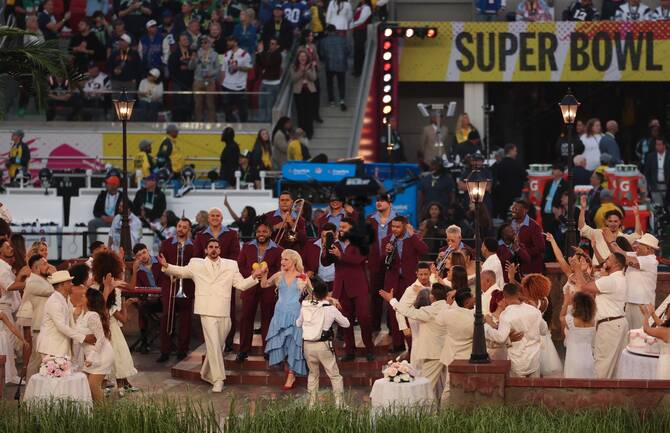
The 2026 Super Bowl halftime performance by Puerto Rican artist Bad Bunny catalyzed a cultural conflict that exposed deeper fractures in American society. Conservative commentators launched boycotts, labeling a Spanish-language performance “not American enough”—a formulation that conflates language choice with national belonging. The conflict split viewers into two distinct camps: those watching the official performance and those tuning to an “All-American” alternative broadcast featuring different musical content.
This cultural conflict, however, masks deeper economic anxieties. The current American crisis stems from three converging pressures: economic stagnation and inequality, declining relative economic position of dominant social groups, and rapid demographic change. These material forces are being channeled through cultural and identity frameworks, transforming what are fundamentally struggles over economic privilege and political dominance into debates about cultural authenticity and national identity.
Dominant social groups—historically accustomed to automatic cultural and political advantages—perceive genuine threats to their “way of life.” Their anxiety is not fabricated, though its political expression often obscures underlying economic causes. The challenge is that solutions to economic inequality require systemic redistribution and policy reform, whereas cultural/identity frameworks promise symbolic victory without material sacrifice.
The Fundamental Question of Legitimacy
In healthy democracies, all sides generally accept the legitimacy of the political system itself, even while disagreeing intensely about policy. Citizens may fiercely oppose an elected government, but they recognize the system’s right to exist and its authority to govern.
This consensus no longer exists in the United States. Major portions of the electorate question not merely policy choices, but the fundamental legitimacy of existing institutions. This constitutes what analysts call “regime cleavage”—a political struggle no longer concerned with electoral victory, but with fundamental disagreement about what constitutes a legitimate nation-state.
The transformation from policy disagreement to regime delegitimation marks a qualitative shift with dire implications. When significant population segments cease believing in institutional legitimacy, those institutions lose capacity to mediate conflict or command obedience. Rule of law depends on broad recognition that laws deserve compliance; when that recognition evaporates, law becomes merely force.
Generational Fracture and Institutional Abandonment
The generational divide in institutional trust has reached historic proportions. According to the Harvard Youth Poll, younger Americans report “financial fears, political polarization, and concerns over an uncertain future” that have “shattered trust in the world around them.” The Center for Information & Research on Civic Learning and Engagement documents that over 65 percent of voters aged 18–25 express dissatisfaction with both major political parties.
This generational distance from institutional legitimacy is particularly significant because younger cohorts have known only a political system characterized by dysfunction and polarization. They lack memory of a period when democratic institutions functioned with broad legitimacy across partisan lines. For Generation Z, the system’s brokenness is not a departure from normal functioning—it is the only normal they have experienced.
This absence of experiential memory undermines efforts to defend existing institutions. Younger Americans cannot be appealed to through nostalgia for functional democracy because they have never experienced it. Their rational conclusion—that the system is fundamentally illegitimate—lacks the emotional resistance that generational memory might provide.
The Historical Tension Between Assimilation and Multiculturalism
The current crisis descends from decades-long tension between two competing models of national identity. The “melting pot” framework envisions immigrant communities and minorities assimilating into a dominant cultural structure (historically understood as white and Christian). The “salad bowl” model, by contrast, allows minorities to maintain distinct languages, customs, and identities while remaining fully American.
What was once highly intellectualized academic debate has transformed into visceral daily conflict. The Super Bowl cultural clash exemplifies this: it represents not merely disagreement about entertainment choices, but fundamental disagreement about what categories of people have the right to define “American” culture and identity.
Dominant groups perceive the salad bowl model as threatening their cultural authority and majority status. Their anxiety is rooted in genuine demographic change: the non-Hispanic white share of the U.S. population is declining, projected to drop below 50 percent within decades. This demographic reality, coupled with economic stagnation affecting large portions of the population, generates authentic fear among dominant groups about future political and economic status.
Political Strategies and Their Limitations
The political right, represented by the Make America Great Again movement and Turning Point USA, has developed substantial clarity of vision and relative political cohesion. Their strategy—mobilizing cultural and identity anxieties, promising restoration of past dominance—offers psychological appeal to constituencies experiencing genuine threat.
The political left, conversely, remains “shrouded in ambiguity,” relying primarily on “counter-demonization” and reactive grievance politics. The Democratic Party, which claims to represent marginalized groups, lacks trust among younger Americans. This institutional weakness means the left lacks coherent strategic vision capable of mobilizing broad coalitions or presenting compelling alternative futures.
The Predictability of Escalation
The 2026 midterm elections approach amid polarization reaching new extremes. A January 2026 Gallup poll showed that 89 percent of Americans expect high levels of political conflict this year. This expectation itself becomes self-fulfilling: when populations anticipate escalation, they prepare defensively, reducing incentives for compromise and cooperation.
The outcome of November elections is, in many respects, predetermined. Regardless of which coalition achieves electoral victory, the underlying structural conditions—economic inequality, demographic change, institutional distrust, dehumanizing political rhetoric—will persist. A victorious coalition will claim mandate to reshape institutions in its image, prompting resistance from displaced groups that view the system as illegitimate. The cycle intensifies.
Conclusion: The Breaking Point and Beyond
The United States is entering a phase of political conflict qualitatively different from ordinary partisan disagreement. Regime legitimacy—the foundational prerequisite for democratic stability—is eroding across generational and social lines. When citizens cease believing the system deserves their allegiance, institutions lose capacity to mediate conflict.
The breaking point approaches not as an external shock, but as the logical conclusion of structural processes: dehumanizing rhetoric normalizes political violence, affective polarization destroys cross-party relationships, institutional distrust prevents democratic solutions, and demographic/economic anxiety generates zero-sum politics wherein groups perceive conflict as existential rather than negotiable.
Original analysis by Dr. Ramzy Baroud, Arab News (February 2026). Restructured and expanded by ThinkTanksMonitor.