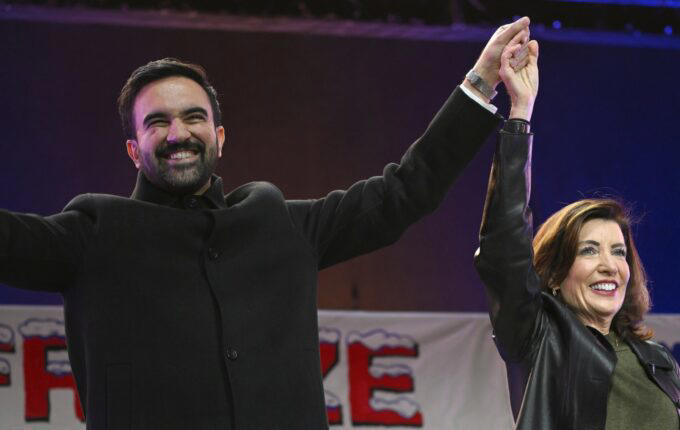
New York City’s democratic socialist mayor has thrown his weight behind the state’s centrist governor, producing one of the most consequential and contentious political endorsements of 2026. Zohran Mamdani’s decision to back Kathy Hochul for reelection in the June Democratic primary reflects a calculated gamble that pragmatic governance can deliver more than ideological purity — and it has exposed deep fault lines within the progressive movement that propelled him to power.
A Childcare Deal as Political Foundation
The endorsement, published as an op-ed in The Nation on February 5, rests on a single, tangible policy achievement. Just eight days after Mamdani’s inauguration as mayor in January 2026, he and Hochul jointly announced an agreement to expand universal childcare for children under five in New York City, backed by more than one billion dollars in state funding. For families in a city where annual childcare costs can exceed $20,000 per child, the program represents a substantial financial reprieve. Mamdani described it as “one of the largest expansions of the social safety net in our city’s history,” crediting the roughly 100,000 volunteers from his mayoral campaign for creating the political conditions that made the deal possible.
The agreement itself had been quietly negotiated over months before Mamdani even took office. According to Politico, staff from both offices began laying the groundwork well before the January inauguration, recognizing that a landmark childcare announcement would serve both leaders: Hochul would demonstrate her capacity to work with the left wing of her party, while Mamdani could show his base that his brand of coalition politics produces real results. The governor’s office committed to partnering with the city on what it branded the “2-Care” program, providing free childcare to two-year-olds as a first step toward universal coverage, with Hochul subsequently announcing a broader $4.5 billion statewide investment and pilot partnerships in three counties.
The Strategic Calculus Behind an Unlikely Alliance
What makes the endorsement politically remarkable is the ideological distance between the two figures. Mamdani, a member of the Democratic Socialists of America who won the mayoral race in November 2025 on a platform of wealth taxation, tenant protections, and expanded public services, now occupies the same political lane that launched national figures like Alexandria Ocasio-Cortez and Bernie Sanders, who spoke at Mamdani’s inauguration. Hochul, by contrast, has governed as a self-described moderate — a former lieutenant governor from Buffalo who assumed office in 2021 after Andrew Cuomo’s resignation and narrowly defeated Republican Lee Zeldin in 2022.
The transactional logic is clear on both sides. For Hochul, the endorsement provides critical progressive cover as she faces a Democratic primary challenge from her own lieutenant governor, Antonio Delgado, who has positioned himself to Hochul’s left and selected democratic socialist India Walton as his running mate. For Mamdani, the alignment secures the state funding and legislative cooperation his administration needs to deliver on its ambitious urban policy agenda. As the Associated Press reported, the endorsement “offers the moderate governor some progressive heft” while Mamdani gains a governing partner at a moment when New York City faces severe budget constraints.
The timing was also calibrated for maximum impact. Days after Mamdani’s endorsement, Hochul resoundingly won the New York Democratic Party’s nomination at the state convention in Syracuse on February 6, where she announced former New York City Council Speaker Adrienne Adams as her new running mate — forming what The City described as the first all-woman slate to run for governor and lieutenant governor in New York state history.
The Progressive Fracture
The endorsement immediately drew sharp criticism from Mamdani’s own political base. NYC-DSA, the local chapter of the organization that helped launch his career, declined to follow his lead. State Senator Jabari Brisport, a fellow democratic socialist and one of Mamdani’s closest Albany allies, endorsed Delgado instead and offered a notable public rebuke: “Even Zohran gets it wrong sometimes,” Brisport told City & State New York. Assembly Member Emily Gallagher, another DSA-aligned legislator, initially questioned Mamdani’s commitment to the movement before walking back her sharpest comments.
The progressive magazine Socialist Call published a more pointed critique, arguing that Mamdani’s support for Hochul while she positions herself as a “moderate check” on his own administration represents a strategic contradiction. The Working Families Party, a bellwether for New York’s progressive infrastructure, declined to endorse either Hochul or Delgado at its convention, nominating placeholder candidates instead — a signal of unresolved discomfort with both options.
Mamdani himself acknowledged the tension openly. “The Governor and I do not agree on everything,” he wrote in The Nation. “We have real differences, particularly when it comes to taxation of the wealthiest.” Yet he framed the disagreement as a feature rather than a flaw, arguing that the Democratic Party succeeds when it “channels conflict toward progress” rather than demanding ideological conformity.
Governing Against Washington
A significant undercurrent in the endorsement is the shared threat both leaders face from the federal government. Mamdani signed an executive order in early February reaffirming New York City’s sanctuary protections, drawing immediate condemnation from the Department of Homeland Security, which accused the mayor of endangering public safety. Hochul, for her part, proposed legislation to ban ICE collaboration contracts with county jails across the state.
Both leaders recognize that the confrontation with Washington requires a unified front between Albany and City Hall — a relationship that was defined for years by dysfunction and rivalry. Mamdani framed the alliance in explicitly defensive terms, noting that Hochul “has defended our social safety net and protected funding for critical infrastructure projects” as federal threats intensify. The governor echoed the sentiment, saying she knows Mamdani “will stand strong alongside me as we fight against Donald Trump’s attacks on this state.”
The Test of Pragmatism
The endorsement presents a case study in the dilemmas facing the American left in an era of divided and hostile government. Mamdani’s argument is essentially that a productive working relationship with an imperfect centrist ally delivers more measurable outcomes than an ideologically satisfying but politically futile challenge. The childcare agreement serves as his primary evidence: a billion-dollar expansion that reached families within days of his taking office, rather than years of advocacy from the opposition.
Critics counter that by legitimizing Hochul, Mamdani has undercut the leverage progressives need to push the governor further on taxation, housing, and labor issues — particularly at a moment when Delgado’s primary challenge could have created competitive pressure from the left. The question of whether pragmatic dealmaking or sustained pressure produces better long-term outcomes for working-class New Yorkers will ultimately be answered not by the endorsement itself, but by what follows it. With a primary in June, a general election in November, and New York City facing an ongoing affordability crisis, the alliance between the democratic socialist mayor and the centrist governor will be tested well beyond the op-ed page.
Originally published by Zohran Mamdani, The Nation. Additional research and contextual analysis conducted through multiple independent sources.