The resumption of diplomatic contact between Washington and Tehran in Oman marks a fragile turning point, but entrenched mistrust, military posturing, and clashing agendas threaten to overwhelm any momentum toward a nuclear agreement.
Three days after American and Iranian delegations concluded hours of indirect discussions in the Omani capital, the fundamental question hanging over the Persian Gulf remains unanswered: did the February 6 session represent a genuine diplomatic opening or merely a tactical pause in an escalatory spiral that has defined relations between the two adversaries since mid-2025? The answer likely lies somewhere in between, and the narrow space occupied by that ambiguity is precisely what makes the coming weeks so consequential.
Military Posturing Overshadows Diplomatic Engagement
Any assessment of the Muscat session must begin not with the substance of what was discussed but with the volatile security environment that preceded it. Within a single 72-hour window before delegations arrived in Oman, two incidents underscored how close military friction had come to derailing diplomacy entirely. On February 3, an F-35C fighter jet launched from the USS Abraham Lincoln shot down an Iranian Shahed-139 drone that approached the carrier strike group in the Arabian Sea. The same day, six Iranian gunboats attempted to intercept the US-flagged tanker Stena Imperative in the Strait of Hormuz, ordering the vessel to halt its engines before it managed to continue its passage.
These were not abstract threats. They demonstrated how rapidly signaling between Washington and Tehran can deteriorate from calculated posturing into genuine miscalculation. The American naval presence in the region—described by President Trump as a “massive armada”—has expanded significantly since late January 2026, part of a broader US military buildup across the Middle East that regional analysts view as designed to maximize coercive leverage ahead of any diplomatic engagement. Tehran, meanwhile, broadcast images of its advanced Khorramshahr-4 ballistic missile being deployed at a Revolutionary Guard underground facility just hours before talks began, a calculated display of strategic defiance.
The composition of the American delegation further blurred the line between diplomacy and coercion. Special Envoy Steve Witkoff and Jared Kushner led the team, but the inclusion of Admiral Brad Cooper, head of US Central Command, in full military dress represented an unprecedented presence at a negotiating table ostensibly dedicated to nuclear issues. Iranian officials responded sharply, with one diplomatic source telling Reuters that Cooper’s attendance “endangered” the process. The deliberate fusion of military command authority with diplomatic engagement reflects Washington’s belief that coercive pressure strengthens its hand—a premise Tehran categorically rejects.
The Trust Deficit at the Heart of Negotiations
Understanding why these talks remain so fragile requires examining the deep structural erosion of confidence between both capitals over the past eight years. Washington’s unilateral withdrawal from the Joint Comprehensive Plan of Action in May 2018—despite repeated confirmation by international inspectors that Iran was fulfilling its obligations—fundamentally shattered Tehran’s faith in America’s capacity to honor agreements. For Iran’s security establishment, the lesson was unambiguous: concessions yielded not relief but further demands and eventual abandonment.
Tehran’s response compounded the damage. Beginning in 2019, Iran systematically exceeded JCPOA enrichment limits, eventually reaching 60 percent purity—a level experts consider a short technical leap from weapons-grade material. This incremental escalation, while framed domestically as a leverage strategy, eroded Iran’s own credibility with European partners and international institutions. The Carnegie Endowment’s analysis of the four key challenges facing negotiations identified this cycle of mutual betrayal as the single most significant barrier to any future accord.
The June 2025 joint US-Israeli strikes on Iranian nuclear facilities transformed this trust deficit into something qualitatively different. Tehran reported over a thousand casualties from attacks that hit three separate nuclear sites, and the IAEA subsequently confirmed direct impacts on underground enrichment halls. Iran has since stated that enrichment activity ceased following the bombing, but it has also conditioned future IAEA inspections on entirely new verification frameworks, citing unexploded ordnance at damaged facilities as a safety concern. This creates an information gap that arms control specialists warn could itself become a source of crisis if either side misinterprets the other’s nuclear posture.
Competing Agendas and the Scope Impasse
At the operational level, the most immediate obstacle confronting any second round of talks is a fundamental disagreement about what the negotiations should even cover. Tehran arrived in Muscat insisting that discussions remain exclusively focused on the nuclear file—and Iranian Foreign Minister Abbas Araghchi subsequently claimed that this condition was met. Washington, however, has been equally explicit that it seeks a comprehensive framework encompassing ballistic missiles, regional proxy networks, and human rights concerns. Secretary of State Marco Rubio stated before the session that “all those issues” needed to be on the table.
Iran effectively won several procedural battles leading into the February 6 meeting. The venue shifted from Istanbul to Muscat at Tehran’s request, regional observers from Egypt, Turkey, and Qatar were excluded from the room, and the discussions reportedly hewed closely to nuclear matters. Yet this procedural success may prove pyrrhic if it convinces Washington that Tehran is simply stalling—a perception that would accelerate rather than restrain the military timeline.
Meanwhile, a separate multilateral initiative emerged around the talks. Diplomats from Egypt, Turkey, and Qatar reportedly presented Tehran with a framework proposal calling for a three-year enrichment moratorium, the transfer of highly enriched uranium to a third country (with Russia signaling willingness to receive it), and a pledge against first use of ballistic missiles. Tehran rejected the package, with Araghchi insisting that enrichment on Iranian soil remains non-negotiable and framing the issue as a matter of national sovereignty. This maximalist position may reflect genuine redlines, but it also narrows the space for the kind of creative compromises that previous rounds of nuclear diplomacy eventually produced.
Oman’s Indispensable but Insufficient Mediation
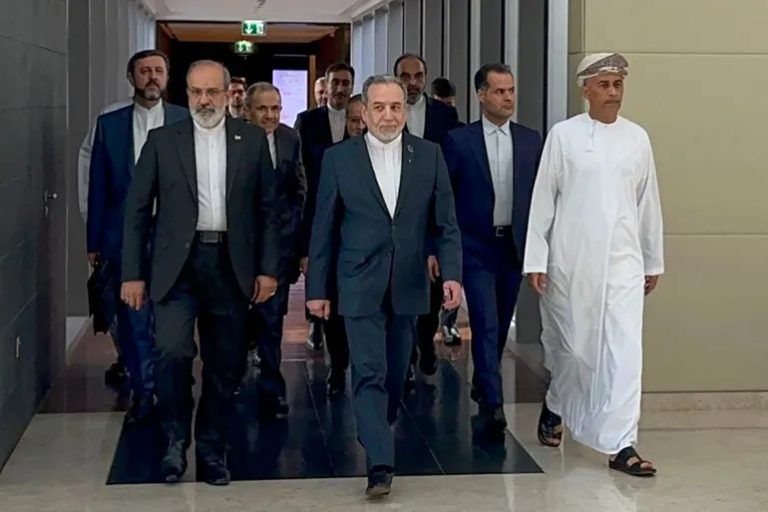
Muscat’s role as the facilitator of US-Iran dialogue has deep roots, and the decision to hold talks there rather than in Turkey reflects Tehran’s enduring trust in Omani neutrality. As the Middle East Institute detailed in its analysis of Oman’s mediating position, the Sultanate occupies a uniquely credible space—trusted by Iran’s leadership while maintaining functional relationships with both Washington and the broader Gulf Cooperation Council. Omani Foreign Minister Badr al-Busaidi described the February 6 discussions as “very serious” and aimed at establishing appropriate conditions for substantive diplomatic and technical negotiations.
Yet Oman’s traditional approach of quiet, patient facilitation may no longer be adequate for the scale of the current crisis. The Gulf International Forum warned that the uncontainable consequences of a US-Iran conflict would place GCC states and Turkey on the frontlines of a war with far-reaching regional implications. Gulf capitals have moved from skepticism about Omani mediation to active support, with Doha, Riyadh, and Muscat reportedly coordinating to prevent military escalation. The shared recognition that neither Washington’s naval buildup nor Tehran’s missile deployments serve regional stability has created an unusual moment of Gulf consensus—one that Oman must now leverage not merely to host talks but to actively shape the conditions under which compromise becomes possible.
Perhaps the most significant unreported development from February 6 was the shift toward direct engagement. According to Axios reporting, Witkoff and Kushner met face-to-face with Araghchi during the session, breaking from the strictly mediated format that Iran had demanded throughout most of the 2025 negotiation rounds. This transition from indirect to partially direct contact suggests both delegations recognize that Omani intermediation alone cannot sustain the level of technical specificity required for actual bargaining over enrichment levels, stockpile management, and verification protocols.
Sanctions Timing Reveals Washington’s Dual Strategy
The economic dimension of Washington’s approach deserves particular scrutiny because it reveals the fundamental tension embedded in US strategy. Within hours of the Muscat session concluding, the State Department announced sanctions on 15 entities, two individuals, and 14 shadow fleet vessels involved in illicit Iranian petroleum trade. The Treasury Department framed the action as part of the administration’s continuing “maximum pressure” campaign. The same day, Trump signed an executive order imposing 25 percent tariffs on imports from any country purchasing Iranian goods—a sweeping secondary sanctions measure targeting Tehran’s remaining trade partners.
For Iranian negotiators who have consistently demanded sanctions relief as the starting point for any substantive progress, this sequencing confirms the precise pattern they fear most: that Washington uses diplomatic engagement as political cover while intensifying economic warfare. Araghchi identified this paradox explicitly, noting that “the mistrust that has developed is a serious challenge facing the negotiations.” The Atlantic Council’s analysis of shadow fleet seizures raised similar questions about whether aggressive enforcement actions can coexist with genuine diplomatic processes, or whether they inevitably communicate to Tehran that negotiations are theater rather than substance.
Washington views this dual-track approach as leverage—squeezing Iran’s revenue while keeping the diplomatic channel open. The logic holds that economic pain will eventually compel Tehran to accept a broader agreement covering not just the nuclear file but also missiles and regional influence. Whether this calculus accounts for the possibility that such pressure instead hardens Iran’s negotiating positions and empowers domestic hardliners who argue diplomacy is futile remains an open and urgent question.
Five Indicators That Will Define the Coming Weeks
The compressed timeline both sides have signaled—with a second round expected within days rather than the weeks that separated sessions in 2025—suggests Washington believes the window for diplomacy is narrowing. Several concrete developments will determine whether this urgency produces meaningful progress or simply accelerates toward confrontation.
The enrichment question stands as the most technically consequential variable. Iran has maintained that enrichment ceased after the June 2025 strikes, but it has simultaneously blocked IAEA access to damaged sites under existing verification frameworks. Any credible evidence of resumed enrichment activity would almost certainly end the diplomatic track, while progress on new inspection arrangements would signal Tehran’s willingness to build confidence incrementally. The status of the American carrier strike group in the Arabian Sea offers another barometer: reinforcement would indicate Washington’s assessment that military options remain actively under consideration, while any drawdown would suggest growing confidence in the diplomatic channel. The rhythm of sanctions announcements between rounds will shape Tehran’s interpretation of American intentions more powerfully than any diplomatic statement, and continued backchannel activity by Oman, Qatar, and regional mediators will determine whether de-escalation space persists between formal sessions.
Neither Breakthrough Nor Collapse—Yet
The most realistic near-term trajectory is neither a transformative agreement nor open conflict but a carefully managed stalemate in which both sides preserve maximum rhetorical positions while avoiding irreversible steps. This kind of strategic ambiguity may buy time, but it is not a substitute for the painstaking, trust-building process that any durable nuclear accord would require. The distance between a communication channel and a credible framework for agreement remains vast, and every day that gap persists is another day in which miscalculation—not deliberate escalation—poses the gravest risk to regional stability.
What Muscat established was modest but not insignificant: a functioning diplomatic channel, a willingness to return to it, and evidence that direct senior-level contact between the two sides is possible. Whether these foundations prove to be the floor of a stabilizing process or merely a brief landing on the way down depends entirely on decisions that will be made in Washington, Tehran, and the capitals of the Gulf in the days ahead.
Original analysis inspired by Muhanad Seloom from Al Jazeera. Additional research and verification conducted through multiple sources.