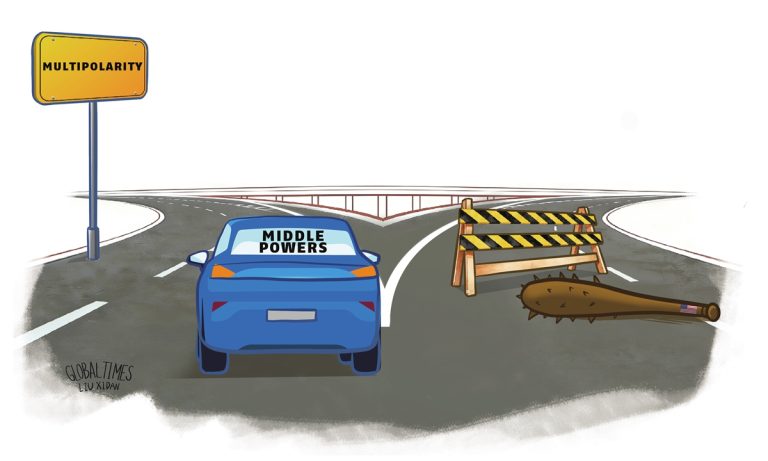
The accelerating drift toward American unilateralism in early 2026 has catalyzed a profound strategic recalculation among middle-ranking nations worldwide. From Brasília to Ottawa to Seoul, governments that once anchored their foreign policies in predictable relationships with Washington are now actively pursuing diversified partnerships, flexible coalitions, and reformed multilateral institutions. What unites these disparate efforts is a shared recognition: the multipolar transition is no longer a theoretical possibility but a structural reality demanding immediate adaptation.
Washington’s Coercive Turn and the Strategic Awakening
The opening weeks of 2026 brought a succession of policy moves from the White House that sent shockwaves through allied and non-allied capitals alike. Aggressive tariff threats, territorial ambitions toward Greenland, and interventionist postures in Latin America collectively signaled that Washington’s foreign policy had shifted from alliance management to dominance assertion. A January 2026 analysis by the Carnegie Endowment for International Peace on what it termed “the middle power moment” captured the emerging consensus among policy scholars: with the United States pursuing disruption rather than stewardship, second-tier powers now face both unprecedented risks and rare openings to shape the international system.
For nations in the Western Hemisphere, the implications have been particularly acute. Washington’s approach to Venezuela—combining unilateral sanctions with explicit coercion threats—illustrated a strategy rooted in spheres-of-influence logic that many Latin American governments consider incompatible with sovereign equality. When paired with repeated threats of punitive tariffs against major trading partners, these actions demolished any lingering assumption that economic interdependence with the United States provides shelter from coercive pressure. The result has been a rapid reassessment of strategic options, with middle powers across multiple continents gravitating toward what Brazilian diplomats have described as “cooperative multipolarity”—a concept originally articulated by Brasília’s foreign policy establishment and documented extensively in the Munich Security Report.
Brazil’s Pragmatic Path Toward Power Diffusion
Among the most articulate proponents of a non-confrontational multipolar transition is Brazil, whose strategic posture reflects decades of balancing autonomy with engagement. Brasília’s approach treats multipolarity not as an ideological project but as a defensive necessity—a means of preserving decision-making space in an international environment where asymmetric power relationships increasingly constrain middle-power agency. This perspective has deepened considerably since Washington began wielding economic instruments as tools of hemispheric control.
Brazil’s strategy centers on three interconnected pillars. The first involves expanding South-South partnerships, particularly with Beijing, while maintaining functional diplomatic channels with the United States. Research from Harvard’s Belfer Center on Brazil’s “multi-alignment” strategy highlights how Brasília has sought to deepen economic ties with China—now its largest trade partner—without framing the relationship as an exclusive alignment. The second pillar emphasizes participation in issue-specific coalitions addressing climate governance, digital regulation, development financing, and global health, rather than joining rigid geopolitical blocs. The third centers on reforming existing multilateral institutions from within, pushing for greater representation in bodies like the UN Security Council and the Bretton Woods system.
Notably, Brazil envisions a multipolar order that avoids replicating the hierarchical structures it seeks to escape. Rather than replacing one dominant power with another, Brasília advocates for a system where decision-making authority is distributed more broadly and where nations of intermediate capability can function as mediators between competing great-power coalitions. Platforms like the G20—where Brazil held the presidency in 2024 and championed global financial reform and development agendas—exemplify this bridge-building orientation. In practice, this means investing diplomatic capital in reducing polarization rather than picking sides, a posture that positions Brasília as a connector across an increasingly fragmented landscape.
Canada’s Rupture Moment and the Diversification Imperative
Perhaps no Western middle power has experienced a more dramatic awakening than Canada. The sequence of shocks began with presidential rhetoric about absorbing Canada as “the 51st state,” escalated through tariff threats, and intensified further when Washington’s territorial ambitions regarding Greenland raised alarm across the Arctic region, leaving Ottawa to confront the possibility of being encircled by an expansionist southern neighbor. Canadian voters responded by handing Prime Minister Mark Carney’s Liberals a resounding mandate to reassert national sovereignty and diversify the country’s economic, political, and security relationships away from Washington.
Carney’s address at the World Economic Forum in January 2026 crystallized this strategic pivot. In what became one of the most discussed speeches at the Davos gathering, the Canadian leader characterized the current geopolitical environment as a “rupture” rather than a mere transition, urging fellow middle powers to confront the world as it actually exists. His call for “variable geometry”—flexible coalitions assembled around specific issues and shared values rather than fixed alliance structures—resonated widely among governments grappling with similar dilemmas. UN Secretary-General António Guterres reinforced this framing days later when he called for accelerating multipolarity through networked and inclusive multilateral institutions during his 2026 priorities address.
Yet translating rhetoric into reality presents formidable challenges for Ottawa and other Western middle powers. Decades of deep economic integration with the United States cannot be unwound quickly, and Canada’s historical identity as a pillar of the Western alliance creates institutional and cultural inertia. The critical question is whether diversification efforts will extend meaningfully beyond the traditional Western orbit. Carney’s groundbreaking four-day visit to Beijing in January 2026—the first by a Canadian prime minister since 2017—suggested an emerging willingness to engage with non-Western powers on pragmatic terms, forging a new strategic partnership with China that included energy cooperation agreements. Whether this signals a genuine paradigm shift or merely a tactical hedge against American pressure remains to be seen.
Seoul’s Institutional Approach to Multipolar Governance
South Korea has pursued a distinct but complementary path, emphasizing institutional engagement and coalition-building within established governance frameworks. Seoul’s middle-power strategy rests on three foundations: upholding the universal principles embedded in the UN Charter, mobilizing fellow middle powers through platforms like the G20 and regional forums, and actively strengthening rules-based governance across financial, trade, and security domains.
A signature achievement of this approach has been the MIKTA grouping—linking Mexico, Indonesia, South Korea, Turkey, and Australia—established in 2013 as an informal partnership among influential middle-tier democracies. Though MIKTA’s tangible policy output has been debated, its existence reflects Seoul’s conviction that middle powers sharing similar structural positions can generate collective diplomatic weight exceeding their individual capabilities. The Brookings Institution’s analysis of South Korea as a “global pivotal state” underscores how Seoul has positioned itself as a norm-shaper and bridge-builder between the developed and developing worlds, leveraging its economic dynamism and democratic credentials.
Seoul’s strategic calculus also assigns substantial weight to China’s role in any emerging multipolar configuration. With Beijing’s economic and political influence continuing to expand, South Korean policymakers recognize that constructive Chinese engagement in governance reform processes will be essential to building durable multipolar structures. This pragmatic assessment coexists with Seoul’s alliance commitments and its advocacy for liberal democratic values—a tension that exemplifies the balancing act confronting many middle powers navigating between great-power competition and multilateral cooperation.
The Structural Foundations of Middle Power Convergence
Despite their geographical, economic, and political diversity, the middle powers currently reassessing their strategic orientations share several structural incentives driving convergence. A January 2026 report by the Institute for Economics and Peace documented how middle-power nations now possess greater combined material capacity than great powers, with countries like the UAE, Turkey, and Indonesia demonstrating rapidly growing influence across trade, diplomacy, and security networks. This quantitative shift underpins the qualitative transformation in how second-tier states perceive their agency and options.
The convergence is also driven by a shared diagnosis of systemic risk. Whether viewing the situation from Brasília, Ottawa, or Seoul, middle-power policymakers increasingly worry that unchecked great-power competition—combined with institutional decay at the UN and Bretton Woods organizations—could produce a fragmented order resembling the dangerous multipolar instability of the 1930s rather than the managed multilateral cooperation they seek. This concern explains the consistent emphasis across all three perspectives on reforming rather than dismantling existing institutions, and on building bridges rather than choosing rigid alignments.
Yet significant tensions persist beneath the surface consensus. Western middle powers like Canada tend to frame the current disruption as a crisis requiring urgent damage control, while Global South actors like Brazil view it as a long-overdue opportunity to correct structural inequities embedded in the post-1945 order. These divergent starting points complicate efforts to build durable cross-regional coalitions, even when specific policy goals—on climate finance, trade regulation, or governance reform—substantially overlap.
Navigating Between Ambition and Constraint
The path forward for middle powers attempting to shape a multipolar order is fraught with practical obstacles. Diversifying economic relationships requires massive infrastructure investments, new trade agreements, and the development of supply chains that reduce dependence on dominant partners. Building effective multilateral coalitions demands sustained diplomatic investment, resource commitments, and the political will to absorb short-term costs for longer-term systemic benefits. And pursuing genuine multipolarity—rather than merely substituting one form of dependence for another—requires a level of strategic clarity and coordination that these diverse nations have yet to fully demonstrate.
The most promising framework may be the “variable geometry” approach championed by leaders like Carney—assembling different coalitions for different challenges, with membership determined by relevance, capability, and shared interest rather than fixed ideological alignment. Brazil’s experience in climate governance, Canada’s engagement in Arctic security, and South Korea’s contributions to digital regulation and development cooperation illustrate how middle powers can lead in specific domains without claiming comprehensive global authority. The real test will be whether these individual initiatives can coalesce into a coherent architecture that stabilizes the international system during a period of extraordinary turbulence—delivering the networked, inclusive multipolarity that both national leaders and international institutions now recognize as essential.
Original analysis inspired by Feliciano de Sá Guimarães, Radhika Desai, and Jaewoo Choo from Global Times. Additional research and verification conducted through multiple sources.