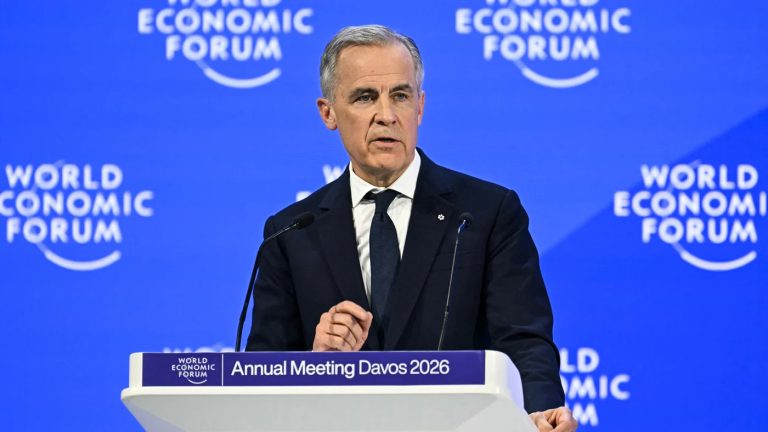
When Canadian Prime Minister Mark Carney took the stage at the World Economic Forum in January 2026, he delivered what may prove to be one of the most consequential speeches by a Western leader in decades. By openly acknowledging the structural collapse of the postwar rules-based order—from within its own institutional temple—Carney signaled that at least some Western capitals are prepared to abandon comfortable fictions about the international system they helped construct.
A Churchill Moment in Reverse
Historical parallels are inherently imperfect, yet the comparison to Winston Churchill’s 1946 address in Fulton, Missouri carries instructive weight. Churchill’s Iron Curtain speech rallied Western democracies toward collective resistance against Soviet expansionism at the dawn of the Cold War. Carney’s intervention at the 2026 World Economic Forum performed a starkly different function: rather than mobilizing Western solidarity, it challenged the foundational myths that have sustained Western cohesion for eight decades. Where Churchill warned of an external threat, Carney diagnosed an internal pathology—the systematic hypocrisy embedded within the very order Western nations claim to defend.
The Canadian leader described a “rupture” rather than a transition, declaring that the rules-based framework was “partially false” because the most powerful nations routinely exempted themselves from its constraints while enforcing compliance on weaker states. As the Lowy Institute’s analysis of the speech observed, Carney argued that middle powers can no longer sustain the fiction of a rules-based order in an era of unrestrained great-power competition. That such an admission came from a G7 leader—before an audience of the very financial and corporate elites who have profited most from that system—gave it extraordinary rhetorical force.
Candor That Resonated Beyond Western Capitals
The speech’s reception revealed a telling asymmetry. In Davos, the assembled elites responded with a standing ovation—an ironic tribute given that Carney had just characterized their cherished global architecture as riddled with double standards. Across the Global South, however, the address was received not as revelation but as belated confirmation. For nations that have long experienced asymmetric enforcement of trade rules and selective application of international law, Carney’s candor validated decades of frustration with Western-led institutions that promised universality while delivering hierarchy.
The charge that Western powers weaponized economic integration—using tariffs as leverage, financial infrastructure as coercion, and supply chains as instruments of subordination—resonated particularly because these practices predate the current American administration. Although Carney avoided naming specific countries, his critique implicitly acknowledged that coercive economic statecraft has been standard operating procedure across successive presidencies. The distinction is largely one of presentation: previous administrations concealed these dynamics behind diplomatic polish, while the current approach operates without pretense.
Ottawa’s Diversification Gambit
Beyond rhetoric, the speech’s significance lies in the concrete strategic pivot it announced. Within six months, Ottawa signed a dozen trade and security agreements spanning four continents, including a groundbreaking strategic partnership with Beijing—the first visit by a Canadian prime minister to China since 2017—alongside new arrangements with Qatar, the EU, and ongoing negotiations with India, ASEAN members, and Mercosur. This flurry of diplomatic activity represents an unprecedented effort by a Western middle power to construct economic and security relationships explicitly designed to reduce dependence on Washington.
Carney’s formulation that middle powers “must act together because if we’re not at the table, we’re on the menu” captured the defensive logic driving this realignment. As IP Quarterly noted in its assessment of the emerging “Carney Doctrine,” the approach requires not just rhetorical boldness but sustained institutional investment and genuine willingness to engage partners outside the traditional Western orbit. The concept of “variable geometry”—assembling different coalitions for different challenges—represents an attempt to operationalize this vision, though its practical execution remains untested against the structural gravitational pull of existing alliances.
Europe’s Conspicuous Silence
Perhaps the most revealing dimension of the Davos moment was what did not happen. As CBC News documented in tracking international reactions, Europe’s leading voices responded to Carney’s address with striking passivity. Finland’s president offered clearly positive comments, and NATO Secretary General Mark Rutte acknowledged the speech politely during a subsequent Davos panel, but no major European leader stepped forward to engage substantively with its central arguments. No French, German, or European Commission official seized the moment to articulate a comparable vision for navigating the post-American strategic landscape.
This silence is all the more striking given that European leaders had themselves just endured public pressure from Washington on multiple fronts—defense spending demands, trade threats, and geopolitical arm-twisting. The reluctance to echo or build upon Carney’s framework suggests either an inability to formulate an independent strategic posture or a lingering calculation that accommodation with Washington remains the path of least resistance, regardless of its diminishing returns.
The Structural Shift Beneath the Speech
Carney’s address draws its deepest significance not from its rhetorical power but from the structural dynamics it reflects. The expanding BRICS grouping—now incorporating new middle powers across Latin America, Africa, and Asia—represents a growing institutional challenge to Western-dominated governance frameworks. Beijing’s increasingly open ambitions for the renminbi to assume a global reserve function threaten what many strategists consider the single most important pillar of American hegemony: control over the world’s financial plumbing. As research from the Institute for Economics and Peace has documented, the dominance of the US dollar is eroding precisely as middle powers gain collective material capacity.
These shifts were already underway before Carney spoke. What his address accomplished was to provide explicit Western acknowledgment—from within the inner circle of the G7—that the international system is transitioning toward polycentrism, and that clinging to outdated assumptions about Western primacy is not merely naive but actively self-destructive. Whether this acknowledgment translates into meaningful strategic reorientation across Western capitals, or remains a singular Canadian initiative driven by the exceptional pressures of geographic proximity to an assertive neighbor, will determine whether the Davos speech enters the historical record as a genuine inflection point or a footnote of unfulfilled ambition.
The Test Ahead
The ultimate measure of the speech’s importance will not be found in its analysis of what went wrong but in whether Western democracies can build something credible in its wake. Canada has taken the first steps toward diversification, but Ottawa alone cannot reconstruct a multilateral architecture capable of managing great-power competition while protecting smaller states from coercion. That project requires European partners who have yet to demonstrate equivalent strategic imagination, Global South engagement built on genuine reciprocity rather than residual paternalism, and domestic political constituencies willing to accept the short-term costs of systemic transformation. If those conditions eventually materialize, Carney’s address at Davos may indeed be remembered as the moment Western democracies began reckoning with realities they had long preferred to ignore.
Original analysis inspired by Marco Carnelos from Middle East Eye. Additional research and verification conducted through multiple sources.