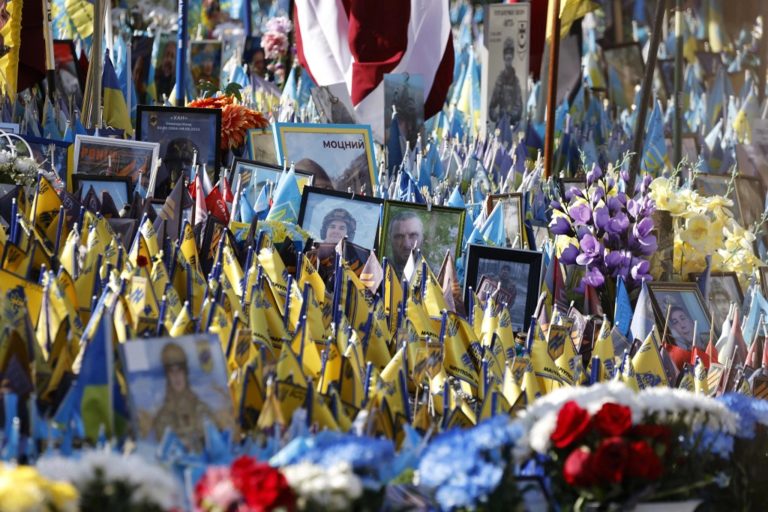
As the fourth anniversary of Russia’s full-scale invasion approaches on February 24, 2026, the conflict has settled into a devastating pattern defined less by territorial movement than by political will. Combined military casualties on both sides are approaching two million, entire cities have been reduced to rubble, and millions of Ukrainians remain displaced. Yet neither the battlefield dynamics nor the diplomatic calculations suggest a resolution is imminent, despite renewed US-brokered negotiations in Abu Dhabi that produced a prisoner exchange but no substantive breakthrough.
The Arithmetic of Attrition
The territorial map of the war has remained remarkably static since early 2023. Russia continues to occupy roughly eighteen percent of Ukrainian territory, including Crimea and portions of the Donbas, a figure that has barely shifted despite Moscow’s relentless offensive operations. A January 2026 study by the Center for Strategic and International Studies estimated that Russian forces have suffered nearly 1.2 million battlefield casualties, including killed, wounded, and missing, with approximately 325,000 dead. Ukrainian losses, while lower in absolute terms, have been devastating for a country with a fraction of Russia’s population; estimates compiled by Russia Matters at Harvard’s Belfer Center place Ukrainian military casualties between 500,000 and 600,000, including 100,000 to 140,000 fatalities.
Moscow’s strategy has remained consistent throughout: absorb staggering losses, maintain pressure along the entire front, and exhaust both Ukraine’s manpower reserves and Western patience. Russian forces are currently sustaining daily casualty rates exceeding one thousand troops — losses that would be politically unsustainable in any democratic system but that the Kremlin has thus far absorbed through a combination of recruitment incentives, coercion, and the importation of foreign fighters. Ukrainian units, by contrast, operate under severe ammunition rationing. Soldiers mobilized in the first months of the 2022 invasion remain deployed, while inconsistent mobilization policies have left critical gaps in frontline rotation.
Innovation Born of Necessity
Where Western arms deliveries have been delayed or restricted, Ukraine’s domestic defense industry has expanded at a pace unmatched by any country in recent decades. Deputy Defense Minister Serhiy Boev stated in late January 2026 that Ukraine plans to produce seven million drones this year, roughly doubling the approximately four million manufactured in 2025. The country’s government now purchases approximately $10 billion in weapons annually from domestic manufacturers, and President Zelensky recently announced plans to open ten weapons export centers across Europe in 2026.
This industrial transformation has given Kyiv strategic reach it was never provided by allied nations. Indigenous cruise missiles and long-range strike drones now routinely hit Russian airfields, ammunition depots, and energy infrastructure deep inside Russian territory. The shift represents a fundamental rebalancing: denied ATACMS missiles and long-range strike permissions for years, Ukraine developed its own capabilities. That these weapons now constitute a core pillar of Ukraine’s defense strategy underscores both Kyiv’s adaptability and the cost of delayed Western decision-making. As the Atlantic Council noted, Ukraine is now leading a military revolution in autonomous warfare, AI-enabled targeting, and drone swarm tactics that will reshape military doctrine worldwide.
The Diplomatic Impasse
Recent US-brokered trilateral talks in Abu Dhabi in early February produced a prisoner-of-war exchange involving 314 detainees — the first such swap in five months — but ended without a broader breakthrough, according to Reuters. American, Ukrainian, and Russian delegations agreed to continue meeting, and the US and Russia separately confirmed plans to re-establish military communication hotlines. But the fundamental gap between the two sides remains enormous.
Moscow’s negotiating position has, if anything, hardened. The Kremlin’s rhetorical framing has shifted markedly since 2022, abandoning earlier justifications about protecting Russian speakers or countering NATO expansion. Russian officials now frame the conflict in explicitly imperial terms, with President Putin referencing the recovery of “historic lands.” Ukraine’s negotiating position, meanwhile, is constrained by public opinion. A January 2026 survey found that 61 percent of Ukrainians still express trust in President Zelensky, while approximately 52 percent remain opposed to territorial concessions even in exchange for security guarantees. A separate New York Times analysis observed growing acceptance of some form of territorial compromise among war-weary segments of the population, though strong security guarantees remain a precondition.
Zelensky himself has undergone a leadership recalibration. In early January, he reshuffled his inner circle, appointing General Kyrylo Budanov and bringing in younger professionals in what Chatham House analysts described as an effort to neutralize political rivals, restore public trust, and prepare for engagement with the Trump administration.
Europe Steps Forward, Unevenly
The most consequential structural shift over four years of war has occurred in European defense. EU member states’ defense expenditure climbed to an estimated 381 billion euros in 2025, representing approximately 2.1 percent of GDP, according to Reuters analysis — up from 1.9 percent in 2024 and well above pre-invasion levels. At the 2025 NATO Summit in The Hague, allies committed to a target of five percent of GDP in defense spending, a figure that would have been inconceivable a decade ago. The European Parliament has scheduled an extraordinary plenary session for the invasion anniversary, at which legislators are expected to approve a €90 billion loan to Kyiv funded through joint EU debt.
Germany’s transformation from Europe’s most cautious military actor to Ukraine’s second-largest weapons supplier stands as one of the war’s most dramatic political consequences. Britain, France, Poland, and the Nordic-Baltic states have maintained steady commitments. According to the Center for European Policy Analysis, EU military commitments to Ukraine now exceed $65 billion, roughly matching cumulative US military assistance. NATO’s expansion to include Finland and Sweden has reshaped northern European security architecture entirely.
Yet the picture is uneven. Hungary continues to obstruct EU-level consensus. European defense industries, despite billions in new orders, have struggled to scale production to wartime levels. Public war fatigue, while not yet decisive in most countries, is a growing factor in domestic politics across the continent.
Russia’s Vulnerabilities and the Frozen Assets Question
Russia’s war economy, while demonstrating unexpected resilience, is showing structural stress. Military spending rose from 3.6 percent of GDP in pre-invasion 2021 to over 7 percent in 2025, with some Western intelligence estimates suggesting actual spending may be significantly higher. The Bank of Finland assessed the Russian economy as entering a period of stagnation, while Reuters reported that Russia’s budget deficit could nearly triple in 2026 as oil revenues decline amid tightening sanctions and reduced Indian purchases.
Soviet-era equipment stockpiles are depleting, sanctions have constrained access to advanced components, and the labor market is strained by the simultaneous demands of military recruitment and civilian production. Whether these pressures will become politically consequential before Ukraine’s own manpower and materiel constraints reach a critical point remains the central strategic question of the conflict.
Meanwhile, approximately $300 billion in frozen Russian central bank assets — primarily held in European financial institutions — remain in legal and political limbo. The EU agreed in late 2025 to indefinitely freeze these assets, and interest generated from them has already been channeled toward Ukrainian assistance. But the question of whether to confiscate the principal for reconstruction, as scholars at Harvard Law School and elsewhere have advocated, remains unresolved, tangled in debates about international legal precedent and financial system stability.
The Consequences of Incrementalism
The most enduring lesson of four years of war is that graduated, calibrated support for Ukraine has prolonged the conflict rather than resolving it. Weapons systems that arrived in 2024 — ATACMS missiles, F-16 fighters, expanded long-range strike permissions — were requested in 2022. Each delay translated directly into lost territory, destroyed infrastructure, and dead soldiers and civilians. Each supposed Russian “red line” that the West declined to test proved, upon crossing, to be a bluff designed to constrain Western decision-making rather than a genuine escalation threshold.
The pattern established by the inadequate Western response to Russia’s 2014 seizure of Crimea — which, in retrospect, enabled the 2022 full-scale invasion — has repeated itself at larger scale. Supporting Ukraine to fight to a stalemate while restricting the tools needed for decisive military advantage has maximized human suffering while minimizing strategic clarity.
As Ukraine’s foreign minister recently stated that only Trump can ultimately broker a final deal, and as reports suggest Washington is pushing for a resolution by mid-2026, the coming months will determine whether the conflict enters a new diplomatic phase or continues its grinding trajectory. What is already clear is that this stopped being exclusively Ukraine’s war long ago. The outcome will shape European security architecture, the credibility of international law, and the calculations of every authoritarian government weighing the costs of territorial aggression for decades to come.
Originally published by Bohdan Nahaylo, Kyiv Post. Additional research and contextual analysis conducted through multiple independent sources.