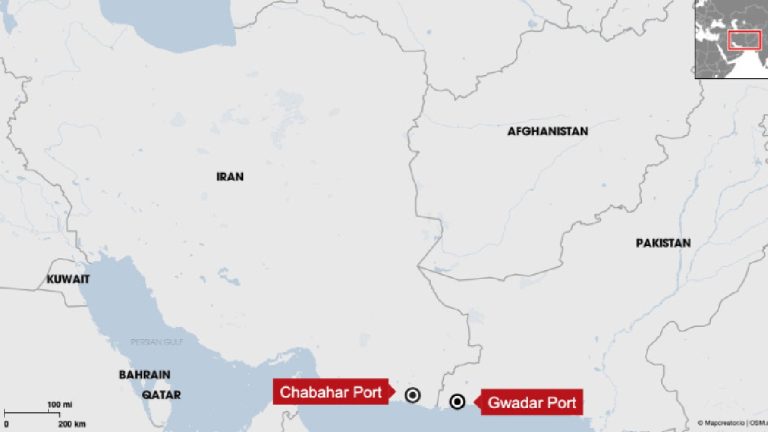
Despite Pakistan’s geographical advantage at the crossroads of South Asia, Central Asia, and the Indian Ocean, the landlocked Central Asian Republics (CARs) consistently bypass Pakistani ports in favor of Iranian alternatives. This ongoing trend, especially highlighted by the growing use of Bandar Abbas and Chabahar ports, challenges Pakistan’s claim of being the most natural gateway for the CARs to the sea. While Pakistan’s strategic location should theoretically make it the prime choice for trade, it fails to leverage this advantage in practice, leading to a shift in regional trade preferences.
The Geopolitical Advantage: A Mirage?
Pakistan’s proximity to Central Asia should make ports like Gwadar and Karachi the go-to options for landlocked economies. On paper, these ports offer the shortest maritime route to the warm waters of the Indian Ocean, which would theoretically lower transportation costs, speed up delivery times, and integrate Central Asia into the global supply chain. However, despite these advantages, the reality has been quite different. The Central Asian economies increasingly prefer Iranian ports, indicating that geography alone does not guarantee economic success.
Iran’s ports, particularly Bandar Abbas and Chabahar, have proven to be more reliable and efficient alternatives to Pakistan’s offerings. Unlike Pakistan, which continues to rely on its geographical location as a strategic asset, Iran has invested in functional and predictable logistical networks. These ports offer established road and rail connectivity, simplified commercial procedures, and stable transit systems, even under the pressure of international sanctions. This practical approach is driving Central Asian trade away from Pakistan and toward Iranian alternatives.
Iranian Ports: The Pragmatic Choice
The key advantage of Iranian ports is their pragmatic functionality. Despite the international sanctions that have long hampered Iran’s global trade, the country has prioritized operational continuity. For Central Asian exporters, who need predictability and efficiency, Iran’s ports are increasingly seen as reliable, flexible, and operational. Iran’s Chabahar Port has evolved into a multi-user port, offering a range of services that cater to the regional trade needs of the CARs, enabling them to diversify away from the Russian-controlled northern corridors and other congested routes.
This focus on operational continuity has enabled Iran to build a strong position in the regional trade market. The integration of ports with inland railways, customs harmonization, and efficient logistics hubs has streamlined trade flows. For landlocked economies, reliability is paramount, as each delay or disruption raises operational costs. Iranian ports have become not just a viable option but a preferred one for Central Asia’s growing commercial demands.
Pakistan’s Strategic Symbolism vs. Practical Connectivity
On the other hand, Pakistan’s strategic initiatives for improving connectivity with Central Asia remain largely symbolic. Gwadar Port is often touted as the future hub of regional trade, yet the reality does not live up to the rhetoric. The lack of sufficient infrastructure, regulatory clarity, and commercial incentives continues to hamper Gwadar’s potential. Pakistan’s road and rail connectivity to Gwadar, particularly through Quetta and onward toward Afghanistan, is still underdeveloped. Additionally, bureaucratic hurdles and regulatory uncertainties discourage consistent commercial activity, making the port less attractive to Central Asian exporters.
For the CARs, the decision of which port to use is based on economic pragmatism. The need for competitive pricing, reliable transit routes, and clear commercial terms outweighs the geopolitical appeal of Gwadar or other Pakistani ports. Despite Pakistan’s strategic location and strong rhetoric on connectivity, it has yet to offer the consistent and reliable infrastructure needed to compete with Iranian ports.
[Learn more about the challenges faced by Gwadar Port and its infrastructure limitations].
Shifting Pakistan’s Approach: Economic Diplomacy over Geopolitical Symbolism
Pakistan’s approach to economic diplomacy with the CARs has often focused on symbolic gestures such as high-level visits and memoranda of understanding, rather than on the practical mechanisms that facilitate trade. Central Asian countries, however, prioritize clear transit guarantees, predictable tariff structures, insurance coverage, and investment protection. While Iran has been able to offer these operational assurances, Pakistan’s engagements have remained aspirational and lacking in tangible trade facilitation.
Moreover, Pakistan’s regional approach is often dominated by broader geopolitical concerns, such as its strategic rivalry with India and relations with the West. This over-politicization of the connectivity agenda has introduced unnecessary uncertainty into the process. The CARs, however, are diversifying their trade routes, utilizing not just Iranian ports but also Russian and Chinese routes. Pakistan, therefore, finds itself competing in a market with multiple choices, rather than a monopoly. In such a diverse environment, the key to gaining access lies in offering reliable and cost-effective trade solutions, not in relying on geographic proximity or geopolitical alliances.
Concrete Steps for Change
If Pakistan is to reverse this trend, it must adopt a more commercially-focused approach to Central Asia’s trade needs. A dedicated transit tariff regime for Central Asian trade, with clear, competitive pricing, should be introduced. This would give Pakistan a chance to directly rival Iranian ports on economic terms. Additionally, Gwadar must be transformed into a purely commercial entity, rather than being seen solely as a geopolitical project. To do this, Pakistan must fast-track infrastructure projects, particularly rail and road connectivity from Gwadar through Quetta and into Afghanistan.
Furthermore, Pakistan should establish a Trade Facilitation Cell for the CARs, which would be staffed with logistics experts, trade economists, and regulatory specialists. This body must work to resolve transit bottlenecks, standardize customs procedures, and create corridor-specific agreements to make trade flows smoother and more predictable. Importantly, Pakistan must decouple connectivity from broader political tensions, offering credible guarantees to Central Asian exporters that their access to Pakistani ports will not be disrupted by security crises or diplomatic disagreements.
Conclusion: Pakistan’s Opportunity for Economic Connectivity
While Pakistan’s geographic advantage remains significant, its failure to translate this into effective, competitive trade infrastructure has allowed Iran to dominate as the port of choice for Central Asia. To change this, Pakistan needs to prioritize economic competitiveness over symbolic geopolitics. This includes improving operational efficiency, reducing regulatory uncertainties, and building reliable connectivity that meets the needs of CAR exporters. The geography of Pakistan offers immense potential, but it is the policy changes that will determine whether this potential is fully realized.
Original analysis inspired by Awais Akmal and Dr. Marriyam Siddique from Center for Strategic and Contemporary Research. Additional research and verification conducted through multiple sources.